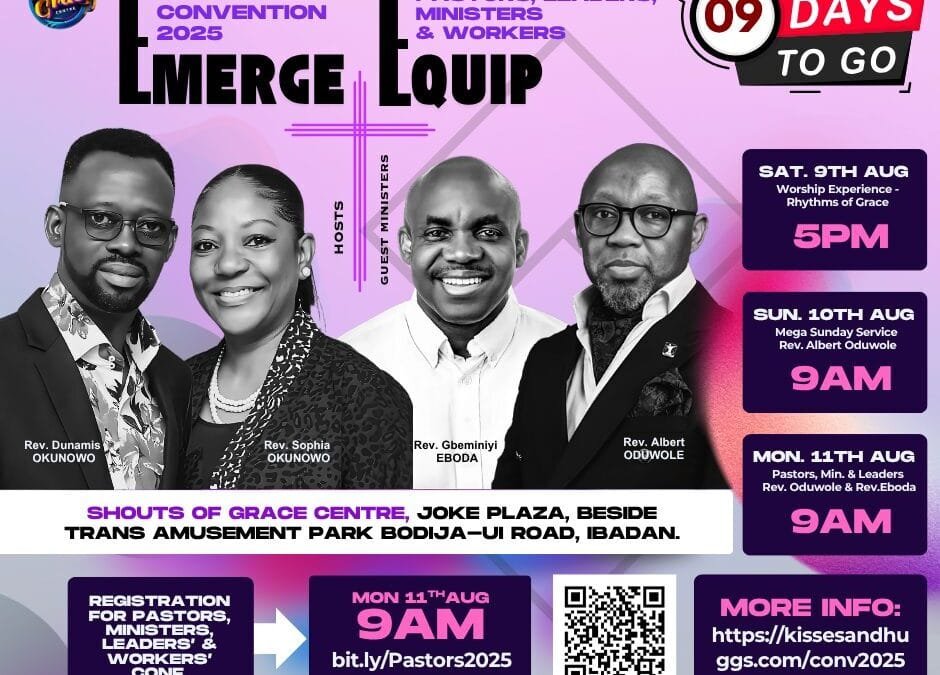
Are you a minister, pastor, church worker, or leader who lives in Ibadan? You are cordially invited to “Equip” a Minister’s Conference with Rev Femi Oduwole and Rev Gbeminiyi Eboda as part of our 9th anniversary convention.
Rev Dunamis and Sophia Okunowo will also be hosting us. Attendance is free, but registration is required. Kindly register HERE
Don’t miss it. Spread the word!
There’s a reason God sometimes delays the kind of love you think you’re ready for. God is more concerned about your heart than your relationship status. Many people rush into love thinking it will heal the wounds they have faced, i.e, loneliness, rejection, heartbreak, and fear. The truth is, love doesn’t heal you. God is the only healer of body and soul.
When you don’t give God access to your broken places, you will bleed on people who didn’t cut you. You will expect your partner to fill voids only God was meant to satisfy. That’s why some relationships feel like cycles of disappointment because what you’re really craving is healing, not romance.
Before Adam ever received Eve, he was whole, walking with God, working, and worshipping. It was in that place of completeness that God decided it was not good for him to be alone. He didn’t say Adam was lonely. He said he was ready.
Meanwhile, being healed before dating doesn’t mean you’re perfect. It means you’ve let God into the mess to allow Him to make sense out of your story, and you’re no longer depending on someone else to fix you. Relationships thrive when two whole people meet, not when two broken hearts try to make each other breathe.
God is not punishing you by keeping you single. He’s preparing you. Don’t despise the season of healing. It is the foundation for the love story you’re praying for. As Psalm 147:3 says, “He heals the broken-hearted and binds up their wounds.” Let Him bind up yours.
When you let God heal you, you stop chasing temporary affection and start attracting purpose-aligned love, and that’s the kind of relationship worth waiting for.
Are you a minister, pastor, church worker, or leader who lives in Ibadan? You are cordially invited to “Equip” a Minister’s Conference with Rev Femi Oduwole and Rev Gbeminiyi Eboda as part of our 9th anniversary convention.
Rev Dunamis and Sophia Okunowo will also be hosting us. Attendance is free, but registration is required. Kindly register HERE
Don’t miss it. Spread the word!
1. Respect His Role
Acknowledge his position as the leader of the home, not because he’s perfect, but because it’s God’s order.
“Wives, submit yourselves unto your own husbands, as unto the Lord.” Ephesians 5:22
2. Speak Kindly and With Respect
Use respectful words and tone when speaking to him or about him, even when you’re correcting or disagreeing.
3. Appreciate His Efforts
Say “thank you” often – for providing, protecting, leading, and trying his best.
4. Support His Decisions
Even if you have your views, allow him to lead and trust his judgment. Please share your thoughts, but don’t override him.
Practical Ways To Honor The Man
5. Pray for Him Daily
Cover him in prayer. A man carries weight you may never fully see. Prayer shows you value and support him.
6. Don’t Compete With Him
Don’t try to take over his role or constantly challenge his leadership. Work with him, not against him.
7. Celebrate Him Publicly and Privately
Praise him before the children, friends, and family. Speak highly of him, not down.
8. Seek His Input Before Big Decisions
Let him know you value his opinion. Don’t just inform him—include him.
9. Be His Peace, Not His Stress
Let home be a safe place. Choose patience and understanding instead of nagging or criticizing.
10. Believe in Him
Even when he’s not there yet, show that you trust in who he is becoming.
These small actions speak volumes and help build a healthy, respectful, and loving relationship in which both partners thrive.
Are you a minister, pastor, church worker, or leader who lives in Ibadan? You are cordially invited to “Equip” a Minister’s Conference with Rev Femi Oduwole and Rev Gbeminiyi Eboda as part of our 9th anniversary convention.
Rev Dunamis and Sophia Okunowo will also be hosting us. Attendance is free, but registration is required. Kindly register HERE
Don’t miss it. Spread the word!
Today, I want to talk about something that doesn’t always get said out loud. What happens when you’ve caught real feelings for someone, and it honestly feels like a gift from God… but then God tells you, “This isn’t it.”
Maybe you met someone who checks almost every box on your list. They love Jesus, they’re kind, they make you laugh, they actually get your weird jokes (on time), they’re responsible, emotionally mature… all the things you’ve prayed for. And you’re thinking, “God, finally. Thank You. This is my person!”
But then something unsettles you. A gentle nudge. A whisper from the Holy Spirit. Or maybe a clear sense that God is saying, “No, not this one, and it’s confusing. Because everything feels right.
So what are you supposed to do when your heart says yes… and God says no?
1. Let Yourself Feel the Disappointment
First, be honest. Rejection hurts, even when it comes gently from God. So don’t fake a smile or pretend you’re fine. God can handle your feelings. He’s not afraid of your tears or your questions.
The Lord is close to the brokenhearted and saves those who are crushed in spirit. Psalm 34:18 (NIV)
You don’t have to be strong all the time. You just have to be real.
2. Just Because It Looks Good Doesn’t Mean It’s God
This part is hard. Because when someone is mostly what you want, it’s tempting to talk yourself into believing it’s God’s will. But “almost right” is still wrong if God says so.
There is a way that appears to be right, but in the end it leads to death. Proverbs 14:12 (NIV)
God sees the full picture.
3. God Isn’t Being Cruel. He’s Being Kind.
It might not feel like it, but God saying “no” is often one of the kindest things He can do. He’s not trying to ruin your happiness. He’s protecting your future.
For I know the plans I have for you,” declares the Lord, “plans to prosper you and not to harm you… Jeremiah 29:11 (NIV)
That person might be great, just not God’s great for you. He knows the road ahead. You don’t.
4. Don’t Try to Force What God Is Gently Closing
One of the biggest mistakes we make? Pushing through red flags because “we prayed about it” or “they love God too.” We try to write the story our way.
But forcing something that God is closing will only wear you out.
Unless the Lord builds the house, the builders labor in vain. Psalm 127:1 (NIV)
Let Him build your love story. His version is better than anything you can try to hold together with your own hands.
5. Peace Is Often Louder Than A Yes
You might not get a booming voice from heaven. But you’ll know when you’re in step with God because there’s peace. Real peace. Not butterflies. Not adrenaline. Peace.
Let the peace of Christ rule in your hearts… Colossians 3:15 (NIV)
If you have to constantly convince yourself it’s right… it might not be.
God sees you. He knows what you long for. He knows what you need. And when He says no, it’s not rejection. It’s redirection toward something fuller, deeper, and far more lasting than your feelings today.
So what do you do when God says no to your feelings?
You pause. You listen. You trust. And you let Him love you through the ache.
Are you a minister, pastor, church worker, or leader, and you live in Ibadan? You are cordially invited to “Equip” a Minister’s Conference with Rev Femi Oduwole and Rev Gbeminiyi Eboda as part of our 9th anniversary convention.
Rev Dunamis and Sophia Okunowo will also be hosting us. Attendance is free, but registration is required. Kindly register HERE
Don’t miss it. spread the word!
There is that space between “I’m working on myself” and “I think I’m ready to love someone,” but you’re also dealing with memories, soul ties, silent temptations, past mistakes, and the fear that you might not get it right.
I used to think I just needed to wait, pray, and stay busy. But healing and wholeness go beyond that. There are layers to it, things you won’t post about. Areas where it’s not about doing devotions or attending programs—it’s more about dealing with the stuff you’ve been ignoring:
That situationship you never fully healed from.
The attention you still crave from people who aren’t serious.
The guilt from compromising, even when you knew better.
That fake confidence you put on to act like this season isn’t hard sometimes.
“Blessed are the pure in heart, for they will see God.” — Matthew 5:8
So yes, wholeness before romance. No pretense whatsoever. Rather, you are you, just growing to become the best version of what God has ordained you to be.
Areas of wholeness
Wholeness here means you’re no longer depending on people for validation. It means your heart has been checked, your boundaries are clear, and your peace isn’t easily shaken just because someone left or didn’t choose you. It’s learning how to guard your heart without hardening it, and that takes real growth, not just time.
Spiritually, it’s about more than reading your Bible or showing up to church. This is about whether your life is actually built around God, or if He’s just someone you run to when your plans don’t work out. If your connection with God rises and falls based on your emotions or your relationship status, something’s off. Being spiritually whole means your identity is rooted in what God says about you—not how lonely you feel, who left, or how long you’ve been waiting. You’re not searching for someone to complete you spiritually; you’re learning to walk with God daily, not just when it’s convenient or when life gets hard. That kind of stability matters, especially when emotions get involved.
Sexually, it’s not just about whether you’re sleeping with someone or not. You can be physically abstinent and still be struggling. Sexual wholeness has more to do with mindset, discipline, and how you respond to pressure, temptation, and loneliness. Are you having conversations you shouldn’t? Are you feeding thoughts and fantasies that slowly wear you down? Are you excusing small compromises because “it’s not that deep”? This is where honesty matters. Sexual purity isn’t just about rules—it’s about not giving yourself away in pieces because you’re tired of waiting. It’s about choosing discipline even when nobody’s clapping for it, because you know your body is not a bargaining chip—it’s sacred. And even if you’ve messed up before, sexual wholeness is still possible when you let God deal with the root, not just the symptoms.
Before bringing someone else into your life, there are certain areas you have to be honest about. Not because you have to be perfect, but because if you’re not whole in these parts of your life, you may end up carrying confusion, frustration, or even damage into the relationship.
Emotionally, it’s easy to think you’ve moved on, until something small exposes the fact that you haven’t. You may not be dating anyone, but your emotions are still tied to someone you stopped talking to months ago. Or you find yourself getting anxious, overly attached, or shutting down quickly because of unresolved issues from your past.
In conclusion
Wholeness isn’t about getting ready for someone—it’s about finally showing up for yourself. The emptiness you feel isn’t fixed by being chosen; it’s healed by letting God into the parts you’ve avoided. Love won’t save you. But God will. And that’s where real healing begins.
Are you a minister, pastor, church worker, or leader, and do you live in Ibadan? You are cordially invited to “Equip” a Minister’s Conference with Rev Femi Oduwole and Rev Gbeminiyi Eboda as part of our 9th anniversary convention.
Rev Dunamis and Sophia Okunowo will also be hosting us. Attendance is free, but registration is required. Kindly register HERE
Don’t miss it. Spread the word!
Relationships demand more than fleeting emotion. They require something deeper, sturdier, and often uncomfortable, which is tolerance. It’s not flashy, and it rarely gets applauded. Yet, the quiet strength keeps relationships from crumbling under the weight of human imperfection.
Be completely humble and gentle; be patient, bearing with one another in love.” Ephesians 4:2 (NIV),
That phrase, “bearing with one another,” holds within it the heart of tolerance. It doesn’t mean putting up with abuse or neglect. It means making room for the rough edges of another soul, edges God might still be shaping.
For the married, this is often tested in the daily rhythm of life. How your spouse leaves the kitchen after cooking, how they process stress, or even how they express affection may not align with your preferences. But tolerance says, “I choose grace. I choose to love you as you are today, not just as I hope you’ll be tomorrow.”
Singles aren’t exempt from this refining process. Whether it’s in friendships, dating, or family dynamics, there’s always an invitation to practice humility and gentleness. Culture often encourages quick exits when discomfort arises, but Scripture calls us to lean in instead.
“bearing with one another and, if one has a complaint against another, forgiving each other; as the Lord has forgiven you, so you also must forgive.”Colossians 3:13 (ESV)
The root of tolerance is love laced with patience. It is recognizing that others are works in progress, just like you. It’s resisting the urge to reshape people into our image and allowing God to do His work in His time.
There is also the other side: allowing others to tolerate us. That means being aware of our own weaknesses and accepting grace when it’s given. That’s humbling. But it levels the ground in any relationship, keeping pride in check.
For the single person waiting for marriage, or the married person weathering seasons of frustration, here’s a truth worth holding onto: Tolerance isn’t settling, it’s sowing. You are planting seeds of mercy, humility, and steadfastness that mirror the very nature of Christ. It won’t always feel rewarding in the moment, but it will shape your heart and your relationships into something deeply resilient.
Are you a minister, pastor, church worker, or leader, and you live in Ibadan? You are cordially invited to “Equip” a Minister’s Conference with Rev Femi Oduwole and Rev Gbeminiyi Eboda as part of our 9th anniversary convention.
Rev Dunamis and Sophia Okunowo will also be hosting us. Attendance is free, but registration is required. Kindly register HERE
Don’t miss it. Spread the word!
Every healthy relationship has conflict. Yes — even the godly ones. Even the mature ones. And even the “we finish each other’s sentences” ones.
The difference between couples who grow stronger and those who grow bitter isn’t the absence of fights. It’s simply how they fight.
Here’s how to fight fair — and still hold hands after:
1. Don’t aim to win; aim to understand.
If your goal is to “win” the argument, someone else has to lose. And when your partner loses, your relationship loses. (LOL)
Ask more questions. Don’t assume. Clarify things. Aim to understand.
2. Watch your tone, not just your words.
Saying “What did you say?” can mean five different things depending on how your eyebrows are positioned.
Tone creates safety — or shuts it down. Use it wisely.
How to Fight Fair and Still Hold Hands After
3. No name-calling. No character assassination.
You can challenge a behaviour without attacking their identity.
“Leaving your clothes everywhere frustrates me” is not the same as “You’re so lazy.”
4. Take breaks if needed; but don’t disappear.
If things get too heated, say, “Can we pause and talk when we’re both calmer?”
Storming out or going silent for days creates fear, not resolution.
5. Pray together, even if it’s awkward.
Nothing humbles a tense heart like holding hands and saying, “God, help us.”
While conflict invites pride, prayer invites peace.
6. Make up well.
Say “I’m sorry” without excuses. Hug. Talk through what you’ve both learned. Then move on. Don’t keep recycling the same argument.
Conflict doesn’t have to end in cold shoulders and quiet dinners.
It can end with better understanding, deeper connection… and yes, still holding hands.
And remember, love isn’t proven by how sweet your date nights are. It’s proven by how kind you are in the middle of a disagreement.
Are you a minister, pastor, church worker, or leader, and you live in Ibadan? You are cordially invited to “Equip” a Minister’s Conference with Rev Femi Oduwole and Rev Gbeminiyi Eboda as part of our 9th anniversary convention.
Rev Dunamis and Sophia Okunowo will also be hosting us. Attendance is free, but registration is required. Kindly register on this link – https://kissesandhuggs.com/conv2025
Don’t miss it. Spread the word!
Choosing a life partner is one of the most significant decisions you’ll ever make. This person will walk beside you through joys and trials, share your dreams, and help shape the legacy you leave behind. But this decision shouldn’t rest solely on human wisdom or fleeting emotions—it must be guided by God’s direction and design. Here’s how to discern who your life partner is with God at the center of the process.
1. Surrender Your Desires to God
Before seeking a spouse, surrender your desires and expectations to the Lord. Often, our vision for “the perfect partner” is shaped by societal standards, past experiences, or unmet needs. However, Psalm 37:4 reminds us, “Delight yourself in the Lord, and He will give you the desires of your heart.” When you delight in God above all else, He aligns your heart with His plan, replacing selfish ambitions with godly priorities.
Pray and ask God to reveal His will for your future spouse. Trust that His timing and choice are far better than anything you could orchestrate on your own.
2. Seek Wisdom and Discernment
God promises wisdom to those who ask (James 1:5), so seek His guidance as you navigate relationships. Look beyond surface-level attractions and evaluate character, values, and spiritual maturity. Proverbs 18:22 says, “He who finds a wife finds what is good and receives favor from the Lord.” Notice the emphasis on finding someone who reflects goodness—a reflection of God’s nature.
Ask yourself: Does this person exhibit fruit of the Spirit (Galatians 5:22-23)? Are they committed to growing closer to God? Do they honor others and demonstrate integrity? These qualities matter far more than external appearances or temporary chemistry.
3. Set Boundaries and Standards Based on Scripture
As you wait for God’s leading, establish clear boundaries and non-negotiable standards rooted in Scripture. For example:
A shared faith in Christ (2 Corinthians 6:14)
A commitment to purity and holiness (1 Thessalonians 4:3-5)
Alignment in core values like family, finances, and ministry
Boundaries protect your heart and ensure you don’t settle for less than God’s best. Remember, compromise on foundational principles can lead to long-term struggles in marriage.
4. Involve Godly Counsel
Proverbs 11:14 states, “Where there is no guidance, a people falls, but in an abundance of counselors, there is safety.” Surround yourself with trusted mentors, pastors, or spiritually mature friends who can provide objective insight into potential partners. They can help identify red flags you might overlook due to emotions or infatuation.
Additionally, observe how the person interacts with their family, friends, and community. Their behavior outside of your relationship reveals much about their true character.
5. Trust God’s Timing
Patience is key when deciding who your life partner is. It’s easy to feel pressured by cultural timelines or comparisons with others, but Ecclesiastes 3:1 assures us, “There is a time for everything, and a season for every activity under the heavens.” Rushing into a relationship without divine confirmation can lead to heartache, while waiting on God ensures alignment with His purpose.
While you wait, focus on becoming the kind of person you hope to marry. Use this season to deepen your relationship with God, serve others, and grow in wisdom and maturity.
Deciding who your life partner is isn’t just about choosing someone—it’s about allowing God to guide you to the right person at the right time. Keep Him at the forefront of your search, trusting that He knows what’s best for you. As you pray, seek wise counsel, and set godly standards, rest assured that He will lead you to a partner who complements your journey and shares your commitment to glorify Him.
Remember, marriage is not only a union between two people—it’s a covenant involving God Himself. Let your decision reflect reverence for His design and dependence on His direction. With faith and obedience, you’ll find the joy and fulfillment that come from partnering with both God and the person He has chosen for you.
Proverbs 19:14 concludes, “Houses and wealth are inherited from parents, but a prudent wife is from the Lord.” Trust that your life partner is a gift from Him—and trust in His perfect timing to bring it to pass.
Are you a minister, pastor, church worker, or leader, and do you live in Ibadan? You are cordially invited to “Equip” a Minister’s Conference with Rev Femi Oduwole and Rev Gbeminiyi Eboda as part of our 9th anniversary convention.
Rev Dunamis and Sophia Okunowo will also be hosting us. Attendance is free, but registration is required. Kindly register HERE
Don’t miss it. spread the word!
No one talks about how scary it is to fall out of love with someone you thought you’d love forever.
One minute, they’re your answered prayer; the next, you struggle to feel anything. You smile less and withdraw more. The connection that once lit up your world now feels like a flickering flame.
But before you make any rash decisions, pause. Love is a commitment, not an emotion. Feelings fade, but godly love doesn’t. The Bible says, “Love bears, believes, hopes, and endures all things. Love never fails…” (1 Corinthians 13:7–8). So the spark isn’t gone, maybe it’s just buried under disappointment, unmet expectations, or unspoken frustrations.
Falling out of love doesn’t always mean the relationship is over; sometimes, it’s time to rebuild.
Ask yourself:
Have we stopped communicating?
Have we stopped praying together?
Have we grown apart because we’ve stopped growing with God?
Many relationships drift because people stop being intentional. Love can’t thrive where neglect lives.
What if you’ve done all you can and the feeling is still gone? Then you need to be honest with yourself, with them, and with God. Staying in a relationship out of guilt, fear, or obligation is not God’s will. He wants you in a relationship that brings peace, not confusion. “God is not unjust; He will not forget your work and the love you have shown…” (Hebrews 6:10).
If you’re in this space where you’re no longer sure, don’t run, reflect. Also, don’t settle; seek clarity from the One who knows your heart even when you don’t. God is not afraid of your silence, confusion, or breaking point. He specializes in restoring what feels lost. However, He also gives you the grace to walk away when love is no longer aligned with His Will.
Are you a minister, pastor, church worker, or leader, and do you live in Ibadan? You are cordially invited to “Equip” a Minister’s Conference with Rev Femi Oduwole and Rev Gbeminiyi Eboda as part of our 9th anniversary convention.
Rev Dunamis and Sophia Okunowo will also be hosting us. Attendance is free, but registration is required. Kindly register HERE
Don’t miss it. Spread the word!
Yesterday, we considered why love feels heavy. If you missed yesterday’s article, you can read it HERE.
Today, we will take a step further to look at practical things to do when love feels heavy.
1. Don’t fake peace. Be honest with God.
You don’t have to pretend to be okay when you’re not. God already knows how you feel. Share with Him where it hurts and what’s wearing you out. There’s no healing in pretending.
2. Pause, don’t panic.
Feeling pressure doesn’t always mean there’s something wrong with your relationship. Take a moment to reflect. What’s really bothering you? Is it something they did? An unresolved issue within yourself? Or maybe it’s the fear of losing control? Slow down and pinpoint what’s really going on before you misinterpret it.
3. Anchor your peace in God, not the relationship.
You love them, but they aren’t your source of happiness. If your mood hinges on how they treat you, you’ll always feel unstable. You weren’t designed to base your emotional balance on another person. Only God can carry that weight.
4. Ask God for wisdom before you act.
Not knowing what to say or do next is perfectly fine. When you’re confused, take it to God. Ask Him, “Lord, what’s the right thing to do here? Help me respond rather than react.” He promised to provide wisdom to those who seek it (James 1:5). Lean on that promise.
Conclusion
The pressure you’re feeling right now doesn’t mean your relationship is doomed or that you’re messing it all up. It might just mean that you’re being refined and that God is teaching you how to love better. You could very well be growing out of emotional immaturity. You’re learning to stay grounded even when your partner isn’t perfect.
So you might feel pressed, but you’re not crushed. Because God isn’t just watching your relationship; He’s in it with you. Supporting you, guiding you, helping you grow, and loving you first so that you can love well.
Are you a minister, pastor, church worker, or leader, and do you live in Ibadan? You are cordially invited to “Equip” a Minister’s Conference with Rev Femi Oduwole and Rev Gbeminiyi Eboda as part of our 9th anniversary convention.
Rev Dunamis and Sophia Okunowo will also be hosting us. Attendance is free, but registration is required. Kindly register HERE
Don’t miss it. Spread the word!
There are days when love feels like a lot to handle. Not because your feelings have changed, but because you’re tired. You’re putting in the effort, showing up, trying to communicate, praying, overthinking, making adjustments, and still, there’s this tension. Something feels off, and you can feel it.
This part is not often talked about. When you’re trying to love someone the right way, it stretches you thin. It’s not about a big disagreement or some obvious issue; it’s the emotional toll of striving to be consistent, patient, forgiving, and open all at once. It can start to feel overwhelming.
That’s why this scripture resonates with me so well, it says;
“We are hard pressed on every side, but not crushed; perplexed, but not in despair.” — 2 Corinthians 4:8 (NIV)
Paul wasn’t necessarily addressing relationships here, but this verse really speaks to them. Love can sometimes feel like a heavy load. When you love someone, especially in a way that reflects God’s heart, it will expand what you can handle. And every now and then, it makes you wonder what’s really going on.
So Why Does It Feel This Heavy?
Here are three reasons love feels heavy, even when it’s genuine:
1. God uses love to grow you.
It sounds good in theory, but in real life, it means you’re going to be stretched. To love someone well, you need patience, self-control, humility, and forgiveness, and those qualities don’t just appear out of the blue. They develop through struggles. True love will expose parts of you that might still be selfish, reactive, insecure, or scared. That’s not a failure but a sign of growth.
2. You’re carrying more than just the present.
Often, the pressure isn’t solely about what’s going on right now. It can stir up past experiences. Maybe it’s a fear of being hurt again or a response to something traumatic. Perhaps your need for control is rearing its head. So, the pressure isn’t just emotional, it’s layered.
3. You’re trying to love from your own strength.
We tend to do this more than we realize. When you try to love without refreshing your spirit through God, you often end up feeling drained. What starts as effort can morph into resentment. Care becomes anxiety, and soon your relationship feels more like a burden than a joy.
Tomorrow, I will tell you what to do when love feels heavy. Don’t miss it.
How Integrity Can Change Your Relationship and Marriage
Are you a minister, pastor, church worker, or leader who lives in Ibadan? You are cordially invited to “Equip” a Minister’s Conference with Rev Femi Oduwole and Rev Gbeminiyi Eboda as part of our 9th anniversary convention.
Rev Dunamis and Sophia Okunowo will also be hosting us. Attendance is free, but registration is required. Kindly register HERE
Don’t miss it. spread the word!
How Integrity can change your relationship and marriage
In simple terms, integrity is doing the right thing even when no one is watching. When both people practice it, love grows in a safe and trustworthy environment..
1. Trust Becomes Solid
Integrity means you say what you mean and mean what you say. When your words and actions match, your partner knows they can trust you. Trust is like the foundation of a house—without it, everything wobbles.
2. You Become Safe for Each Other
When you keep your promises and stay truthful, your spouse or partner feels safe with you. They know you won’t betray their confidence or play games with their emotions
3. It Reduces Unnecessary Fights
Most arguments in relationships come from misunderstandings, half-truths, or broken promises. Integrity clears that out. When you are honest, there’s less drama and less suspicion.
4. Respect Grows Naturally
Integrity commands respect. When your partner sees you living out what you say—whether in finances, friendships, or commitments—they naturally respect you more.
5. It Sets a Standard
Living with integrity sets the tone for the relationship. It inspires your partner to also be truthful and upright, making your relationship stronger and more stable.
Are you a minister, pastor, church worker, or leader who lives in Ibadan? You are cordially invited to “Equip” a Minister’s Conference with Rev Femi Oduwole and Rev Gbeminiyi Eboda as part of our 9th anniversary convention.
Rev Dunamis and Sophia Okunowo will also be hosting us. Attendance is free, but registration is required. Kindly register HERE
Don’t miss it. Spread the word!
To my future wife, whoever and wherever you are—this letter is for you. Though we may not yet know each other, I want to speak honestly about the journey ahead of us. Marriage is a sacred covenant, not just between two people but also with God (Malachi 2:14). It requires preparation, humility, and intentionality from both sides. So before our paths cross or our vows unite us, let me ask: Are you really ready for me?
1. Are You Ready to Partner in Purpose?
Marriage isn’t just about romance—it’s about partnership. Amos 3:3 asks, “Do two walk together unless they have agreed to do so?” Before we can walk side by side, we must first agree on the direction we’re heading. Are you pursuing God’s purpose for your life? Do you understand that marriage amplifies ministry, calling us to serve Him together as one? If we’re both aligned with His will, our union won’t just be a relationship—it’ll be a mission field.
2. Are You Ready to Embrace Imperfection?
Let’s get real—I’m far from perfect. Neither of us will enter this marriage without flaws, struggles, or areas where growth is needed. Ephesians 4:2 calls us to bear with one another in love, “being completely humble and gentle.” Can you embrace my imperfections while challenging me to become better? Likewise, am I willing to do the same for you? Love isn’t blind; it sees clearly yet chooses to stay committed through grace and forgiveness.
3. Are You Ready to Communicate Openly?
Healthy communication is the backbone of any strong marriage. James 1:19 reminds us to be quick to listen, slow to speak, and slow to become angry. Are you ready to share your heart vulnerably, even when it feels uncomfortable? Will you extend patience when misunderstandings arise? Honest dialogue fosters trust, intimacy, and unity—the pillars of a thriving relationship.
4. Are You Ready to Prioritize God Above All Else?
Our marriage won’t succeed if it’s built solely on feelings or convenience—it must be rooted in God. Matthew 6:33 tells us to seek first His kingdom, and everything else will fall into place. As much as I long to love and cherish you, nothing should come before my relationship with Christ—and the same must be true for you. When God is at the center, our love becomes unshakeable because it’s anchored in eternity.
5. Are You Ready to Fight Together?
Marriage isn’t always easy; there will be seasons of joy and seasons of struggle. But here’s the truth: We won’t fight against each other—we’ll fight for each other. Ecclesiastes 4:12 says, “A cord of three strands is not quickly broken.” With God binding us together, we’ll face challenges as a team. Are you prepared to stand firm, pray fervently, and never give up—even when the road gets tough?
Final Thought:
My dearest future wife, I write these words not to intimidate but to inspire. Marriage is a beautiful journey, but it demands readiness—from both of us. As you prepare your heart for this lifelong commitment, remember that love is more than a feeling; it’s a choice, a sacrifice, and a reflection of God’s unwavering devotion to us.
If you’re reading this, take courage. Whether we meet tomorrow or years from now, I trust that God is preparing you just as He’s preparing me. Let’s commit to seeking Him above all else, knowing that He will guide our steps toward each other in His perfect timing. Until then, keep growing, keep praying, and keep believing—for the best is yet to come.
When Love Gets Tired: Understanding Emotional Fatigue in Relationships
Are you a minister, pastor, church worker, or leader, and you live in Ibadan? You are cordially invited to “Equip” a Minister’s Conference with Rev Femi Oduwole and Rev Gbeminiyi Eboda as part of our 9th anniversary convention.
Rev Dunamis and Sophia Okunowo will also be hosting us. Attendance is free, but registration is required. Kindly register on this link – https://kissesandhuggs.com/conv2025
Don’t miss it. Spread the word!
If you think love is always butterflies, then I’m sorry to let you know that it isn’t. Love is not always butterflies and long phone calls. Sometimes, love gets tired. Yes, it happens!
Love does get tired. Not tired of loving, but tired of carrying too much weight emotionally.
As a single, maybe you have poured your heart into someone who barely gave anything back. You’re always the one texting first, checking in, holding the conversation—and now you feel drained. That’s emotional fatigue. It’s your heart telling you: “This isn’t balanced” (or “e no balance!”)
My dear, it’s okay to step back. Real love shouldn’t feel like a performance where you always have to audition to be chosen. You deserve a relationship where the effort is mutual, not one-sided.
As married couples, emotional fatigue mostly creeps in silently. The busy routines, the endless responsibilities, the unspoken hurts—they simply just pile up. And before you know it, one day, one or both of you will feel like you’re running on empty.
What can you do?
1. Check in emotionally: Don’t just ask “How was your day?”—ask “How are you, really?”
2. Share the load: If one person is always giving and the other always taking, someone will burn out.
3. Create space to breathe: Sometimes, a short walk together or a quiet evening without screens can do a lot more for your marriage than a vacation.
4. Speak up early: Don’t wait till you explode. Learn to say, “I’m feeling overwhelmed” instead of pretending you’re okay.
Emotional fatigue is real, but it’s not the end. It’s a signal—an invitation to pause, recalibrate, and refill your emotional tank.
Yeah, even love needs rest. And when you honour that, your relationship becomes not just a place to give love, but to receive it too.
Cheers!
To healthy and fulfilling relationships and marriages.
I declare over you today:
You will marry well in the name of Jesus!
May the remaining part of this year bring you pleasant surprises in the name of Jesus!
That which has stood against you works for you now in the name of Jesus!
The Silent Struggle in Relationships and Marriages
Are you a minister, pastor, church worker, or leader, and do you live in Ibadan? You are cordially invited to “Equip” a Minister’s Conference with Rev Femi Oduwole and Rev Gbeminiyi Eboda as part of our 9th anniversary convention.
Rev Dunamis and Sophia Okunowo will also be hosting us. Attendance is free, but registration is required. Kindly register HERE
Don’t miss it. Spread the word!
Dianna struggled deeply with masturbation. She was new in her faith, and it all started when a guy made her feel wanted through flirty chats and sexual conversations. He spoke to her in ways that made her feel special, then convinced her to explore her own body. Before she knew it, self-pleasure had become a habit.
Eventually, guilt overwhelmed her. She said:
“I feel so condemned… like God is angry with me.”
Maybe you’ve felt the same, whether you’re single or married. But here’s the truth: God is not waiting to punish you. He’s waiting to restore you.
“Therefore, there is now no condemnation for those who are in Christ Jesus.”Romans 8:1 (NIV)
God doesn’t hold your sin over your head when you come to Him with honesty.
“Their sins and lawless acts I will remember no more.”Hebrews 10:17 (NIV)
So… Is Masturbation Really a Big Deal?
In today’s world, it’s often seen as completely normal. “Everyone does it,” they say. Teens, singles, and even married people use it as an emotional or physical escape.
But the real question is: Is it helpful or holy for someone who wants to follow Jesus?
Sex was created by God for intimacy and unity in marriage. When we take it outside that purpose, whether with another person or by ourselves, we often end up with lust, shame, and distance from God.
Masturbation feeds the flesh but leaves the spirit starved.
“Dear friends, I urge you… to abstain from sinful desires, which wage war against your soul.”1 Peter 2:11 (NIV)
This isn’t about shame. It’s about spiritual health and freedom.
So Why Do We Do It?
Sometimes it’s boredom. Sometimes loneliness. Sometimes, emotional pain. In some marriages, it might come from unmet needs or a lack of connection.
Whatever the reason, here’s a better question: What’s feeding the desire?
Porn? Romance novels? Late-night scrolling? Who are your influences? Friends? Online content? Even a spouse can sometimes encourage unhealthy habits.
“Do not be misled: Bad company corrupts good character.”1 Corinthians 15:33 (NIV):
So, How Do We Break Free?
Start with Jesus. Not in fear, but in honesty.
“I will give you a new heart and put a new spirit in you.”Ezekiel 36:26 (NIV)
That’s a promise. And He means it.
Fill your time with scriptures, prayers, worship, community, and accountability.
And yes, cut off triggers. Don’t keep the door open to things that keep you trapped.
Also—talk to someone. A mentor, a spiritual leader, someone mature in faith. Healing begins when we bring things into the light.
You Can Be Free
Don’t believe the lie that you’ll always struggle with this. You won’t. The power of Jesus is greater than your habits.
You are not alone. You are not too far gone. And you can live free.
Are you a minister, pastor, church worker, or leader, and you live in Ibadan? You are cordially invited to “Equip” a Minister’s Conference with Rev Femi Oduwole and Rev Gbeminiyi Eboda as part of our 9th anniversary convention.
Rev Dunamis and Sophia Okunowo will also be hosting us. Attendance is free, but registration is required. Kindly register HERE
Don’t miss it. Spread the word!
Loving Someone Who Isn’t Ready Yet
There’s a special kind of ache that comes from loving someone who isn’t ready. You see the potential, the prayers you’ve prayed seem to be forming in them but they’re not quite there yet. You’re emotionally invested, but spiritually torn. And so, you wait. Now, the real question is: did God ask you to wait?
Many times, we romanticize waiting. We tell ourselves we’re being patient, loyal, and long-suffering. Meanwhile, love without wisdom is an idol, and you may unknowingly be putting yourself in the place of God. If they’re not ready for commitment, consistency, or growth, then you need to call yourself back. If you keep hoping they will change, you have to ask: Is this faith or fear of letting go?
God’s kind of waiting always brings peace, not anxiety. He doesn’t keep us in emotional limbo. When God says “wait,” it comes with assurance, clarity, and purpose, not confusion or heartbreak. “For God is not the author of confusion but of peace…” (1 Corinthians 14:33).
It’s okay to love someone or something deeply and still choose obedience. God will never ask you to lose yourself while trying to prove your love to someone else. If they are not ready, that’s it. No amount of waiting can make them become who only God can shape them to be.
Sometimes, the most powerful display of love is letting go and trusting that if it’s God’s will, He’ll bring it back matured, whole, and aligned. Until then, choose your peace, clarity, and God’s timing over emotional desperation. “He has made everything beautiful in its time…” (Ecclesiastes 3:11).
Here are five steps to detach from someone who isn’t ready yet:
1. Accept the truth
Stop holding on to their potential. You may see glimpses of who they could become, but love must be rooted in reality. God doesn’t call us to wait on maybes. If they’re not showing up with clarity, commitment, or growth, believe what you see, not just what you hope for.
2. Pour your emotions out to God
God can handle your heartbreak. He can bring the tears, confusion, and disappointment to Him without filters. This is where healing begins. “Cast all your cares on Him, for He cares for you.” (1 Peter 5:7)
3. Create a healthy distance
Love doesn’t mean unlimited access. Guard your heart by setting boundaries emotionally, mentally, and even digitally. Muting, unfollowing, or creating space isn’t cruelty; it’s wisdom. You can’t heal while staying where you’re constantly triggered.
4. Reclaim your identity and purpose
You are not less because someone wasn’t ready for you. You are still chosen, loved, and whole in Christ. So, refocus on who you are and what God has called you to do. Your worth is not tied to their readiness.
5. Surrender the outcome to God
Let go of the emotional control. Trust that if it’s truly God’s will, it will return whole, healed, and aligned. Until then, choose obedience and peace over those pressures.
Dear KHCites, love is a beautiful thing, but it must be mutual, mature, and God-led. If they’re not ready, don’t stay stuck. Trust God with your heart. He knows how to restore, redirect, and reward those who obey even when it hurts.
How to Fight for Your Relationship as a Single Person
Are you a minister, pastor, church worker, or leader, and you live in Ibadan? You are cordially invited to “Equip” a Minister’s Conference with Rev Femi Oduwole and Rev Gbeminiyi Eboda as part of our 9th anniversary convention.
Rev Dunamis and Sophia Okunowo will also be hosting us. Attendance is free, but registration is required. Kindly register HERE
Don’t miss it. Spread the word!
Being single doesn’t mean you’re sidelined in the journey of love—it’s an opportunity to prepare, grow, and actively position yourself for the relationship God has designed for you. While society often pressures singles to “wait” passively, Scripture encourages us to take intentional steps toward the future He has promised. Here’s how you can fight for your future relationship while still single.
1. Fight for Your Own Growth
The foundation of any healthy relationship starts with you. Use this season to become the best version of yourself spiritually, emotionally, and mentally. Focus on developing qualities like patience, kindness, humility, and self-control (Galatians 5:22-23). Invest time in personal hobbies, education, or skills that align with your purpose. When you prioritize growth, you not only honor God but also prepare yourself to contribute positively to a future partnership.
Proverbs 4:7 says, “The beginning of wisdom is this: Get wisdom, and whatever you get, get insight.” Wisdom and maturity are gifts you bring into any relationship, so start cultivating them now.
2. Fight Through Prayer and Fasting
One of the most powerful ways to fight for your future relationship is through prayer and fasting. Ask God to prepare both you and your future spouse. Pray for clarity about His timing, protection from unhealthy relationships, and guidance toward the right person. Fasting adds spiritual intensity to your prayers, demonstrating your dependence on God rather than your own efforts.
Matthew 7:7 reminds us, “Ask and it will be given to you; seek and you will find; knock and the door will be opened to you.” Trust that God hears your cries and is working behind the scenes to align everything according to His perfect plan.
3. Fight Against Negative Mindsets
Society bombards singles with messages of inadequacy, loneliness, and impatience. Combat these lies by renewing your mind with truth from Scripture. Remind yourself daily that your identity isn’t tied to relationship status—it’s rooted in Christ (Ephesians 2:10). Refuse to settle out of desperation or fear of being alone. Instead, embrace singleness as a gift (1 Corinthians 7:32-35) and use this time to deepen your walk with God.
Philippians 4:8 encourages us to focus on what is true, noble, right, pure, lovely, and admirable. Fill your mind with these truths instead of doubt or discouragement.
4. Fight for Healthy Boundaries
Even as a single person, boundaries are essential. They protect your heart and ensure you’re pursuing relationships that honor God. Set clear standards for the type of person you’ll date—for example, someone who shares your faith, values, and commitment to Christ. Avoid compromising just because you feel pressure to be in a relationship.
Proverbs 4:23 advises, “Above all else, guard your heart, for everything you do flows from it.” Establishing boundaries demonstrates self-respect and attracts partners who value you appropriately.
5. Fight by Building Strong Friendships
Healthy friendships lay the groundwork for strong romantic relationships. Surround yourself with godly men and women who model Christlike character and can offer wise counsel when needed. Learn how to communicate effectively, resolve conflicts, and show empathy within friendships—skills that will serve you well in marriage.
Ecclesiastes 4:9-10 highlights the importance of community: “Two are better than one… If either of them falls down, one can help the other up.” Cultivate meaningful connections that reflect God’s love and prepare you for partnership.
Fighting for your relationship as a single person means trusting God’s timing while actively preparing yourself for the blessing He has in store. It’s not about sitting idly by but engaging in the process of becoming ready—spiritually, emotionally, and relationally.
Remember, Psalm 37:4 promises, “Delight yourself in the Lord, and He will give you the desires of your heart.” As you focus on growing closer to God and living purposefully, He will align your life with His plans, including the right relationship at the right time. So keep fighting—not out of desperation, but out of faith. Your future begins today.