The welder in the shop next to their old apartment used to work late, and some nights the sound of metal fusing under the torch would carry through their bedroom window. She mentioned once, half asleep, that it reminded her of their wedding day, two separate pieces of metal, heated and pressed together until they weren’t separate pieces anymore, just one piece with a seam you could barely find if you didn’t already know where to look. He laughed at the comparison at the time. Years later, in a genuinely harder season of their marriage, he found himself thinking about it again, and realized how accurate it actually was.
Genesis 2 records the second creation account in Scripture, focused not on the cosmic scope of creation itself but on the intimate, close-up detail of humanity’s beginning, God forming Adam, recognizing his aloneness as “not good,” and creating Eve as his counterpart. After bringing the two together, the text steps back from the narrative for a moment to offer commentary, a foundational statement about what marriage is meant to be, one that Jesus himself later quotes as authoritative when teaching on marriage and divorce in Matthew 19, treating this ancient verse as still binding for his own listeners.
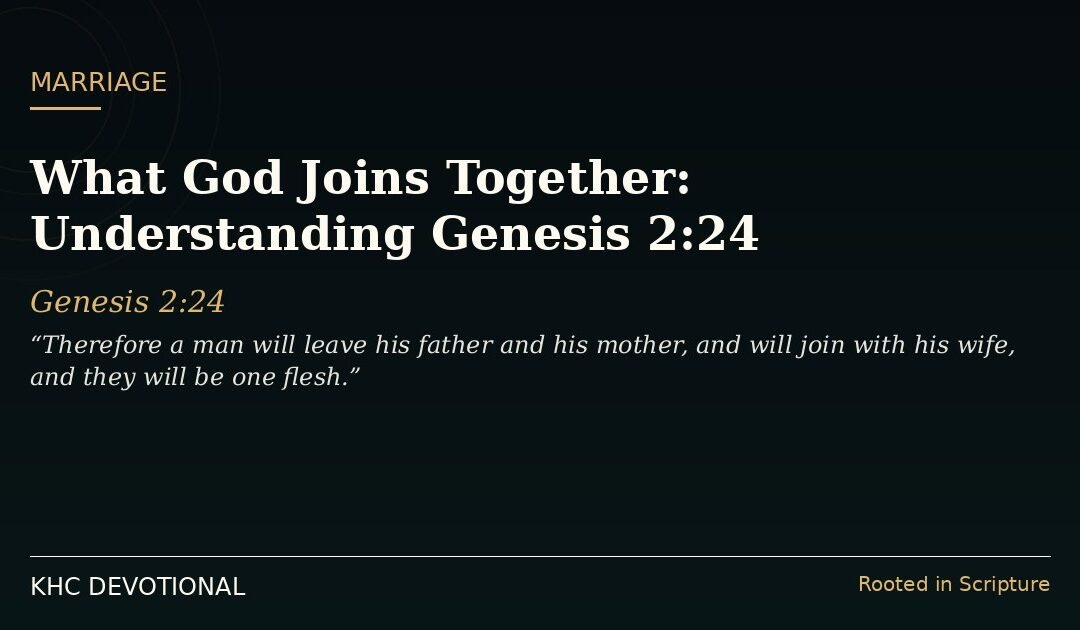
“Therefore a man will leave his father and his mother, and will join with his wife, and they will be one flesh.” (Genesis 2:24, WEB)
Three actions sit inside this single verse, and each one matters. Leave. Join. Become one flesh. Leaving isn’t primarily about geography, though it often includes that. It’s about a fundamental shift in primary loyalty, from the family you were raised in to the family you are now building. This doesn’t erase honor for parents, Scripture is clear elsewhere about that obligation, but it does mean a married couple’s household now operates as its own unit, no longer subordinate to either set of parents’ preferences, expectations, or unspoken rules. Many marriages strain precisely at this point, when one or both spouses never fully left, still quietly seeking a parent’s approval, comfort, or final say over decisions that now belong to the marriage alone, not to the household either of them grew up in.
Joining is the deliberate, active choice that follows leaving. The Hebrew word behind “join” carries the sense of clinging tightly, sticking fast on purpose, an intentional adhesion rather than a passive drift toward someone who happens to be nearby. This is significant, because it frames marriage as an ongoing, active verb, not a single completed event finished on the wedding day. You didn’t just join your spouse once, at the altar. Joining is something a healthy marriage keeps doing, choosing closeness deliberately, especially in seasons when drifting apart would require no effort at all and staying joined requires real intention.
Then comes one flesh, the culmination of leaving and joining, a union so complete that Scripture describes two individual people as becoming a new, singular thing. This certainly includes physical union, but the phrase reaches well beyond it, into every shared dimension of two lives. One flesh describes a merging of life, resources, future, identity, and purpose so thorough that harming your spouse becomes, in a real sense, harming yourself, and Paul later draws exactly this connection in Ephesians 5 when instructing husbands to love their wives as their own bodies. Like two pieces of metal fused under heat, a healthy marriage isn’t simply two people standing near each other, it’s two people who have become, through God’s design and their own ongoing choice, functionally one.
The very next verse in Genesis adds a detail easy to skip past: “The man and his wife were both naked, and they were not ashamed.” That line belongs together with this one, not as a separate afterthought but as part of the very same picture Moses is painting for us. One flesh isn’t only about physical union, it’s about a completeness of vulnerability, being fully known by another person without needing to hide. Shame is what fractures oneness. It creates the very separateness Genesis 2:24 says marriage was designed to overcome. A couple that is growing in one-flesh union is a couple that is slowly becoming safer places for each other’s unedited selves, not just physically, but emotionally, financially, and spiritually.
What This Looks Like This Week
Consider a couple who has been married five years but who still defaults, almost automatically, to calling a parent first with major news, financial decisions, or conflict before ever discussing it with each other. It isn’t malicious, it’s simply an old habit that never got replaced with a new one. Leaving, in their case, is unfinished business. This week, they sit down and decide together on a simple new household rule: major decisions and hard days get processed with each other first, before either one of them picks up the phone to call home. It’s a small structural change, but it’s a real act of leaving, redirecting primary loyalty toward the one-flesh union God designed their marriage to be.
This week, identify one place where you or your spouse haven’t fully “left,” whether that’s decision-making, emotional processing, or unspoken deference to a parent’s opinion, and have an honest conversation about redirecting that toward each other first. Then choose one deliberate act of “joining,” initiating closeness rather than waiting for it to happen naturally. Consider also whether shame, over a past mistake, a body insecurity, a financial fear, has been keeping you from full vulnerability with your spouse, and take one small step this week toward letting them see the part you usually keep hidden.
God didn’t design marriage to be two people living parallel lives under one roof, sharing a mortgage but little else. He designed a joining so complete that it reshapes identity itself, weaving two separate histories into a single, shared story. Lean into that design this week, and watch how differently your marriage feels when leaving and joining are both active, ongoing choices rather than distant memories from your wedding day.
Reflect
In what area, decision-making, emotional support, financial choices, have you not fully "left" your family of origin to prioritize your spouse first?
Is "joining" still an active, ongoing choice in your marriage, or has it become something you assume happened once and no longer tend to?
How does viewing your spouse as "one flesh" with you change the way you'd respond to hurting or dismissing them?
A Prayer for Today
Father, thank you for designing marriage as a leaving, a joining, and a becoming one flesh. Show me any place where I have not fully left my family of origin to make my spouse my first priority. Renew in me the active, ongoing choice to join my spouse, not just once at the altar, but every day since. Help me remember that when I dismiss or wound my spouse, I am wounding someone Scripture calls my own flesh. Fuse our hearts together the way you designed, and help us live like the one union you have made us to be. Amen.
Your Action Step
This week, identify one decision or hard moment you'd normally process with a parent or friend first, and bring it to your spouse first instead.
Somewhere around year seven of marriage, folding laundry on an unremarkable Thursday, she caught herself thinking a sentence she never expected to think: “He’s not holding up his end of this.” It wasn’t said out loud, not yet, but it sat there in her mind like an unmet term in a business deal, quietly recorded and gone unfulfilled. He wasn’t doing his part lately, or so it seemed to her, and some part of her quietly felt entitled to stop doing hers too. It felt reasonable in the moment. It also felt, if she was honest, nothing like what she’d promised at the altar.
That quiet shift, from covenant thinking to contract thinking, happens to almost every marriage eventually, often gradually enough that neither spouse notices the transition while it’s happening. The prophet Malachi wrote to Israel during a period of spiritual apathy after the exile, when the people had grown careless about their commitments, both to God and to each other. In one striking passage, Malachi confronts the men of Israel directly about their unfaithfulness to their wives, and in doing so, gives one of Scripture’s clearest definitions of what marriage actually is.
“Yet you say, ‘Why?’ Because Yahweh has been witness between you and the wife of your youth, against whom you have dealt treacherously, though she is your companion, and the wife of your covenant.” (Malachi 2:14, WEB)
Two words in this verse matter enormously: witness and covenant. Malachi says God himself stood as witness to the marriage, meaning the vows exchanged weren’t merely a private arrangement between two people, but a promise made in God’s presence, with God as a party who holds both spouses accountable to it. And the word covenant, used deliberately instead of a term for ordinary agreement, ties marriage to the same category of relationship God uses to describe his own commitment to his people, unconditional, binding, and not contingent on performance.
A contract and a covenant look similar on the surface, both involve promises, both involve two parties. But their logic is entirely different. A contract is fundamentally transactional: I will do this if you do that, and if you fail to hold up your end, I am considered released from mine. Contracts exist to protect each party’s individual interests, and they dissolve when either side stops delivering. A covenant operates on a completely different logic. It is a commitment of identity, not performance, I am now bound to you not because of what you continue to provide, but because of who I have become in relation to you. Covenant doesn’t ask, “What have you done for me lately?” It asks, “What have I promised, regardless of what happens next?”
This distinction is not abstract theology reserved for seminary classrooms, it is the exact fork in the road every single marriage eventually reaches, usually more than once. Contract thinking creeps in quietly, through disappointment, exhaustion, or unmet expectations, and it always sounds perfectly reasonable in the moment: he stopped trying, so why should I keep trying; she doesn’t appreciate what I do, so I’ll pull back too and see how she likes that. Malachi calls this exact posture treachery, a strong word, because it describes breaking faith with someone who was promised faithfulness regardless of circumstance. God’s charge against Israel’s men wasn’t that they had stopped feeling love. It was that they had reduced a sacred covenant to a conditional arrangement they felt free to abandon once it stopped serving them.
There’s an unexpected freedom hidden inside covenant thinking that contract thinking can never offer. A contract requires constant vigilance, checking whether the other party is still holding up their end, calculating whether you’re still getting a fair return on your investment. That kind of vigilance is exhausting, and it quietly poisons intimacy, because you can never fully relax with someone you’re still evaluating. Covenant removes that calculation entirely. When your commitment isn’t contingent on your spouse’s daily performance, you’re freed from the anxious auditing that contract thinking demands, and you can actually rest in the relationship instead of constantly measuring it.
What This Looks Like This Week
Picture a couple ten years into marriage, both quietly keeping a mental ledger, tracking who initiated the last apology, who’s been carrying more of the emotional labor, who deserves to coast for a while. Neither of them would ever call it keeping score out loud, but that’s exactly what it is underneath, contract logic quietly disguised as fairness. One evening, instead of waiting for her husband to make the next move, the wife decides to plan a night out purely as a gift, not because he’s earned it that particular week, and not because it happens to be her turn, but because covenant love doesn’t actually operate on turns at all. It unsettles the pattern. It reminds them both, without either having to say it directly, that their commitment was never actually conditional on who’s currently performing better in any given season.
This week, notice any place you’ve been quietly keeping score in your marriage, waiting for your spouse to earn continued effort from you. Choose one act of covenant love this week that isn’t a response to something they’ve done, an unearned kindness that reflects the promise you made rather than the mood you’re currently in. If naming the scorekeeping out loud feels vulnerable, say that vulnerability too, something like, “I realized I’ve been waiting for you to do something before I do something kind, and that’s not the marriage I promised you.” Confession like that tends to soften a spouse far faster than silent resentment ever could.
Your marriage was witnessed by God, not just by the guests in your wedding photos. That means your covenant doesn’t depend on your spouse’s performance this week, it depends on the promise you made, and God’s grace is more than enough to help you keep it, the same grace he has extended to his own covenant people across every generation, including the ones who broke faith with him first.
Reflect
Where in your marriage have you slipped into contract thinking, quietly conditioning your effort on your spouse's performance?
Are you currently keeping any kind of mental ledger in your marriage, tracking who owes whom?
What would one unearned act of covenant love toward your spouse look like this week, something given regardless of what they've recently done?
A Prayer for Today
Lord, thank you for witnessing my marriage and for calling it a covenant, not a transaction. Forgive me for the times I have quietly treated my commitment as conditional, holding back love until my spouse earns it. Help me remember that you have never treated your covenant with me that way. Teach me to love my spouse the way you have loved me, faithfully, even when it isn't reciprocated in the moment. Strengthen our marriage to reflect the unconditional nature of the promise we made before you. Amen.
Your Action Step
This week, do one deliberate act of kindness for your spouse that isn't a response to something they've done or a turn you're taking, simply an unearned expression of covenant love.
The opposite will always attract in marriage. You fell in love with your spouse because he/she is different from you. This is so not to encourage disagreement but to bring a different viewpoint into your covenant relationship.
Your love should move from being emotional to being intentional. This is where commitment, maturity, and understanding come to play.
You don’t do marriage because of feelings, you do because of commitment and respect to God who instituted marriage
Emotional love is when you have butterflies in your belly. When your spouse is so nice, loving, caring and he/she is just dope. No faults. No flaws. Everything is just right about them.
But you move to a point of maturity when even though you don’t feel loving towards your spouse because of what they have done or what they have not done, you are intentional and committed to doing those things that keep the love alive.
You don’t kill the embers of the fire of love. You keep on servicing love. Serving and maintenance is an important part of anything we hold dear and anything of value to us that we use.
We maintain our cars, clean up and repair things in our houses so also we should be ready to service our marriage.
Just because things are broken in your car or house doesn’t mean you throw them away. You are committed to spending your money and time fixing whatever needs to be fixed.
Did you miss out on yesterday’s devotional, we’ve got you covered kindly go HERE. For KHC video Devotionals kindly go HERE
Remember, marriage is till death do us part. You are not going anywhere. You stick with it until you have a breakthrough.
Don’t wait till everything breaks downtown beyond repairs. Just like you don’t wait till your four tyres are flat before repairing and changing them
May God grant us more understanding in Jesus mighty name.
God bless your marriage.
CONFESSION FOR THE DAY I am intentional about my marriage
PRAYER FOR THE DAY Lord, give me wisdom
THOUGHT FOR THE DAY Ecclesiastes 4:9 (NIV)Two are better than one, because they have a good return for their labor:
ACTION PLAN FOR THE DAY Have a logical conversation with your spouse