by Rev Dunamis Okunowo | Sep 26, 2026 | Marriage
Reading Time: 5 minutesSomewhere during the eighteen months when your father-in-law was dying and your job doubled its hours and the toddler stopped sleeping through the night, something quietly wore down between you and your spouse. Nobody had an affair. Nobody lied about money. And yet, on the other side of that season, when things finally calmed down enough to notice, you looked at each other across the kitchen and realized you weren’t sure you trusted this person to show up for you the way you needed anymore. Not because they did anything wrong exactly, because in survival mode, both of you had learned to expect less from each other, and expecting less had quietly become believing less.
Trust doesn’t only break through betrayal. It erodes, slowly and undramatically, in seasons of hardship where both people are simply too depleted to show up the way the relationship needs. That kind of erosion is real, even if it doesn’t have a headline event attached to it, and Scripture speaks directly into the ache it leaves behind.
“Yahweh is near to those who have a broken heart, and saves those who have a crushed spirit.” (Psalm 34:18, WEB)
David wrote this psalm out of his own experience of real danger and desperation, but its promise applies broadly to anyone whose spirit has been crushed by a hard season, including the particular ache of realizing your marriage feels less safe than it used to. What’s significant about this verse isn’t just the comfort it offers; it’s the posture it describes. God doesn’t stay distant from broken hearts, waiting for them to heal up before He’ll draw near. He moves toward brokenness. Nearness, not distance, is His response to a crushed spirit.
It’s worth distinguishing this kind of erosion from trust broken by a single, discrete betrayal, because the repair process looks different. A betrayal usually requires a clear reckoning, full honesty about what happened, sustained accountability, and time. Erosion from a hard season usually doesn’t have one moment to reckon with; it has many small moments, spread across months, none of which look like a violation on their own. That can make it harder to address, because there’s no obvious starting point for the conversation. But Psalm 34:18 applies to both: God draws near to broken hearts regardless of what broke them, and the healing He offers isn’t reserved only for the dramatic ruptures.
That posture is instructive for rebuilding trust in a marriage after a hard season. The instinct, when trust has eroded, is often to withdraw further, to protect yourself from more disappointment by expecting less, needing less, risking less. It feels safer. But it also guarantees the trust stays broken, because trust can only be rebuilt through the very vulnerability that withdrawal is designed to avoid. God’s example is the opposite: He draws near to what’s broken rather than waiting at a safe distance for it to fix itself. Rebuilding trust in a marriage requires the same movement, toward each other, in the middle of the brokenness, not after it’s already resolved.
It’s worth being honest about what rebuilding trust after a depleting season actually requires, because it’s rarely one conversation. It usually starts with naming the erosion out loud, which is harder than it sounds when nobody did anything overtly wrong. It can feel unfair to say “I don’t fully trust you right now” to a spouse who was simply surviving alongside you. But naming it honestly is far healthier than letting quiet distance become the new normal, mistaken for peace because it’s not loud.
From there, trust rebuilds the way it always does, not through grand gestures, but through small, consistent reliability, repeated over time. This is where couples often get discouraged, expecting one good conversation to restore what eighteen months of depletion wore down. It won’t. What restores trust is your spouse doing the small thing they said they’d do, again and again, until your nervous system believes it before your mind decides to. It’s showing up on time. It’s following through on a promise to help with the kids’ bedtime routine three nights this week. It’s checking in during a hard day instead of assuming the other person is fine because they haven’t said otherwise.
Consider a couple in exactly this spot, coming out of a hard season with no single event to point to, just distance. A concrete step this week: sit down together and each name one specific way you felt unsupported during the hard season, not to assign blame, but to make the invisible erosion visible and namable. Then agree on one small, repeatable action each of you can offer the other in the coming weeks: a nightly check-in, a Saturday morning set aside with no distractions, a specific chore reliably handled without being asked. Small, kept promises are what rebuild the belief that you can count on each other again.
It also helps to revisit what depleted the relationship in the first place, not to relitigate who could have done more, but to plan for the next hard season before it arrives. Couples who’ve been through a depleting stretch often find it helpful to agree in advance: “The next time work gets overwhelming, or a parent is sick, or a baby isn’t sleeping, here’s the one thing we’ll protect no matter what,” a weekly check-in, a standing date, even just ten minutes before bed with phones away. Naming that commitment now, while the hard season is fresh in memory, makes it far more likely to actually hold the next time life gets hard again.
If your marriage feels quietly worn down by a season neither of you chose, take heart: God draws near to exactly this kind of brokenness, not the dramatic kind alone. He is present in the slow rebuilding as much as in the crisis, and He can restore what depletion wore away, often through nothing more remarkable than two people choosing, small act by small act, to become trustworthy to each other again.
Reflect
- Can you name a season, without a single dramatic event, where trust in your marriage quietly eroded through exhaustion or distraction?
- Have you responded to that erosion by withdrawing further, or by moving toward your spouse the way God moves toward the brokenhearted?
- What small, repeatable action could you offer your spouse this month that would slowly rebuild the belief that you can be counted on?
A Prayer for Today
Lord, thank You that You draw near to broken hearts instead of waiting at a distance for us to heal ourselves first. Some of the trust in my marriage has quietly worn thin, not through betrayal but through a season that asked more of us than we had to give. Teach me to move toward my spouse in this rebuilding instead of protecting myself through distance. Give me patience for the slow work of small, kept promises, and give my spouse the same patience with me. Restore what depletion wore away in our marriage, and remind us both that You are present in the rebuilding, not just in the crisis that came before it. Amen.
Your Action Step
Sit down together this week and each name one specific way you felt unsupported during a recent hard season, then agree on one small, repeatable action you'll each offer the other in the coming weeks.
by Rev Dunamis Okunowo | Sep 25, 2026 | Marriage
Reading Time: 5 minutesThe moment the disagreement starts, something almost automatic kicks in for both of you, and it’s not the same something. You want to stay in the room and work it out right now, pin down what happened, say what you’re feeling, hear a response, land somewhere resolved before you go to bed. Your husband wants the opposite: quiet, a walk around the block, an hour of not talking about it so he can figure out what he actually thinks. To you, his silence feels like avoidance, maybe even punishment. To him, your insistence on talking immediately feels like being cornered before he’s ready. You’re not actually disagreeing about the original issue anymore. You’re disagreeing about how to disagree.
Paul’s description of love in 1 Corinthians 13 is often read at weddings in its most poetic form, but tucked into the list is a phrase with real teeth for exactly this dynamic:
“Love doesn’t behave itself inappropriately, doesn’t seek its own way, is not provoked, takes no account of evil.” (1 Corinthians 13:5, WEB)
“Doesn’t seek its own way” is the phrase worth lingering on here. It’s easy to read this as being about generosity with money or preferences, who picks the restaurant, who controls the remote. But it applies just as directly to something less obvious: the way each of us instinctively wants conflict handled. Your preferred conflict style, talk it out now, or take space and process alone, feels to you like simply “how conflict works.” It doesn’t feel like a preference; it feels like the correct method, and your spouse’s different instinct feels like a character flaw or a lack of care. Paul’s phrase confronts that assumption directly. Love doesn’t insist that conflict be resolved your way, on your timeline, according to your internal wiring.
Marriage counselors have long observed this same pattern using different language, one partner pursuing connection through immediate conversation, the other withdrawing to self-regulate, sometimes called the “pursuer-withdrawer” dynamic. Left unexamined, it becomes a vicious cycle: the pursuing spouse chases harder as the withdrawing spouse retreats further, each one’s coping mechanism triggering more of the other’s. Paul’s ancient instruction anticipates this dynamic by centuries. Love that doesn’t insist on its own way breaks the cycle at its root, because it stops treating your own instinct as the standard your spouse is failing to meet.
This isn’t a modern invention layered onto an ancient text, it’s a genuinely different psychological wiring most couples discover the hard way. Some people process externally: talking is how they think, and silence during conflict feels like the relationship is in danger. Others process internally: talking before they’ve had time to think feels like being forced to perform clarity they don’t have yet, and can lead to saying things they don’t mean. Neither instinct is sin. Neither is more spiritual than the other. But when each spouse assumes their own instinct is simply “normal,” conflict about the actual issue gets buried under a second, unspoken conflict about method, and that second conflict is often more damaging than the first.
Learning your spouse’s conflict language means becoming a student of how they’re actually wired, not how you wish they were wired, or how you assume everyone is wired. It means noticing: does my spouse need ten minutes of quiet before they can talk productively, or do they spiral into worse anxiety the longer a conversation is postponed? Does raising your voice slightly signal passion to you and danger to them? Does silence read as “I need space to think” or “I am punishing you,” and how would you know the difference unless you asked?
Here’s the practical shift for a couple like the one above: instead of treating “talk now” versus “need space” as a battle to be won, name it as a difference to be managed. That might sound like agreeing in advance, outside of conflict, on a shared plan: “When we disagree, I’ll tell you I need twenty minutes before I can talk about it productively, and I’ll actually come back in twenty minutes, not disappear for the night. You tell me clearly that you need to process, instead of just going quiet, so I don’t spiral into thinking you’re punishing me.” That single agreement, made calmly, before the next fight, not during it, can defuse an enormous amount of unnecessary hurt, because it stops each person from interpreting the other’s wiring as rejection.
One couple who worked through this wrote their agreement down, almost like a small treaty: “When we disagree, the pursuer will say, ‘I need to keep talking about this,’ and the withdrawer will say, ‘I need twenty minutes,’ rather than either of us guessing what the silence or persistence means. We’ll set a timer if it helps. We’ll come back to the table when the timer goes off, no matter what.” Having it written down, rather than just discussed once, gave them something to return to in the heat of an actual disagreement, when neither of them was thinking as clearly as during the calm conversation that produced the agreement.
This week, have that conversation outside of conflict, while things are calm. Ask your spouse directly: “When we disagree, what do you actually need from me in that moment, space, or my full attention right away?” Then tell them what you need in return. You’re not seeking your own way by having this conversation; you’re doing the opposite, building a shared way that makes room for both of your instincts to be honored.
Give this some grace as you practice it. You won’t switch overnight from assuming your instinct is universal to genuinely honoring your spouse’s different wiring. There will be disagreements where old patterns resurface, where you forget the agreement you made and default to old assumptions. That’s part of learning any second language, fluency comes slowly, through repeated, imperfect practice, not through a single conversation that fixes everything at once.
Love that doesn’t insist on its own way isn’t love that has no preferences. It’s love mature enough to learn a second language, your spouse’s, so that conflict, when it comes, doesn’t have to cost you connection on top of the original disagreement.
Reflect
- Do you process conflict by talking immediately or by needing space first, and have you ever named that instinct to your spouse directly?
- Have you interpreted your spouse's different conflict instinct as rejection or lack of care, when it may simply be different wiring?
- What agreement could you and your spouse make in advance, outside of conflict, that would honor both of your instincts during the next disagreement?
A Prayer for Today
Father, my spouse and I are wired differently, and in the middle of conflict that difference sometimes feels like a wall instead of just a difference. Teach me not to seek my own way when it comes to how we resolve disagreements. Help me become a genuine student of how my spouse processes conflict, instead of assuming my instinct is the only right one. Where I've misread their silence as punishment, or my urgency as an attack, give us both patience to explain ourselves honestly. Let our differences in conflict style become something we navigate together with love, not something that divides us further. Amen.
Your Action Step
This week, outside of any active disagreement, ask your spouse directly what they need from you during conflict, space or immediate connection, and share your own need in return, then agree on a plan for next time.
by Rev Dunamis Okunowo | Sep 24, 2026 | Marriage
Reading Time: 5 minutesThree nights now. You pass the salt when it’s asked for and answer questions with as few words as legally required, “fine,” “sure,” “whatever works,” but the real conversation, the one about what actually happened Tuesday night, hasn’t been touched since it started. You tell yourself you’re not really angry anymore, not exactly. You’ve just decided it’s easier not to talk about it. Across the table, your spouse is doing the same math, waiting for you to break first. Neither of you calls it the silent treatment. It just sort of happens, this cold, mutual withdrawal that somehow feels safer than saying what’s actually wrong.
Paul’s letter to the Ephesians addresses anger head-on, and what he says is worth sitting with carefully, because it doesn’t tell you not to be angry. It tells you what to do, and not do, with the anger you have.
“Be angry, and don’t sin.” “Don’t let the sun go down on your wrath, and don’t give place to the devil.” (Ephesians 4:26-27, WEB)
The first phrase is almost startling in a church culture that sometimes treats anger itself as sinful. Paul assumes you will get angry, at your spouse, at circumstances, at real wrongs done to you, and he doesn’t condemn the emotion itself. What he condemns is what you do with it: sinning in your anger, and, this is the part that speaks directly to the silent treatment, letting it fester past sundown, unaddressed.
The silent treatment feels, to the person doing it, like restraint. It feels like the opposite of sinning in anger, after all, you’re not yelling, not saying something you’ll regret, not throwing anything. But Paul’s second command exposes what silence actually is: a refusal to resolve, which he equates with giving the anger overnight lodging it was never meant to have. “Don’t let the sun go down on your wrath” isn’t a literal twenty-four-hour deadline as much as it’s a principle: anger left to sit, unaddressed, doesn’t cool into peace. It calcifies into distance. And Paul’s final phrase names exactly what that calcified distance becomes: an open door, “give place” is territory language, for the enemy to work in a marriage.
It’s worth noting what “be angry, and don’t sin” does not authorize. It doesn’t authorize using anger as a weapon, raising your voice to intimidate, or nursing a grievance quietly for weeks while pretending everything’s fine. Anger, in Paul’s framework, is meant to be a signal, not a residence. It tells you something matters, something feels unfair or hurtful, and it’s meant to prompt a conversation, not replace one. The silent treatment actually inverts Paul’s whole instruction: instead of using the anger to fuel honest resolution, it uses the anger to punish, indirectly, without ever naming what’s wrong. That’s a subtler sin than yelling, but Paul’s language suggests it’s no less serious, because it “gives place” to exactly the kind of division the enemy wants to establish in a marriage.
That’s a serious claim. Paul isn’t being dramatic when he links unresolved anger to spiritual vulnerability. Think about what silence actually does inside a marriage over time. It teaches both spouses that withdrawal, not honest conversation, is how conflict gets handled. It lets resentment compound in the dark, where neither person can correct a misunderstanding because neither person is talking. It communicates, wordlessly but unmistakably, “you are not safe enough for me to be honest with.” Every day the silence continues, it digs the relational trench a little deeper, and makes the eventual conversation, because it will eventually have to happen, that much harder to start.
The alternative Paul offers isn’t suppression (“just get over it and act normal”) or explosion (“say everything you’re feeling without restraint”). It’s timely, honest processing. Be angry, acknowledge it, even to your spouse, out loud: “I’m still upset about Tuesday, and I need to talk about it.” Don’t sin, that acknowledgment isn’t a license to attack, name-call, or bring up unrelated grievances. And don’t let it sit, address it in the same day, or as close to it as reasonably possible, rather than letting silence become the relationship’s default operating mode.
If you recognize your own marriage in the dinner table scene above, here’s what obeying this passage could look like tonight: instead of another meal of clipped answers, be the one who breaks the silence first, not with a fresh accusation but with an honest bid, “I’ve been quiet because I’m still hurt about Tuesday, and I don’t want to just let this sit between us anymore. Can we actually talk about it?” That sentence costs pride. It’s far easier to wait for your spouse to crack first. But Paul’s command isn’t addressed to whoever is more wronged, it’s addressed to both of you, and someone has to go first.
Some couples find it helpful to agree in advance on a simple phrase that signals, “I’m still upset, but I’m choosing not to go silent,” something like, “I need a minute, but I’m not shutting you out.” That small verbal bridge keeps necessary space for cooling down from sliding into the kind of prolonged, punishing silence Paul warns against. The goal isn’t instant resolution of every conflict before bed; it’s making sure silence never becomes the whole strategy.
If the silence has already stretched past days into weeks, consider bringing in help, a pastor, a counselor, a trusted mentor couple, to facilitate the conversation neither of you has been able to start alone. There’s no shame in needing a bridge back to each other.
Remember, too, that breaking a pattern of silence rarely feels natural the first few times you try. You may still feel the pull to retreat into quiet distance the next time you’re hurt. That’s normal. What matters is building a track record, one honest conversation at a time, until speaking up becomes more instinctive than shutting down.
Your marriage was never meant to run on cold wars. Anger will visit, Paul assumes it will, but it was never meant to move in and unpack its bags. Let today be the day you close that door instead of leaving it open one more sundown.
Reflect
- How long do you typically let silence sit in your marriage before addressing what's actually wrong, and what does that silence usually communicate?
- Do you tend to view withdrawal as restraint, or can you recognize it as its own form of unresolved anger?
- What would it cost you, in pride or comfort, to be the one who breaks the silence first tonight?
A Prayer for Today
Lord, I don't want silence to become the way conflict gets handled in my marriage. Forgive me for the times I've let anger sit unspoken instead of bringing it honestly into the light. Give me courage to say what's actually wrong instead of retreating into cold distance, and give me gentleness so that when I do speak, it builds rather than wounds. Close every door I've left open for bitterness or division to grow between my spouse and me. Help us become a couple who resolves conflict quickly and honestly, so that no sundown finds us still holding on to silence instead of each other. Amen.
Your Action Step
If there is unresolved silence in your marriage right now, be the one to break it tonight with a specific, honest sentence like, 'I've been quiet because I'm still hurt, and I don't want to let this sit anymore. Can we talk?'
by Rev Dunamis Okunowo | Sep 23, 2026 | Marriage
Reading Time: 5 minutesMarcus thinks eight-year-old Noah needs to learn to solve his own problems with the kid down the street, even if that means a bruised ego. Elena thinks a parent should step in when another kid is being deliberately cruel, even if that means Noah doesn’t learn to fight his own battles today. Neither of them is wrong, exactly. Marcus has a point about resilience. Elena has a point about protection. But by the time they’re arguing about it in the kitchen at nine p.m., the actual disagreement about parenting has turned into a disagreement about whether Marcus is too hands-off or Elena is too controlling, and now it’s not about Noah anymore at all.
This is one of the hardest categories of marital conflict: not the fight where one of you is simply wrong, but the fight where you’re both bringing something legitimate to the table, and the tension itself doesn’t have a clean resolution. Solomon, writing to his son in Proverbs, doesn’t promise a formula for making disagreements disappear. He offers something more realistic: a way to keep disagreement from becoming destruction.
“A gentle answer turns away wrath, but a harsh word stirs up anger.” (Proverbs 15:1, WEB)
Notice what this proverb doesn’t say. It doesn’t say a gentle answer makes you right, or resolves the underlying issue, or guarantees your spouse will suddenly see things your way. It says a gentle answer changes the temperature. It’s about de-escalation, not victory. Harsh words, even accurate ones, pour gasoline on a disagreement. Gentle words, even when you’re defending a position you’re not budging from, keep the conversation survivable long enough for actual resolution to become possible.
It helps to remember what kind of literature Proverbs is. Proverbs are not ironclad promises but distilled wisdom, general truths that hold reliably, though not mechanically, in real life. A gentle answer doesn’t guarantee your spouse’s wrath evaporates instantly every single time. But as a consistent practice over years of marriage, gentleness reliably produces a different climate than harshness does. Couples who default to gentle answers build a track record of safety with each other, so that even hard “both right” conversations happen inside a relationship that has proven, over time, it can hold disagreement without breaking. Couples who default to harshness build the opposite track record, so that even minor disagreements start to feel dangerous before a word is spoken.
This matters enormously for the “both right” category of conflict, because when neither person is simply mistaken, the temptation is to escalate the tone in order to compensate for the lack of a clean win. If you can’t out-argue your spouse’s point, you might raise your voice, bring up old grievances, or attack their character instead of their position, not because you’ve thought it through, but because harshness feels like the only lever left when logic alone won’t settle it. Solomon’s proverb interrupts that instinct. Gentleness isn’t weakness or capitulation; it’s the discipline that keeps two legitimate perspectives from turning into two wounded people.
There’s a repair dimension to this proverb too, which matters even after the initial disagreement has cooled. “Both right” conflicts often don’t get fully resolved in the moment — Marcus and Elena may go to bed that night with the actual parenting philosophy question still unsettled. What needs repair isn’t necessarily the disagreement itself; it’s the wake the disagreement left behind: the tone that got sharp, the assumption that the other person doesn’t respect your judgment, the sense of being on opposite teams instead of the same one. A gentle answer, offered even after the fact, “I got harsh earlier, and I’m sorry, even though I still see it differently than you do,” repairs the relationship without requiring either person to abandon a legitimate conviction.
It’s also worth saying that some “both right” disagreements never fully resolve, and that’s acceptable. Marcus and Elena may parent this exact scenario differently for years, adjusting case by case rather than settling on one fixed philosophy forever. A healthy marriage doesn’t require total agreement on every parenting, financial, or relational judgment call. It requires the ability to disagree well, repeatedly, without the disagreement itself becoming a source of division.
This is where many couples get stuck: they think repair requires agreement. It doesn’t. You can fully repair the relational damage from a disagreement while still disagreeing about the actual issue. Gentleness, respect, and humility toward your spouse’s reasoning are entirely possible even when you haven’t been persuaded to change your position.
For Marcus and Elena, repair might look like sitting down the next morning, not to relitigate the argument, but to acknowledge the tone: “I raised my voice last night because I felt like you thought I didn’t care about protecting him. That’s not true, and I shouldn’t have gotten harsh.” From there, the actual parenting question can be revisited with curiosity instead of combat: what is each of them actually afraid of? Marcus fears raising a son who can’t handle conflict. Elena fears raising a son who thinks cruelty is something you just have to absorb. Named that way, the “both right” tension becomes something they can navigate together, maybe landing on a middle path, maybe taking turns trusting each other’s instincts in different situations, rather than a scoreboard either person needs to win.
A concrete practice some couples adopt for these “both right” disagreements is simple: after the tone has been repaired, agree to try one approach for a set period, say, two weeks of Elena’s closer supervision, or two weeks of Marcus’s hands-off approach, and then compare notes on what you both observed, rather than trying to resolve the philosophical disagreement in the abstract. Testing an approach in real time often reveals nuance neither position accounted for, and it keeps the disagreement productive instead of circular.
This week, when you hit a disagreement where you’re both bringing something true to the table, try this: address the tone before you address the topic. Offer the gentle answer first, not as surrender, but as the thing that keeps you and your spouse on the same side of the table while you work out where you actually land. Wrath doesn’t have to be the price of two people holding different, legitimate convictions. Gentleness can hold both truths, and your marriage, at the same time.
Reflect
- Can you recall a recent disagreement where you and your spouse were both bringing something legitimate to the table, and how did you handle the tone?
- Do you tend to escalate harshness when logic alone isn't winning an argument, and what does that usually cost your marriage afterward?
- What is a 'both right' disagreement in your marriage right now that needs the tone repaired, even if the underlying issue stays unresolved?
A Prayer for Today
Lord, not every disagreement in my marriage has a clean winner, and I need Your help holding my convictions with gentleness instead of harshness. When I can't out-argue my spouse, keep me from reaching for sharper words just to compensate. Teach me that a gentle answer doesn't mean surrendering what I believe, it means protecting the relationship while we work through what we don't yet agree on. Where my tone has hurt my spouse recently, even when I felt justified, give me the humility to repair that first, before the actual issue is resolved. Help our marriage hold differing convictions without letting them turn into wounds. Amen.
Your Action Step
The next time you and your spouse disagree and neither of you is simply wrong, address the tone before the topic: apologize for any harshness first, then revisit the actual issue with curiosity instead of combat.
by Rev Dunamis Okunowo | Sep 22, 2026 | Marriage
Reading Time: 5 minutesThe car went silent somewhere around exit 14. Twenty minutes earlier, what started as a disagreement about whose family to visit for the holidays had turned into something uglier — words about being “just like your mother,” about feeling like an afterthought, about wondering out loud if either of you even likes who the other has become. Now you’re both staring at the road, replaying what you said, wishing you could reach into the air and take the words back before they landed. You weren’t trying to hurt your spouse. Somewhere in the middle of trying to be right, that’s exactly what happened.
Paul wrote to the church at Ephesus about the kind of speech that either builds a community up or tears it down, and while he was addressing the whole church, few relationships put his words to the test more than marriage, where you know exactly which words will land hardest and are most tempted to use them.
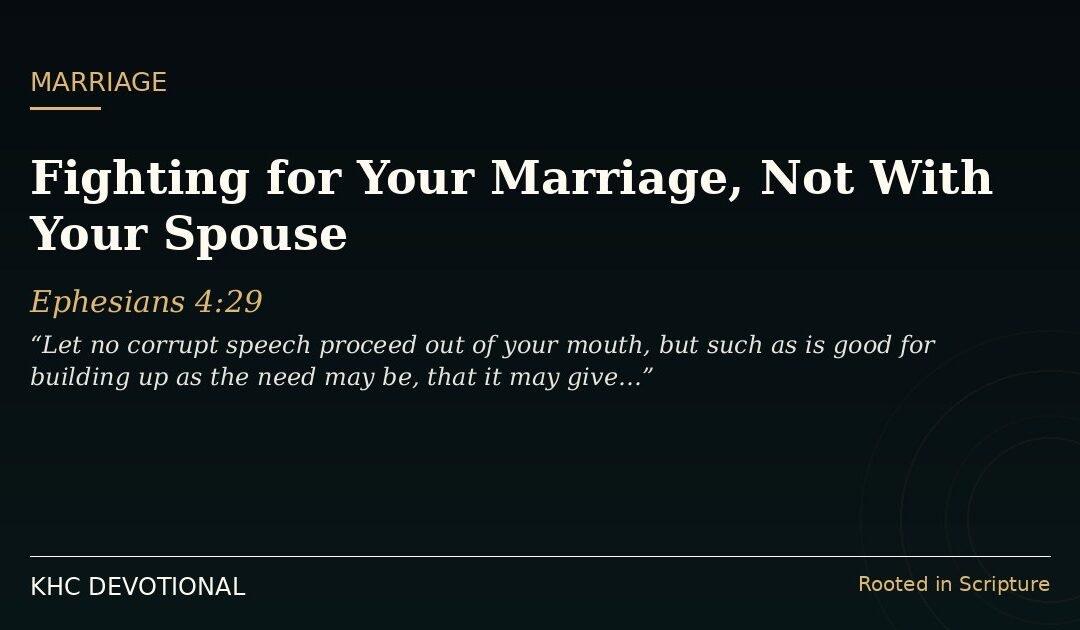
“Let no corrupt speech proceed out of your mouth, but such as is good for building up as the need may be, that it may give grace to those who hear.” (Ephesians 4:29, WEB)
The word Paul uses for “corrupt” describes something rotten, spoiled food, decaying matter. He’s not only talking about cursing or crude language; he’s describing any speech whose effect is decay rather than growth. That reframes conflict entirely. The question in a disagreement was never supposed to be “how do I win this argument,” but “is what I’m about to say going to build something or rot something?” You can be completely right about the actual issue — whose family to visit, how to spend the tax refund, who was supposed to call the plumber — and still speak corruptly if your words are chosen to wound rather than resolve.
Paul’s standard is unusually specific: speech “good for building up as the need may be.” That phrase matters. It’s not building up in some vague, unrelated sense, it’s meeting the actual need of the moment. Sometimes what a conflict actually needs is honest confrontation, not silence. Paul isn’t asking couples to avoid hard conversations; earlier in the same letter he tells believers to speak truth to one another. But truth spoken as a weapon isn’t the truth Paul has in mind. He’s describing truth aimed at repair.
Paul closes the verse with an unusual phrase: speech “that it may give grace to those who hear.” Grace-giving speech doesn’t mean flattery or avoiding hard truths, it means your words leave the hearer better off for having heard them, even when the content is difficult. That standard, applied to marital conflict, reframes the goal of every hard conversation. The test isn’t whether you got your point across or won the exchange; it’s whether your spouse walked away feeling more loved and more clear, even if they still disagree with you. That’s a genuinely higher bar than simply avoiding cruelty. It asks conflict itself to become a vehicle of grace rather than merely the absence of sin.
This is the heart of “fighting for your marriage, not with your spouse.” Every couple disagrees — Scripture never promises conflict-free marriage, and pretending otherwise sets couples up to panic the first time they disagree, as if disagreement itself is the failure. The failure isn’t disagreement; it’s treating your spouse as the opponent instead of the disagreement itself as the opponent. When you fight with your spouse, the goal quietly becomes winning, being understood, being vindicated, even at your spouse’s expense. When you fight for your marriage, the goal is that the two of you, together, defeat the actual problem: the miscommunication, the hurt feeling, the unmet expectation.
Practically, this shift shows up in small but decisive choices in the middle of an argument. It’s the difference between “you always do this” (an attack on character) and “I felt dismissed when that happened” (a description of impact). It’s the difference between bringing up unrelated past failures to strengthen your position and staying focused on the actual issue in front of you. It’s noticing the moment your words are aimed at winning rather than resolving, and choosing to stop.
Consider a couple like the one in the car above. The wisest thing they could do, once home, isn’t to pretend the fight didn’t happen or rehash it a second time with the same tactics. It’s to sit down once emotions have cooled and name specifically what was said that crossed the line from truth-telling into corrupt speech, the comment about “just like your mother,” the character attack disguised as an observation, and apologize for that specifically, separate from resolving the actual holiday-planning disagreement. Separating the sin from the substance keeps you from either avoiding real issues to preserve peace, or steamrolling real relationship damage to “win” a logistical decision.
When they finally talked it through that weekend, neither pretended the holiday disagreement was fully resolved, they still needed to work out logistics. But before touching that topic again, the husband said plainly, “What I said about your mother wasn’t fair, and it wasn’t really about the holidays. I’m sorry.” She responded, “I raised my voice too, and some of what I said about feeling like an afterthought came out sharper than I meant.” Only after that repair did they return to the actual question of whose family to visit, and found the conversation went far more smoothly once the corrupt speech from the car ride had been named and set aside.
One practical habit worth adopting this week: before your next disagreement escalates, pause and ask each other, “Are we fighting for us right now, or against each other?” That single question, spoken honestly, can interrupt corrupt speech before it does its damage, and redirect both of you back toward the same side of the table.
Your marriage will have more car-ride arguments. That’s not a sign something is broken, it’s a sign two real people are learning to live as one. What determines whether those moments strengthen your marriage or slowly erode it isn’t whether you disagree, but whether your words, even in disagreement, are still working to build something between you.
Reflect
- In your last real disagreement, was your goal to be understood and vindicated, or to resolve the issue together with your spouse?
- What specific words or phrases do you reach for in conflict that you know are aimed at wounding rather than resolving?
- What would change in your next disagreement if you asked yourself mid-argument, 'Am I building or am I rotting something right now?'
A Prayer for Today
Father, my words can build my marriage up or slowly rot it, and I don't always choose carefully in the heat of an argument. Forgive me for the times I've used truth as a weapon instead of a tool for repair. Teach me to fight for my marriage instead of against my spouse, to aim my words at the actual problem, not at their character. Give me self-control in the moment conflict starts to escalate, and give me the humility to apologize quickly when I cross the line into corrupt speech. Let every hard conversation in our marriage end with both of us feeling more built up, not more torn down. Amen.
Your Action Step
Before your next disagreement, agree with your spouse on a shared phrase you can say to each other mid-argument, like 'same team,' as a reminder to redirect from attacking each other to solving the problem together.
