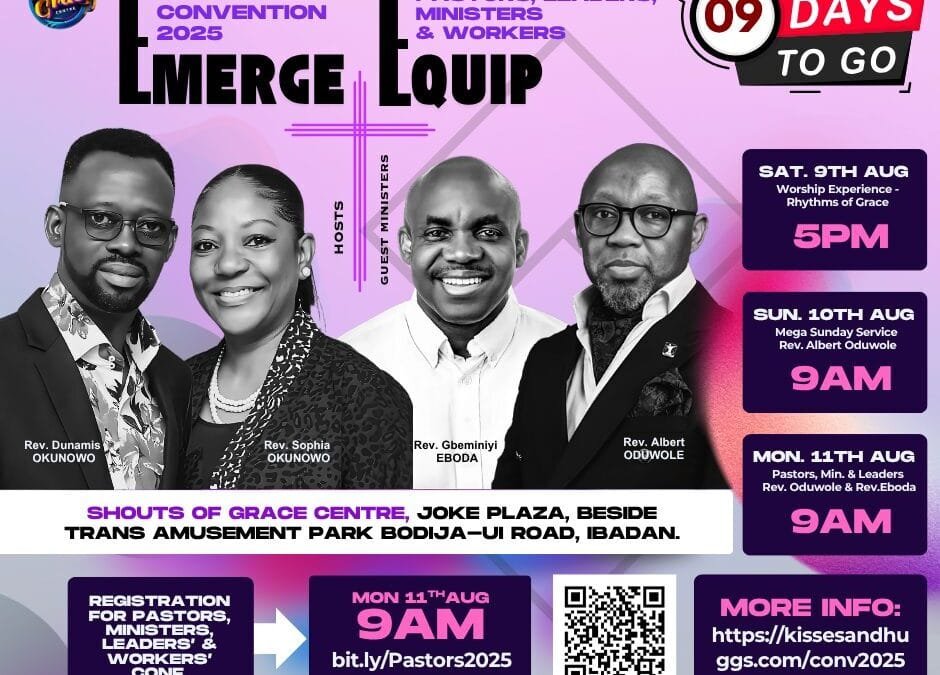
Are you a minister, pastor, church worker, or leader, and you live in Ibadan? You are cordially invited to “Equip” a Minister’s Conference with Rev Femi Oduwole and Rev Gbeminiyi Eboda as part of our 9th anniversary convention.
Rev Dunamis and Sophia Okunowo will also be hosting us. Attendance is free, but registration is required. Kindly register on this link – https://kissesandhuggs.com/conv2025
Don’t miss it. Spread the word!
Choosing a life partner is one of the most significant decisions you’ll ever make. This person will walk beside you through joys and trials, share your dreams, and help shape the legacy you leave behind. But this decision shouldn’t rest solely on human wisdom or fleeting emotions—it must be guided by God’s direction and design. Here’s how to discern who your life partner is with God at the center of the process.
1. Surrender Your Desires to God
Before seeking a spouse, surrender your desires and expectations to the Lord. Often, our vision for “the perfect partner” is shaped by societal standards, past experiences, or unmet needs. However, Psalm 37:4 reminds us, “Delight yourself in the Lord, and He will give you the desires of your heart.” When you delight in God above all else, He aligns your heart with His plan, replacing selfish ambitions with godly priorities.
Pray and ask God to reveal His will for your future spouse. Trust that His timing and choice are far better than anything you could orchestrate on your own.
2. Seek Wisdom and Discernment
God promises wisdom to those who ask (James 1:5), so seek His guidance as you navigate relationships. Look beyond surface-level attractions and evaluate character, values, and spiritual maturity. Proverbs 18:22 says, “He who finds a wife finds what is good and receives favor from the Lord.” Notice the emphasis on finding someone who reflects goodness—a reflection of God’s nature.
Ask yourself: Does this person exhibit fruit of the Spirit (Galatians 5:22-23)? Are they committed to growing closer to God? Do they honor others and demonstrate integrity? These qualities matter far more than external appearances or temporary chemistry.
3. Set Boundaries and Standards Based on Scripture
As you wait for God’s leading, establish clear boundaries and non-negotiable standards rooted in Scripture. For example:
A shared faith in Christ (2 Corinthians 6:14)
A commitment to purity and holiness (1 Thessalonians 4:3-5)
Alignment in core values like family, finances, and ministry
Boundaries protect your heart and ensure you don’t settle for less than God’s best. Remember, compromise on foundational principles can lead to long-term struggles in marriage.
4. Involve Godly Counsel
Proverbs 11:14 states, “Where there is no guidance, a people falls, but in an abundance of counselors, there is safety.” Surround yourself with trusted mentors, pastors, or spiritually mature friends who can provide objective insight into potential partners. They can help identify red flags you might overlook due to emotions or infatuation.
Additionally, observe how the person interacts with their family, friends, and community. Their behavior outside of your relationship reveals much about their true character.
5. Trust God’s Timing
Patience is key when deciding who your life partner is. It’s easy to feel pressured by cultural timelines or comparisons with others, but Ecclesiastes 3:1 assures us, “There is a time for everything, and a season for every activity under the heavens.” Rushing into a relationship without divine confirmation can lead to heartache, while waiting on God ensures alignment with His purpose.
While you wait, focus on becoming the kind of person you hope to marry. Use this season to deepen your relationship with God, serve others, and grow in wisdom and maturity.
Deciding who your life partner is isn’t just about choosing someone—it’s about allowing God to guide you to the right person at the right time. Keep Him at the forefront of your search, trusting that He knows what’s best for you. As you pray, seek wise counsel, and set godly standards, rest assured that He will lead you to a partner who complements your journey and shares your commitment to glorify Him.
Remember, marriage is not only a union between two people—it’s a covenant involving God Himself. Let your decision reflect reverence for His design and dependence on His direction. With faith and obedience, you’ll find the joy and fulfillment that come from partnering with both God and the person He has chosen for you.
Proverbs 19:14 concludes, “Houses and wealth are inherited from parents, but a prudent wife is from the Lord.” Trust that your life partner is a gift from Him—and trust in His perfect timing to bring it to pass.
I have come to realize that choosing a spouse is not as spookyas some people make it to feel. If you can just follow God all through, the journey will be less complicated.
Also, I have realized that more often than not, your spouse is very much around you. Godis not just about to create your spouse. You just need to be discerning to know where he or she is.
Ex 32:1(KJV) And when the people saw that Moses delayed to come down out of the mount, the people gathered themselves together unto Aaron, and said unto him, Up, make us gods, which shall go before us; for as for this Moses, the man that brought us up out of the land of Egypt, we wot not what is become of him.
After Moses had gone for a long while, the children of Israel became impatient and demanded a god. Where would they get the raw materials to fabricate a god? Remember, they were in the wilderness.
See what Aaron said.
Ex 32:2-4 (KJV) And Aaron said unto them, Break off the golden earrings, which are in the ears of your wives, of your sons, and of your daughters, and bring them unto me. 3 And all the people brake off the golden earrings which were in their ears, and brought them unto Aaron. 4 And he received them at their hand, and fashioned it with a graving tool, after he had made it a molten calf: and they said, These be thy gods, O Israel, which brought thee up out of the land of Egypt.
Aaron made the golden calf with the earrings he found around him.
Who would have thought something good could come out of those earrings?
I mean, they wear these earrings every day. They see it every day. They use it every day. It was looking too common in their eyes, so they couldn’t see the golden calf in it.
And that is how this marriage thing is. You are probably seeing your spouse every day. You are probably interacting with your spouse every other day. The issue is that you may not know. It took Aaron, the priest, to see that something good could come out of the earrings. Likewise, it will take a priest to see if something worthwhile will come out of that lady or gentleman lurking around you.
However, as believers, we don’t need any Aaron. You are the Priest and Prophet over your life.
You are the one who will look beyond the physical and go for what you want.
You are the one who will cry to God to open your eyes that you may see what others are not seeing in that person.
Everyone saw a woman with five husbands, but Jesus saw an evangelist.
Everyone saw gold earrings, but Aaron saw a golden calf.
Everyone saw something whitish, but Moses saw food for the Israelites.
When it comes to choosing the right partner, I hear people say a lot. I want a God fearing man. He or she must be a Christian [I wonder if you want to consider an unbeliever before]. I want someone who can demonstrate the gifts of the spirit, and so on.
While you may be entitled to your choice, there is an important factor I would love you to consider in your prospective fiance or fiancee.
Marriage is a whole lot. It would be wise for you, if you can, to reduce the issues you would face in marriage.
When the bible says you should not be yoked with unbelievers, it is to your advantage. Apostle Paul says marriage comes with additional stress in an already stressful life. How do you want to add that to a partner who doesn’t share your spiritual values?
Back to my discourse, the very first thing I feel you should consider before saying yes is integrity. Does this person have integrity? Is he or she a person of his/her words? Do they mean yes when they say yes?
When the disciples were to choose the seven deacons, the first criteria was honesty.
Acts 6:3 [KJV] Wherefore, brethren, look ye out among you seven men of honest report, full of the Holy Ghost and wisdom, whom we may appoint over this business.
They chose integrity before they mentioned being full of the spirit.
Acts 6:3 [AMP] Therefore, brothers, choose from among you seven men with good reputations [men of godly character and moral integrity], full of the Spirit and of wisdom, whom we may put in charge of this task.
What does that tell you?
Don’t be swayed by the gifts of the spirit you see manifesting in that person’s life. Check for integrity. Check for honesty. You can’t afford to get married to someone who doesn’t value truthfulness.
Even God honors His words above His name. That is integrity!
Ps 138:2 [NKJV] I will worship toward Your holy temple, And praise Your name For Your lovingkindness and Your truth; For You have magnified Your word above all Your name.
Marriage is an institution created by God for a purpose. It’s one of the most significant decisions you will ever make. This is a world where emotions run high and destiny calls, but many singles still find themselves asking if they should marry for love or purpose.
Genesis 2:18 (NIV) The Lord God said, “It is not good for the man to be alone. I will make a helper suitable for him.”
The scripture gave us a reason why it is not good for a man to be alone which is why it said He will make him a helper suitable for him. The gospel truth is that love and purpose work together and every destiny decision must have a strong WHY.
The first thing Adam saw in Eve was her beauty. He was blown away and immediately gave her the name WOMAN. When he was to name the animals that God created, God had to give the instructions, but when he saw his wife, his purpose to oversee, to be fruitful and to multiply began to flow effortlessly, which made him name Eve immediately. Even though he was asleep when she was created out of his ribs, he got her name at first sight and followed through with sweet lines.
Genesis 2:23 (NIV)The man said, This is now bone of my bones and flesh of my flesh, she shall be called ‘woman,’ for she was taken out of man.”
There has to be a complementation between you and your spouse that allows you to flow naturally in the fulfillment of your purpose with deep love.
So, leaving purpose out for love does not balance with the equation of God.
Here are reasons you should marry for love and purpose.
1. Love without purpose is risky
Love is a powerful force. It makes your heart race, gives you butterflies, and makes you believe in forever. But love alone is not enough to sustain a marriage. Feelings can be fleeting, and what happens when life gets hard? You will no longer feel the excitement you once had. When you make love a choice, your WHYs will reflect and you will be able to sustain better than relying on the feelings of love alone.
Proverbs 19:21 (NIV) “Many are the plans in a person’s heart, but it is the Lord’s purpose that prevails.”
Marriage without purpose is like a car without fuel. It may look good on the outside, but it won’t go far.
2. Purpose without love is a struggle
On the other hand, marrying only for purpose, whether it’s for ministry, business, or societal expectations without genuine love can feel like a job instead of a joyful union. If you choose a partner just because they align with your calling but lack deep affection, your marriage may feel forced and duty-bound rather than fulfilling.
Ecclesiastes 4:9-10 (NIV) “Two are better than one because they have a good return for their labor: If either of them falls down, one can help the other up.”
Purpose alone won’t carry you through the days when you need warmth, affection, and deep emotional connection.
3. Balance love with purpose
The best marriages are those where love and purpose align. Love brings joy, intimacy, and companionship, while purpose gives direction, meaning, and a shared vision. God’s design for marriage is not just about romance or function, it’s about a divine partnership that glorifies Him.
Before saying “I do,” ask yourself:
● Does this person truly love me, not just in words but in action?
● Do we share the same spiritual and life purpose?
● Will our marriage honor God and advance His kingdom?
God’s plan for marriage includes love, partnership, and purpose to work together. If you marry only for love, you may wake up one day wondering why you’re together. If you marry only for purpose, you might feel emotionally disconnected and unfulfilled.
It’s only when love and purpose meet that you experience a marriage that is not only joyful but also God-ordained. So, love and the tendency of your purpose fulfillment have to be found in the person you’re choosing for marriage.
Emotional intelligence is a pivotal quality to seek in a prospective husband. It plays a fundamental role in understanding, managing, and navigating emotions, both his and yours. A partner with high emotional intelligence will be attuned to your feelings and able to manage his own emotional responses effectively, fostering a balanced and healthy relationship. Emotional intelligence encompasses self-awareness, self-regulation, motivation, empathy, and social skills. These attributes collectively contribute to a relationship built on mutual respect and understanding.
Effective communication skills are equally crucial. Key attributes to assess include active listening, empathy, and the ability to convey thoughts and feelings clearly. Active listening involves paying full attention to the speaker, understanding their message, and responding thoughtfully. It signifies valuing the other person’s perspective, which is essential in resolving conflicts and fostering intimacy.
Empathy enables a partner to put themselves in your shoes, understanding your feelings and viewpoints. This ability to connect on an emotional level enhances emotional closeness and support in the relationship. Clear communication is another cornerstone. A prospective husband should express his thoughts and feelings openly and honestly. This transparency helps in building trust and avoiding misunderstandings.
Anecdotal evidence suggests that couples who score higher in emotional intelligence and communication skills tend to have more fulfilling and lasting relationships. For instance, Sarah and John, married for over a decade, credit their strong relationship to their ability to communicate effectively and understand each other’s emotional needs. Sarah shares, “John is always there to listen without judgment, and he shows empathy towards my feelings, which has strengthened our bond tremendously.”
Experts also assert the importance of these skills. Dr. John Gottman, a renowned relationship expert, highlights that couples who practice active listening and show empathy are more likely to navigate the complexities of a relationship successfully. Therefore, seeking a partner with high emotional intelligence and strong communication skills is indispensable for a thriving, long-term relationship.
When considering a prospective husband, one of the most pivotal factors to examine is shared values and long-term goals. These elements form the foundation of any successful marriage, as they represent the core beliefs and aspirations that will guide a couple’s life together. Ensuring that both partners are aligned in areas such as family planning, financial goals, and lifestyle choices is essential for maintaining harmony and preventing future conflicts.
Family Planning
Family planning is a fundamental aspect where shared values are critical. Couples must discuss their desires regarding children, including the number of children they wish to have and their parenting philosophies. Mismatched expectations in this area can lead to significant strife. For instance, if one partner desires a large family, while the other prefers to remain child-free, this disparity can create insurmountable challenges. Open, honest discussions about family planning early in the relationship can help avoid such conflicts.
Financial Goals
Financial goals and values also play a crucial role in a marriage. Understanding each other’s perspectives on saving, spending, and investing is indispensable. For example, one partner may prioritize saving for retirement, whereas the other may value spending on travel and experiences. Aligning these financial priorities can be achieved through detailed discussions and compromises, ensuring that both partners’ values are respected and integrated into their financial planning.
Lifestyle Choices
Lifestyle preferences, such as attitudes toward work-life balance, health and fitness, and social activities, should also be aligned. A couple with synchronized views on these matters is more likely to enjoy a cohesive and satisfying life together. For example, if both partners value a healthy lifestyle, they can support each other in maintaining fitness routines and healthy eating habits.
The absence of synchronized values and long-term goals can lead to perpetual disagreements and dissatisfaction. Relationship counselors often stress the importance of alignment in these core areas. Real-life experiences further illustrate the advantages of shared values. Couples who take the time to understand and align their values and goals tend to navigate the complexities of marriage more effectively, fostering a resilient and enduring partnership.
Financial Responsibility and Stability
When evaluating a man as a prospective husband, financial responsibility and stability are crucial factors to consider. These elements not only reflect an individual’s ability to manage resources but also their capability to provide a secure future. A constructive approach to saving, judicious spending, efficient debt management, and prudent financial planning are indispensable traits of a financially responsible individual.
Firstly, his approach to saving says a lot about his priorities and foresight. A man who systematically saves, regardless of his income level, demonstrates a commitment to future stability. Observing his attitude towards savings can offer insights into his long-term goals and preparedness for unforeseen circumstances. Conversely, reckless spending and poor financial planning often lead to financial stress, which can place a significant strain on a marriage.
Effective debt management is another critical aspect. Understanding how he handles existing debts, his views on borrowing, and his strategy to mitigate liabilities can help in assessing his financial health. Accumulating debt carelessly can impact credit scores and future loan opportunities, which are vital considerations, especially when planning major life investments like buying a home.
Financial planning extends beyond day-to-day expenses, encompassing long-term objectives such as retirement, investments, and emergency funds. A well-rounded financial plan indicates that he is thinking about the future and is prepared to take necessary steps to secure it. It involves setting realistic goals, monitoring progress, and being adaptable to life’s changes.
Financial compatibility is intrinsically linked to marital satisfaction. Misaligned financial habits and goals can foster resentment and conflict. Transparent financial communication, be it about income, debts, or spending habits, ensures that both partners are on the same page. Practically, discussing financial habits early in the relationship and regularly reviewing financial plans together can build a strong foundation.
To sum up, evaluating a partner’s financial responsibility and stability requires careful consideration and open discussions. Ensuring that both partners share similar financial values and goals can lead to a more harmonious and secure marital relationship.
Respect and Support for Individual Growth
When considering qualities in a prospective husband, respect and support for individual growth stand as pivotal. Mutual respect lays the foundational framework for a harmonious relationship, where each partner’s uniqueness is acknowledged and appreciated. Encouraging each other’s personal and professional aspirations is an indispensable component of a thriving partnership. Prospective husbands who actively support their spouse’s goals exemplify a commitment to shared success, fostering a deeply interconnected bond.
Healthy boundaries are essential in maintaining individuality within the union. A husband who values your personal space and understands the importance of me-time demonstrates wisdom and emotional intelligence. These boundaries create a balanced coexistence, ensuring that both partners can flourish without encroaching on each other’s personal growth. This equilibrium allows the relationship to thrive as a union of two healthy, fulfilled individuals.
Moreover, growing together while respecting each other’s needs and ambitions fosters a unique synergy. Every couple faces the challenge of evolving together while maintaining their individuality. A supportive husband not only celebrates your achievements but also stands by you during setbacks, offering a steady hand of encouragement. This two-way street of mutual support often results in a relationship that can withstand various life challenges.
One example illustrating this dynamic comes from a couple married for over two decades. The wife pursued a career in academia, while her husband built a successful business. Despite their demanding schedules, they always made time to discuss and support each other’s aspirations, celebrating small victories and providing solace during tough times. Testimonials like these underscore the significance of a partner who values and nurtures your growth.
In the end, a prospective husband who respects and supports your individual journey not only contributes to a strong relationship but also ensures that both partners can achieve their fullest potential, cultivating a resilient and enduring partnership.