Beyond the Scalpel – The Miraculous Journey of Dr. Chika
Introduction
In a small village nestled beneath a hill in Africa, lived a widow named Amaka and her son Chika. Their story is one of resilience, faith, the miraculous, and the transformative power of education and forgiveness. After the loss of her husband Nnamdi, Amaka and her son faced significant challenges but remained steadfast in their faith and determination.
Eviction and Hardship
Shortly after Nnamdi’s death, Amaka and Chika were cast out of their home by Nnamdi’s greedy relatives. The family of Nnamdi, driven by greed and devoid of compassion, had cast them out from the home Nnamdi had built. The relatives, believing they had the right to claim his property, seized everything, leaving Amaka and Chika with nothing but the clothes on their backs.
Homeless and destitute, they sought refuge under a tree in the village, where they faced the indifference of their neighbors. Amaka struggled to find food and work, relying on the charity of a few kind souls. Despite these hardships, she remained determined to provide for Chika.
Finding Work and Stability
Desperation drove Amaka to seek work, and she found employment as a housemaid for a wealthy family. Although the pay was meager and the work exhausting, it allowed her to keep Chika in school and put some food on the table. Amaka’s hard work and determination began to pay off, as Chika excelled in his studies.
Each day, Amaka would leave early in the morning and return home tired but eager to hear about Chika’s day at school. Despite her exhaustion, she always encouraged him and emphasized the importance of education, and faith, and always to expect the miraculous.
Education and Faith
Chika’s exceptional intellect did not go unnoticed. A wealthy benefactor sponsored his education at a private secondary school in the village, where he continued to excel. Amaka’s faith and prayers remained a constant source of strength, and she instilled in Chika the virtues of serving God and the importance of education.
Through their darkest days, Amaka’s unwavering faith inspired Chika. She taught him the value of perseverance and faith, and their bond grew stronger as they navigated their challenges together. Chika’s hard work and dedication paid off when he received a scholarship to study medicine at the university.
Reconciliation and Forgiveness
During a critical moment in Chika’s medical career, he encountered his estranged uncle Henry, the very man who had cast them out years ago. Henry was in desperate need of surgery, and Chika, guided by his mother’s teachings of compassion and forgiveness, decided to help him. This act of kindness led to a reconciliation between the family members.
Amaka’s capacity for forgiveness was a turning point in their lives. She forgave Henry, demonstrating the power of grace and setting an example for Chika. This moment reinforced Chika’s understanding that his calling was not just to heal bodies but also to heal hearts and souls.
Achievements and Legacy
Chika’s influence continued to grow as he balanced his medical career with his spiritual calling. He authored books and hosted a radio program that reached millions. His story of overcoming adversity and achieving greatness inspired many. Chika’s dedication to both medicine and faith was further solidified during a humanitarian mission where he experienced a miraculous event, underscoring his divine mission.
Amaka lived to see her son’s achievements and the fulfillment of her dreams. Her unwavering faith and perseverance had transformed their lives and left a lasting legacy.
Conclusion
The journey of Amaka and Chika is a testament to the power of resilience, faith, and education. Through hardship and adversity, they remained steadfast in their beliefs and ultimately achieved greatness. Their story serves as an inspiration, demonstrating that with faith, hard work, and forgiveness, one can overcome even the greatest challenges.
Amaka and Chika’s Hardship
Even in the face of betrayal and loss, resilience and determination can help you survive and overcome extreme adversity.
Struggle for Survival
Hard work and sacrifice are essential to providing for loved ones and ensuring their future well-being.
Educational Excellence
Dedication to education can open doors to new opportunities and pave the way for success.
Faith and Prayer
Unwavering faith and persistent prayer can provide strength and hope during difficult times.
Mother-Son Bond
A strong, supportive relationship between parent and child can be a powerful source of motivation and resilience.
Career in Medicine
Compassion and skill in one’s profession not only lead to personal success but also positively impact the lives of others.
Forgiveness and Reconciliation
Forgiving those who have wronged you can lead to healing and the restoration of relationships.
Threads of Love Between Chidi and Adama – A Romantic Journey
Introduction
In the lush and vibrant village of Owawa, known for its wise elders and rich traditions, lived two young lovers, Chidi and Adama. Their romantic journey, filled with cultural richness and spiritual depth, stands as a testament to the enduring power of love and the sacredness of marriage.
Meeting at the Festival of the Harvest
Chidi and Adama first met in their early twenties during the annual Festival of the Harvest, a grand celebration that brought villagers together to honor the bounty of the land. The festival, with its music, dance, and vibrant colors, was the perfect setting for their romantic journey to begin.
Adama’s Grace and Skill
Adama, known for her beauty and grace, moved through the festival with a natural elegance. She was an accomplished weaver, and her intricate patterns were admired by many. Her creations often became the highlight of the festival’s market, drawing attention from all around.
Chidi’s Musical Talent
Chidi, a skilled drummer, provided the heartbeat of the festival with his powerful rhythms. His music brought joy and energy to the event, captivating everyone who heard it. Chidi was also known for his kindness and strength, qualities that endeared him to the village.
An Unspoken Connection
During one of Chidi’s performances, Adama was drawn to the stage by the power of his drumming. Mesmerized by his talent, she moved closer, and their eyes met, creating an instant and unspoken connection between them.
The First Meeting
That evening, Chidi approached Adama at her stall, captivated by her presence. Introducing himself with a warm compliment about her work and a smile, he began a conversation that revealed their shared values and dreams.
Bonding Over Shared Dreams
They spent the evening sharing stories and aspirations. Chidi dreamed of teaching children to play the drums, while Adama hoped to open a school to teach young girls the art of weaving. Their mutual respect and admiration grew, laying the foundation for their deepening relationship.
The Proposal and Marriage
Over the following months, Chidi and Adama’s bond grew stronger. When Chidi decided to ask for Adama’s hand in marriage, he did so with great love and respect, presenting gifts and a promise to honor her. Adama’s family, recognizing Chidi’s sincerity, gladly gave their blessing.
A Sacred Covenant
Their marriage was not just a union of love but a sacred covenant, blessed by the village elders. This covenant was a reflection of the greater bond with the Spirit of God, emphasizing the importance of faithfulness and mutual support.
Challenges and Redemption
Despite their deep love, Chidi and Adama faced challenges. Pride and stubbornness led to frequent conflicts, straining their relationship. In her frustration, Adama began to seek solace outside her marriage, nearly making a grave mistake.
A Turning Point
On the brink of infidelity, Adama was stopped by the innocent words of a child, who reminded her of the story of Bathsheba and David. Realizing the gravity of her actions, Adama turned back, seeking forgiveness from Chidi and the Spirit of God.
Renewed Commitment
Chidi and Adama confessed their mistakes to each other, praying for strength and guidance. They renewed their vows, promising to honor their sacred covenant and support each other through their romantic journey.
An Inspiration to the Village
Chidi and Adama’s renewed dedication brought blessings to their lives and served as an inspiration to the entire village. Their story of love, faith, and redemption was passed down through generations, teaching the importance of honoring sacred bonds.
Conclusion
Chidi and Adama’s journey illustrates the power of love and the importance of spiritual guidance in overcoming life’s challenges. Their romantic journey, rich with cultural and spiritual significance, remains a timeless reminder of the strength found in honoring sacred covenants and supporting each other with love and respect.
Lessons from the Story of Chidi and Adama
The Sacredness of Marriage
Their marriage is depicted as a sacred covenant, emphasizing that marriage is not just a union of two people but a commitment that involves spiritual and communal dimensions.
Pride and Stubbornness Can Harm Relationships
The story shows how pride and stubbornness can lead to conflicts and strain relationships, serving as a caution to be mindful of these traits.
The Power of Forgiveness and Redemption
Both Chidi and Adama make mistakes but find a way back to each other through forgiveness and a renewed commitment, demonstrating that redemption is possible with genuine effort and repentance.
Mentoring and Accountability
The wisdom of the elders and the spiritual guidance from the Spirit of God play crucial roles in helping Chidi and Adama navigate their challenges, underscoring the value of seeking wisdom and spiritual support.
Temptation and Consequences
Adama’s near infidelity and the intervention that stops her highlight the dangers of temptation and the importance of staying true to one’s commitments.
The Significance of Spiritual Covenants
The story draws parallels between the marital covenant and the spiritual covenant with God, emphasizing the sacredness and depth of commitments made before God and the community.
In the quiet town of Koja, a remarkable story of faith, light, perseverance, and divine intervention unfolded. Manuel, a civil servant, and his wife Kofo, a trader, welcomed their daughter Ada with joy, defying societal norms by prioritizing her education. Their happiness grew with the birth of their son, Ade, completing their family portrait.
However, their bliss was short-lived. A visit to Manuel’s estranged uncle in the village set in motion a series of events that would test their faith to its limits. Unbeknownst to the family, the uncle, consumed by jealousy and resentment, sought the help of a dark herbalist to curse young Ade.
The effects were immediate and devastating. Ade fell ill with a mysterious ailment that defied medical diagnosis and treatment. The once-happy family found themselves plunged into a world of fear, uncertainty, and despair. They moved from hospital to hospital, consulted various doctors, but Ade’s condition only worsened.
In their darkest hour, Manuel and Kofo switched on the light by turning to their faith. They prayed fervently, fasted, and sought spiritual counsel. They forgave those who had wronged them, recognizing that harboring unforgiveness could hinder their prayers. Despite the lack of visible improvement, they clung to hope, reciting healing scriptures and trusting in God’s timing.
Their unwavering faith was rewarded in a miraculous way. One night, Ade had a vivid dream where Jesus, appearing as a doctor, performed a spiritual surgery on him. The young boy woke up completely healed, to the astonishment and joy of his parents. Their prayers had been answered in the most unexpected and extraordinary way.
The family’s trials, however, had taken their toll. Ada’s education had been severely affected, and their finances were strained. Yet, they persevered. Ada worked tirelessly, taking odd jobs and even deferring her university admission. Her determination paid off when she secured a scholarship that allowed her to study abroad with her father.
This opportunity became the turning point for the family. Ada excelled in her studies, winning more scholarships and eventually starting a successful company with her father. She found her faith, married, and built a beautiful life – a testament to how God can turn adversity into blessing.
The story of Manuel’s family teaches us powerful lessons about faith, resilience, and the transformative power of prayer. It reminds us that even in our darkest moments, there is light. Their journey from curse to blessing, from despair to triumph, serves as an inspiration to all who face seemingly insurmountable challenges.
Their experience emphasizes the importance of family unity, forgiveness, and unwavering faith in the face of adversity. It showcases how spiritual guidance and mentorship can provide strength and direction during difficult times. Most importantly, it illustrates how God’s protection and deliverance can manifest in unexpected ways, turning what was meant for evil into something profoundly good.
In the end, Manuel’s family emerged stronger, more united, and with a deeper appreciation for the power of faith. Their story echoes the words from John 1:5, “The Life-Light blazed out of the darkness; the darkness couldn’t put it out.” It stands as a powerful reminder that with faith, perseverance, and divine intervention, even the darkest of shadows can be overcome by the brilliance of light.
Lessons from Manuel’s Story
1. Faith in Adversity
Their story teaches the importance of holding on to faith, even when circumstances seem dire.
2. Power of Prayer
Consistent, fervent prayer can bring about miraculous changes and divine intervention.
3. Forgiveness
This emphasizes the importance of forgiveness in maintaining spiritual health and receiving blessings.
4. Family Unity and Oneness
Their close-knit bond and collective efforts in prayer and care exemplify the strength found in family unity.
5. Resilience
Despite numerous setbacks, they persisted, showing that resilience can lead to eventual victory.
6. Impact of Spiritual Leadership
Seeking counsel from their pastor and following spiritual guidance was pivotal in their journey, emphasizing the value of spiritual leadership and mentorship.
7. God’s Protection and Deliverance
The eventual downfall of their uncle, who planned evil against them, reinforces the belief that God protects and delivers His people from their enemies.
This story was conceived by Pastor Sophia Okunowo and developed by Pastor Dunamis Okunowo, your favorite relationship and marriage counselors and therapists. Don’t keep this life-changing story to yourself – share it with your friends, family, and social networks. Let’s spread the love and build a community of thriving relationships!”
In a small African village, Adamma is known as the promiscuous girl, judged harshly by her community. Her reputation conceals a history of childhood trauma and pain, inflicted by those who should have protected her. This is the story of her journey towards healing and redemption, guided by the compassionate therapist, Uncle Chidi.
The Weight of Judgment
Adamma’s reputation as a promiscuous woman precedes her, and she is constantly judged by the people in her village. The whispers and disdainful glances follow her everywhere, adding to her emotional burden.
The Reality of Her Actions
What the community doesn’t see is the pain behind her actions. Adamma’s promiscuity is a façade, a mask she wears to protect herself from the harsh judgments and to hide the deeper scars of her childhood trauma.
Early Abuse
Adamma’s childhood trauma began with abuse from her uncle, cousin, and even a teacher. These betrayals left deep emotional wounds that she struggled to cope with throughout her life.
Coping Mechanisms
In response to her childhood trauma, Adamma used her body as both a weapon and a shield, engaging in promiscuous behavior as a way to cope with the pain and to seek validation.
A Compassionate Listener
Uncle Chidi, a therapist from a neighboring community, arrives in the village and takes an interest in Adamma’s well-being. Unlike others, he doesn’t judge her; instead, he listens to her story with empathy and understanding.
Therapy Sessions
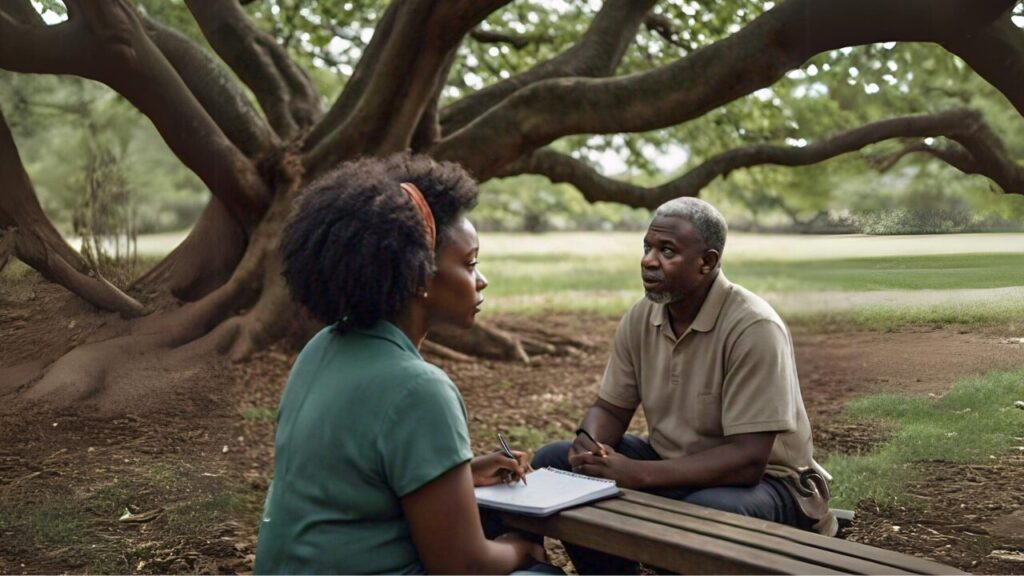
Under the ancient Iroko tree, Uncle Chidi conducts therapy sessions with Adamma. These sessions become a sanctuary where she can unravel her painful past and begin the process of healing from her childhood trauma.
Confronting the Past
With Uncle Chidi’s guidance, Adamma confronts the names of her abusers and externalizes her anger. This confrontation is a crucial step in her healing journey.
Learning to Forgive
Adamma learns that forgiveness is not about absolving her abusers but about freeing herself from the burden of anger and resentment. This lesson is pivotal in her path to liberation.
Shedding the Old Skin
Adamma slowly sheds her old identity as a promiscuous girl and begins to see herself as a survivor. She learns to embrace her vulnerability and find strength in her pain.
Genuine Connections
Her journey attracts genuine connections into her life. She meets Bola, a kind-hearted farmer, and together they build a life based on mutual respect and understanding.
Family and Hope
Adamma marries Bola and they raise a family, creating a legacy of love, compassion, and understanding. Her children grow up hearing stories of resilience and forgiveness.
Beacon of Hope
Adamma becomes a beacon of hope in her village, listening to others’ stories and offering encouragement just as Uncle Chidi did for her. She helps others see that healing from childhood trauma is possible, even in the darkest of times.
Conclusion
Adamma’s transformation from a figure of judgment to one of resilience and strength is a testament to the power of compassion, vulnerability, and forgiveness. Her journey underscores the importance of safe spaces, supportive figures, and the healing power of storytelling. In facing her pain head-on, Adamma not only heals herself but also becomes a source of hope and inspiration for others.
The Lessons.
1. Judgment and Compassion
True understanding comes from compassion, not judgment.
2. Vulnerability
Embracing vulnerability is a path to healing and growth.
3. Forgiveness as Liberation
Forgiveness is a gift we give to ourselves, not just to others.
4. The Impact of Unresolved Trauma
Unresolved trauma can manifest in harmful behaviors, but facing it can lead to healing. Adamma’s promiscuity was a coping mechanism for her unresolved childhood traumas.
5. The Importance of Safe Spaces
Safe, non-judgmental spaces are crucial for effective healing and self-expression.
6. The Role of a Supportive Figure
A compassionate guide can help navigate the path to self-discovery and healing.
7. Finding Self-Worth Beyond Mistakes
One’s past does not define one’s future; redemption is possible.
8. Seeking Fulfillment Through Authentic Connections
True fulfillment comes from genuine relationships, not superficial encounters.
9. The Healing Power of Storytelling
Sharing one’s story can be a powerful tool for both personal healing and helping others.
10. The Interconnection of Pain and Strength
Strength often emerges from the confrontation of pain and adversity
Proverbs 3:5-6 (NIV): “Trust in the Lord with all your heart and lean not on your own understanding; in all your ways submit to him, and he will make your paths straight.”
In the heart of the African savannah, within a small village, lived a woman named Judith, known for her sharp tongue and unkind heart. Judith was married to Chidi, a quiet businessman who was often away, leaving Judith dissatisfied and seeking a lavish lifestyle. They had a daughter named Helen, who, influenced by her mother’s harsh ways and her father’s absence, felt rejected and struggled with a lack of affection and guidance.
The Unkind Mother
Judith’s behavior was characterized by constant comparisons with others and a disregard for her family’s needs. Her unkindness extended to her daughter, Helen, who grew up feeling rejected and craving her mother’s approval. Despite her father Chidi’s efforts to provide for the family, his frequent absences left a void that Judith failed to fill with love and nurturing.
Helen’s Struggles
Helen’s childhood was marked by a lack of affection and a desire to seek validation. One poignant incident on her tenth birthday highlighted her mother’s neglect. Helen’s heart hardened over time, leading her to seek validation through material possessions and relationships with older, wealthy men. Her life became a pursuit of fleeting pleasures, which left her feeling empty, unfulfilled and rejected.
The Role of Mama Adama
Amidst the turmoil, Helen’s grandmother, Mama Adama, never ceased praying for her. Known for her deep faith, Mama Adama believed in the power of mercy and the strength of prayer. Her prayers and unwavering hope played a crucial role in Helen’s eventual transformation.
A Life-Changing Diagnosis
Helen’s reckless lifestyle led to a severe health crisis. Diagnosed with a terminal illness, and rejected by all, she faced her mortality with despair. However, it was during this darkest hour that a miraculous event occurred, bringing healing and hope to her life. This divine intervention was a response to Mama Adama’s fervent prayers.
The Miraculous Healing
Helen’s miraculous recovery baffled doctors and brought about a significant change in her outlook on life. She experienced a divine presence that filled her with peace and renewed faith. This miracle marked the beginning of a transformation that affected not only Helen but her entire family.
Reconciliation and Redemption
With her newfound health, Helen sought forgiveness from her parents and committed to living a life of kindness and humility. Judith and Chidi, moved by their daughter’s change, also sought to amend their ways. Judith, in particular, learned the importance of love and nurturing, seeking guidance from her mother and the village elders.
The Power of Community
The village played a vital role in the family’s transformation. The support and wisdom from the community helped Judith and Chidi reconnect with their roots and offer kindness where they once gave none. The story of their transformation became a testament to the power of faith, love, and communal support.
Lasting Lessons
Helen’s story left a lasting impact on the village, teaching valuable lessons about the importance of family, the power of prayer, and the need for love and nurturing. It became a cherished tale passed down through generations, reminding everyone that no heart is too hard to be softened by love, and no life is beyond redemption.
Conclusion
The story of Helen, Judith, Chidi, and Mama Adama underscores the transformative power of love, faith, and community. It highlights the importance of family bonds, the consequences of neglect, and the miraculous potential of unwavering faith. Their journey from neglect and materialism to reconciliation and redemption serves as a powerful reminder of the enduring strength of love and the possibility of second chances.
Key Points
1. Family First, Always
Prioritizing genuine family bonds over material wealth is essential.
2. Love and Nurturing Matter
Kindness and a nurturing environment are crucial for healthy growth.
3. Your Actions Have Consequences
One’s actions shape not just one’s life but also others’ lives.
4. Don’t Compare, Just Appreciate
Constant comparison breeds unhappiness; appreciate what you have.
5. Supernatural Backup
Strong support systems and genuine care make a significant difference.
6. Second Chances Exist
It’s never too late to turn around and make things right.
7. Materialism Isn’t Everything
True fulfillment comes from within and meaningful relationships.
8. The Power of Faith
Mama Adama’s faith brought miraculous change to the family.
Epic Tale of Faith and Miracles: King Ayomide’s Journey
Introduction
In the ancient African city of Ilese, King Ayomide ruled with wisdom and strength. Despite his respected position, he faced a profound sorrow: his four beautiful wives, chosen from across the land, could not bear children. This left the king and the entire empire deeply concerned, as there were no heirs to continue his legacy. In a turn of events, three of the wives chose to leave, believing the king to be the one unable to father children. Only Queen Adefolake remained loyal, believing in faith and miracles.
Encounter with Faith
One day, a traveling preacher arrived in Ilese, speaking of God’s power, promise, faith and miracles. He approached King Ayomide with a prophecy, saying, “Your faith will be tested, O King, but put your trust in God, for He will always show up in your hour of need.” These words deeply resonated with King Ayomide and Queen Adefolake, who began to question whether their barrenness was a curse from the gods or a test of faith from a higher power.
A Crossroads of Belief
Traditionally, the people of Ilese consulted the oracle for guidance, believing in the power of ancestral spirits and rituals to shape their destiny. The oracle was revered as the intermediary between the people and their gods, and its decrees carried significant weight. However, the preacher’s message of God’s love and power caused the royal couple to reconsider their beliefs. In private, King Ayomide wrestled with the decision: to continue venerating the oracle or to embrace the teachings of Jesus Christ.
A Bold Decision
The pressure mounted as the palace buzzed with speculation and fear. Some advisors warned of dire consequences if the king turned his back on the oracle—a wrathful punishment that could claim his life and plunge the kingdom into chaos. Despite these warnings, King Ayomide chose to put his trust in God, embracing His faith and miracles. Ignoring the ominous warnings and the counsel of his chiefs, he declared his allegiance to Jesus Christ and committed himself and Queen Adefolake to a life of prayer and devotion.
Miraculous Events
As days turned into weeks, the tension within the palace grew palpable. Whispers of rebellion and dissent among the courtiers circulated. Yet, King Ayomide remained resolute, his resolve for faith and miracles drew from the teachings of the preacher and the unwavering support of Queen Adefolake. Then came the day of reckoning when the oracle’s priests confronted the king with solemn warnings of impending doom. But nothing happened. Instead, a profound peace settled over King Ayomide’s heart—a peace that affirmed his decision and strengthened his resolve.
Answered Prayers
True to God’s promise, in His appointed time, Queen Adefolake became pregnant, a miracle that filled the kingdom with joy. For nine months, the people of Ilese rejoiced, eagerly awaiting the birth of the heir. When the time came, Queen Adefolake delivered two healthy baby boys, Adesina and Adedayo. The entire empire celebrated this joyous occasion, praising God for His blessings.
Betrayal and Despair
However, the three former wives, consumed by envy and bitterness, plotted a sinister scheme. One moonless night, cloaked in darkness, they crept into the royal chamber and stole the sleeping infants from their cradles. The palace guards, loyal but unsuspecting, were deceived by the stealth of the wives. By the time their treachery was discovered, the three wives had disappeared into the night, leaving behind a distraught king and a devastated community.
Faith Amidst Grief
King Ayomide, in anguish, declared a bountiful reward for anyone who could find and return his beloved sons. The kingdom was thrown into mourning, but King Ayomide remembered the preacher’s words: “Put your trust in God, for He will always show up.” Rejecting the counsel of his chiefs to consult the oracle, he declared a time of fasting and prayer throughout Ilese. He called upon the entire community to join him in seeking God’s intervention, urging them to put aside their mourning garments and lift their hearts in faith.
Jubilation in Faith
During this time, King Ayomide made a bold declaration: amidst the fasting and prayers, he announced seven days of jubilation and praise unto God. This proclamation bewildered his chiefs and the people of Ilese. Yet, the king insisted, “Our celebration is an act of faith and miracles. We are not rejoicing in the loss but in the assurance that God is with us, even in this darkest hour.” Despite initial confusion, the people of Ilese obeyed their king, joining in fasting, prayer, and songs of faith and miracles.
A Miraculous Change
As the days of jubilation unfolded, a miraculous change began to sweep through the kingdom. The air seemed lighter, and the people’s hearts were lifted by their collective act of faith. Even the most skeptical of the chiefs could not deny the palpable presence of hope and divine assurance that settled over Ilese. Meanwhile, the three wives, fearing the consequences foretold by the oracle, returned the royal twins to the palace.
Restoration and Gratitude
The return of Adesina and Adedayo brought immense relief and joy to the kingdom. King Ayomide, filled with gratitude and awe at God’s faithfulness, ordered the traitorous wives to be cast into the deepest dungeons as punishment for their betrayal. In recognition of God’s mercy, King Ayomide declared that henceforth, the people of Ilese must serve God all their days. The city erupted in jubilation, celebrating the safe return of the twins and the reaffirmation of their faith under God’s divine protection
Lessons
1. Faith in God:
King Ayomide’s steadfast faith in God’s promise, despite overwhelming challenges, demonstrates the power of trusting in divine guidance even in times of despair.
2. Choosing Faith over Fear:
When faced with adversity, King Ayomide chose to trust in God rather than seeking immediate worldly solutions. This teaches the importance of placing faith above fear and uncertainty.
3. The Power of Prayer and Fasting:
Through prayer and fasting, King Ayomide and the people of Ilese sought divine intervention. This underscores the strength found in communal prayer and spiritual discipline during trials.
4. Celebrating in Faith:
King Ayomide’s decision to declare days of jubilation and praise amidst mourning reflects the faith-driven celebration of God’s promises, even before seeing tangible outcomes.
5. Divine Providence and Deliverance:
The safe return of Adesina and Adedayo underscored God’s faithfulness and intervention in protecting the innocent and thwarting evil intentions.
6. Gratitude and Humility:
King Ayomide’s gratitude and humility in recognizing God’s mercy and deliverance reinforce the importance of thankfulness and humility in times of blessing and trial alike.
In a small village nestled between rolling hills and lush forests in the heart of Africa, lived a man named Kofi. Known for his wisdom, kindness, and unwavering faith, Kofi was a respected figure in his community. This is the story of his life, the tragedy that befell his family, the trials they faced when a new woman entered their lives with ill intentions, and how the stepmother’s secret was exposed.
Life Before Tragedy
Kofi was happily married to Ama, a woman of gentle spirit and nurturing nature. Together, they had two children, Kwame and Akua. Ama was not only a devoted wife and mother but also a pillar of strength in the community, always ready to lend a helping hand.
The Tragic Loss
One stormy night, Ama tragically lost her life while gathering herbs for a sick neighbor. The village mourned with Kofi and his children, who were left to navigate life without her. Kofi’s faith in God became his anchor, guiding his family through their grief.
The Arrival of Afia
Years after Ama’s death, Kofi met Afia, a woman with a tragic past. Despite warning signs from God, Kofi, driven by loneliness and longing for companionship, married her. Afia’s beauty and charm clouded his judgment, leading him to overlook his unease.
Disruption of Harmony
Afia’s arrival brought darkness into Kofi’s home. She resented Kwame and Akua, seeking to turn Kofi against them. One of the stepmother’s secrets was that she visited a local herbalist for potions to manipulate Kofi’s mind, filling his ears with lies about his children’s ingratitude and disobedience.
The Revelation
Despite Afia’s cruelty, Kwame and Akua remained steadfast in their faith. One Sunday, after a service with Pastor Mensah, they were filled with the Holy Spirit and had a revelatory dream. They saw their stepmother’s secret and were told to keep praying and not confront their father.
Divine Guidance
Kwame and Akua’s dreams instructed them to trust in God’s plan. They prayed fervently and read the Bible together, drawing strength from their faith. They endured Afia’s harsh treatment with grace, knowing justice would come in God’s time and their stepmother’s secret would soon be exposed.
The Confession
One night, while Afia was away with her lover, Kwame and Akua felt a deep sense of peace. The next day, during a village gathering, Afia’s lover confessed their affair publicly, and to Kwame and Akua, exposing their stepmother’s secret. The villagers and Kofi were shocked, and Afia admitted to her actions.
Kofi’s Repentance and Reconciliation
Kofi, heartbroken and repentant, sought forgiveness from Kwame and Akua. Despite their suffering, the children forgave their father, thanking God that their stepmother’s secret was finally exposed and their family bond was restored. The villagers, who had once welcomed Afia, now turned their backs on her.
Lessons Learned
Faith and Resilience
Kofi’s family’s journey highlights the importance of faith, patience, and resilience. Their story shows that love and forgiveness can overcome even the greatest trials.
Divine Justice
Afia’s downfall serves as a reminder that justice, though sometimes delayed, is inevitable. Kwame and Akua’s experience of divine intervention underscores the belief that a higher power is always watching over and guiding the faithful.
Conclusion
Kofi, Kwame, and Akua emerged from their trials stronger and more united. Their story is a testament to the power of faith, love, and resilience. It serves as an inspiration to trust in divine justice and remain steadfast in the face of adversity.
Key Points
• Cheaters Never Prosper:
Afia’s deceit led to her downfall, showing the consequences of dishonesty.
• Patience and Forgiveness Win:
Kwame and Akua’s patience and love highlight the power of responding to hatred with grace.
• Pray and Slay:
The siblings’ dedication to prayer provided them strength, emphasizing the importance of spiritual connection.
• Justice Will Be Served:
Afia’s exposure and punishment affirm that justice is inevitable.
• Bounce Back:
Kofi and his children’s resilience demonstrates the ability to rebuild and emerge stronger after adversity.
• Divine Intervention:
The revelations received by Kwame and Akua emphasize the presence of a higher power guiding them.
• Ignoring Red Flags:
Kofi’s dismissal of warning signs about Afia shows the dangers of ignoring intuition.
Rescued from Shadows: Chioma’s Encounter with a Ritualist: Chioma’s Encounter with a Ritualist
Introduction
In a vibrant Nigerian village, a young lady named Chioma finds herself in a perilous situation due to her impatience and ambition. Her journey from a high-maintenance lifestyle to a path of redemption illustrates powerful lessons about the dangers of materialism and the importance of faith, love, and integrity.
Want to see full story in action? Check below:
Chioma’s Desires and Decisions
Chioma is an ambitious and impatient young woman who dreams of a lavish lifestyle. She prefers the company of wealthy, older men, believing that they can provide her with the luxury she desires. Despite repeated warnings from her family and friends, she disregards their concerns and continues to date older men solely to sustain her high-maintenance lifestyle. Chioma’s single-minded pursuit of wealth blinds her to the potential dangers of her choices.
Family’s Concerns and Prayers
Throughout her tumultuous journey, Chioma’s grandmother never ceases to pray for her. Day and night, she lifts Chioma up in prayer, beseeching God for her protection, guidance, and redemption. Her family’s concerns grow as Chioma’s relationships become increasingly risky, but their warnings fall on deaf ears.
Meeting Chief Okoro
Chioma meets Chief Okoro, a wealthy and influential man known for his mysterious ways. Despite numerous warnings and rumors about his secretive lifestyle, Chioma is drawn to his wealth and the luxurious life he promises. Her family and friends plead with her to reconsider, emphasizing the potential dangers of her choice. However, Chioma, blinded by the allure of luxury, refuses to listen.
The Lure of Luxury
Chioma enjoys the lavish gifts, extravagant parties, and the envy of her peers. However, beneath the surface, Chief Okoro harbors dark secrets. Unbeknownst to Chioma, his wealth is sustained through dark and dangerous means as he is a ritualist. Her quest for a fast life leads her straight into a serious and perilous predicament.
The Turning Point
Chief Okoro promises Chioma a trip to London, a city she has always dreamed of visiting. Eager to embrace this glamorous opportunity, Chioma agrees, ignoring her doubts. As they make their way to a final meeting to arrange their travel plans, Chioma feels uneasy but brushes it aside. Upon arrival at a secluded location, Chioma is led into a dimly lit room where Chief Okoro’s true intentions become apparent. She is drugged and kidnapped, realizing too late the gravity of her situation.
Ade’s Intervention
Ade, a young hunter, hears Chioma’s cries for help while tracking a deer in the forest. Ade, who has been praying for a wife and believes in a divine message that he will save his future wife, rushes to Chioma’s location. Without hesitation, he abandons his hunt and fights off Chief Okoro’s henchmen to rescue her. His bravery and determination shine through as he overpowers the henchmen and saves Chioma from the ritualist’s den.
A New Beginning
Chioma’s being rescued from shadows marks a turning point in her life. She realizes the folly of her previous pursuits and embraces a life of love and faith with Ade. Ade supports her transformation, helping her grow in faith and character. Together, they build a humble but fulfilling life based on mutual respect and faith in God.
Justice for Chief Okoro
Months later, Chief Okoro is brought to justice. Chioma bravely testifies against him, revealing his atrocities and how she was rescued from shadows. During the trial, it is revealed that Chief Okoro is Ade’s estranged father, adding a dramatic twist to the narrative. Despite this revelation, Ade forgives Chioma, and their bond strengthens as they face the challenges of their intertwined pasts with courage and faith.
Conclusion
Chioma and Ade’s story becomes a testament to the power of God’s grace and the transformative journey of redemption. They live a life filled with love, faith, and true happiness, inspiring others in their village to seek true love and righteousness. Their story highlights the importance of integrity, the power of prayer, and the value of genuine love and sacrifice.
Lessons Learned
1. Don’t Chase Clout Over Character:
Chioma learns that chasing wealth and status without considering values and integrity can lead to dangerous situations.
2. Love Means Sacrifice
Ade’s actions show that real love involves sacrificing for someone’s well-being, even when it’s tough.
3. Prayer Works
Chioma’s grandmother’s unwavering prayers significantly impact Chioma’s life, illustrating the power of faith and spirituality.
4. Expose the Dark Stuff
Discovering Chief Okoro’s shady past highlights the importance of facing and overcoming ugly truths to move forward.
5. Forgive and Move On
Ade’s forgiveness towards Chioma, despite their intertwined pasts, underscores the healing power of forgiveness.
6. Choose Values over Trends
Chioma’s shift from a flashy lifestyle to one based on love and faith with Ade demonstrates that real happiness comes from staying true to one’s values.
Ada, a young woman of both beauty and intellect, found herself thrust into a marriage of obligation rather than choice. Her union with Okeke, the son of a wealthy trader, was born from her family’s desperate need to settle hospital bills for her ailing brother. Despite her hopes for a loving partnership, Ada encountered a reality far removed from her dreams.
Okeke, a man hardened by privilege and entitlement, wielded his authority over Ada with a callousness that left scars deeper than physical bruises. From the early days of their marriage, he asserted dominance over every aspect of Ada’s life. His disdain for her dreams and aspirations was palpable, and his treatment of her swung between icy neglect and explosive rage.
Ada, determined to make her marriage work despite the challenges, silently bore the brunt of Okeke’s unpredictable temper. She had always been taught that a woman’s duty was to endure, to keep the peace at any cost. Her own dreams of love and companionship faded into the background as she focused on surviving each day.
When their son Chika was born, Ada hoped that the arrival of their child would soften Okeke’s heart, but it only seemed to amplify his cruelty. Okeke viewed Chika as an extension of himself, a legacy to mold in his own image. He showed little interest in fatherhood beyond the superficial, leaving Ada to navigate the complexities of parenting alone.
As Chika grew older, he became a witness to his parents’ tumultuous relationship. He saw the fear in his mother’s eyes and the cold detachment in his father’s demeanor. Despite Ada’s efforts to shield him from the worst of Okeke’s outbursts, Chika’s young mind couldn’t help but absorb the tension that permeated their home.
Tragically, Okeke’s life was claimed by a terminal illness when Chika was just five years old. In the aftermath, Ada found herself thrust into a new nightmare. Okeke’s family, always suspicious of her humble origins and blaming her for their son’s illness, made it clear that she was no longer welcome in their midst. With Chika in tow, Ada was forced to leave the comfort of the only home she had known, picking up the pieces of a shattered life.
Desperate and destitute, Ada was vulnerable when Emeka, a man from her community, offered her a lifeline in the form of marriage. Emeka was kind at first, offering the stability and security that Ada desperately craved. Yet, beneath his charming facade lurked a darkness that Ada had grown all too familiar with.
Emeka’s abuse started subtly, with cutting remarks and possessive behavior. Ada, scarred by her previous experiences, initially dismissed it as her own paranoia. But as their marriage progressed, Emeka’s true nature emerged in full force. He controlled Ada’s every move, isolating her from her friends and family, and subjected her to verbal and physical abuse behind closed doors.
Chika, now a sensitive and withdrawn boy, bore witness to the renewed cycle of violence in his mother’s life. He saw her bruises and heard her tearful apologies, feeling powerless to protect her from Emeka’s wrath. The once vibrant and athletic boy retreated into himself, finding solace only in books and solitary activities that shield him from the harsh realities of his home life.
Despite her own suffering, Ada remained determined to shield Chika from the worst of Emeka’s abuse. She patched up his wounds, both physical and emotional, and whispered words of comfort in the darkness of their shared bedroom. But as Chika grew older, resentment and anger simmered beneath his calm exterior. He despised Emeka for the pain he inflicted on his mother, yet felt helpless against the looming presence of his stepfather.
Amidst the chaos of their home life, Chika discovered an outlet for his frustrations on the sports field. His natural athleticism and determination caught the attention of his school’s coaches, propelling him into the spotlight as a rising star in various track and field events. Ada watched with bated breath as her son found temporary reprieve in his achievements, hoping against hope that it would provide him with an escape route from their turbulent reality.
Chika’s talents soon earned him accolades beyond their small town. He represented his school, then his state, in regional competitions, his speed and agility becoming a source of pride and hope for Ada. When he was selected to represent his country in an international competition, it felt like a miracle—a chance for Chika to break free from the suffocating grip of their past.
But even as Chika soared to new heights on the track, the scars of his upbringing continued to haunt him. The specter of his stepfather’s abuse lingered in his subconscious, shaping his interactions and relationships in ways he couldn’t fully comprehend.
It was during this tumultuous period that Chika met Abigail, a fellow athlete with a kind heart and a gentle spirit. Abigail saw beyond Chika’s stoic facade, recognizing the pain and vulnerability that lay beneath. They found solace in each other’s company, their shared passion for sports providing a bond that transcended words.
Yet, as their relationship deepened, Chika found himself wrestling with unfamiliar emotions. The bitterness and anguish he had endured at the hands of Emeka seemed to seep into his own soul, tainting his interactions with Abigail. He withdrew into himself, pushing her away with harsh words and thoughtless actions, mirroring the hurtful patterns he had witnessed all his life.
Abigail, bewildered and hurt by Chika’s sudden transformation, confronted him with compassion and honesty. She refused to accept his abusive behavior, challenging him to confront the demons that threatened to derail their budding relationship. It was a wake-up call for Chika, a painful reckoning with the legacy of pain and violence that had shaped his understanding of love and intimacy.
With Abigail’s unwavering support, Chika took the first tentative steps towards healing. He sought therapy and counseling, unraveling the tangled knots of his past traumas with each session. It was a journey fraught with setbacks and breakthroughs, moments of despair followed by glimpses of hope.
As Chika delved deeper into his own healing process, he discovered a newfound purpose in helping others who had experienced similar hardships. He volunteered at local shelters and youth centers, offering guidance and support to young boys and girls who, like him, had known the sting of abuse and neglect. His athletic prowess became a tool for empowerment, inspiring others to believe in their own strength and resilience.
Meanwhile, Ada found her own path to healing and empowerment. Through sheer determination and unwavering faith, she rebuilt her life from the ground up. She pursued higher education, securing a stable job that provided financial independence and stability for herself and Chika. With each obstacle she overcame, Ada grew stronger in spirit, reclaiming the sense of agency that had been stripped away during her tumultuous marriages.
As Chika and Ada’s individual journeys of healing converged, their bond as mother and son deepened into a partnership built on mutual respect and admiration. Chika’s transformation from a frightened boy into a compassionate and empathetic young man filled Ada’s heart with pride and gratitude. Together, they celebrated each milestone—Chika’s academic achievements, his continued success in athletics, and his burgeoning career as a mentor and advocate for abuse survivors.
In time, Chika found the courage to confront Emeka, not out of vengeance, but out of a desire for closure and forgiveness. Their meeting was fraught with tension and painful memories, but Chika emerged from it with a newfound sense of liberation. He no longer carried the weight of his stepfather’s abuse like a millstone around his neck. Instead, he embraced his own journey of healing, knowing that he had the power to break the cycle of violence that had threatened to consume him.
With Abigail by his side, Chika forged a path forward—one defined by compassion, understanding, and a commitment to justice. Together, they founded a nonprofit organization dedicated to supporting survivors of domestic abuse, offering resources and refuge to those in need. Their work became a beacon of hope in their community, inspiring others to speak out against injustice and champion the rights of the vulnerable.
As Chika and Abigail’s love story blossomed into marriage, Ada found herself at peace, knowing that her son had found a partner who cherished and supported him unconditionally. She watched with pride as Chika and Abigail welcomed their own children into the world, raising them in a home filled with love, respect, and empathy.
Ada, too, found love in her later years—a kind and gentle man who saw her strength and admired her resilience. Their union was one of equals, built on mutual trust and shared values. Together, they embarked on new adventures, savoring the simple joys of companionship and companionship.
1. The Cycle of Abuse and Healing:
Ada and Chika’s story vividly illustrates how abuse can perpetuate itself through generations if left unaddressed.
2. Have Courage to Seek Help:
Both Ada and Chika demonstrated immense courage in seeking help to break free from their past traumas.
3. Breaking the Silence:
Ada and Chika’s openness about their experiences with abuse helped break the silence surrounding domestic violence.
4. Choosing Healthy Relationships:
Abigail’s unconditional love and support became a catalyst for Chika’s healing, while Ada found happiness in a relationship built on mutual respect and equality.
5. Empathy and Compassion:
Chika’s transformation into a mentor and advocate highlights the profound impact of empathy and compassion.
6. Forgiveness and Closure:
Both Ada and Chika’s journeys involved confronting their pasts, including forgiving those who had hurt them.
7. Self-discovery and Personal Growth:
Ada and Chika’s paths to healing were journeys of self-discovery and personal growth.
In the vibrant city of Lagos, Nigeria, where the pulse of life beats through crowded streets and bustling markets, lived Loveth, a driven and ambitious young woman navigating the complexities of modern dating. As a talented marketer with dreams of launching her own digital agency, Loveth’s days were filled with meetings, strategy sessions, and the constant buzz of city life. Yet, amidst her professional pursuits, she found herself increasingly isolated in her personal life, as no love story had been written about her.
Her close-knit circle of friends, once her pillar of support, had dispersed across the globe in pursuit of their careers. Weekends that used to be filled with laughter and shared adventures now passed quietly, with only the hum of her laptop and occasional phone calls to punctuate the solitude. Loveth craved companionship—a connection that could bridge the gap between her career aspirations and her longing for emotional fulfillment.
One evening, as she sat alone in her cozy apartment overlooking the city skyline, Loveth found herself scrolling through profiles on a popular dating app. The glowing screen cast a soft light across her face as she swiped left and right, her heart skipping a beat with each new profile that appeared. She had heard stories—both heartwarming and cautionary—about online dating, but Loveth, ever the optimist, believed in the possibility of finding and perhaps writing her love story in the digital age.
It was then that she came across Ade’s profile—a handsome, well-dressed entrepreneur based in Accra, Ghana. His photos exuded confidence and warmth, and his bio spoke of his passion for travel and his successful ventures in the tech industry. Intrigued, Loveth swiped right, initiating a connection that would alter the course of her love story.
Their initial conversations were effortless, filled with witty banter and shared interests. Ade’s messages were thoughtful and engaging, each one deepening the bond between them. They spoke about their dreams and aspirations, their favorite cuisines, and their love for West African culture. As the days turned into weeks, Loveth found herself looking forward to their late-night video calls, where they would discuss everything from business strategies to personal philosophies.
Loveth’s friends, concerned about her growing attachment to someone she had never met in person, gently voiced their apprehensions. They warned her about the dangers of online dating—stories of deception, financial scams, and broken hearts. But Loveth swept up in the excitement of newfound connection, dismissed their concerns. She believed she had found a kindred spirit in Ade, someone who understood her ambitions and shared her values.
Months passed, and Loveth’s feelings for Ade deepened. They made plans to meet in person, discussing potential travel dates and imagining their future together. Loveth shared her hopes and dreams with Ade, trusting him with intimate details of her life that she had rarely divulged to others. She was captivated by his charm, his intelligence, and the way he made her feel seen and valued. Seems her love story was eventually coming into play.
Yet, amidst the intoxicating rush of emotions, there were subtle signs that Loveth chose to overlook. Ade’s explanations for postponing their meetings grew increasingly elaborate, citing business trips and unexpected emergencies that kept him away. He assured Loveth of his commitment and apologized profusely for the delays, promising that their time together would come soon and their love story would be great.
One evening, as Loveth sat alone in her cozy apartment, the soft glow of her laptop illuminated her face as she scrolled through messages and notifications. Among them was a message from Ade. Ade’s messages were always filled with enthusiasm and ambition, qualities that resonated deeply with Loveth, a driven and ambitious young woman herself.
Ade’s latest message sparked excitement as he shared news of a lucrative business opportunity in Ghana. He painted a vivid picture of a thriving market ripe for investment, promising substantial returns and the potential to establish a business empire together. Loveth, buoyed by her trust in Ade, fueled by her own entrepreneurial spirit, and determined to scribble her love story, saw this as more than just an investment opportunity—it was a chance to forge a meaningful partnership and achieve financial success.
Despite the late hour, Loveth eagerly engaged with Ade, discussing the details of the venture and envisioning a future where their combined efforts would lead to prosperity. Ade’s persuasive words and convincing arguments swayed Loveth’s decision, and without consulting her business partners or conducting due diligence, she agreed to invest a substantial sum of money from her company’s funds into the venture.
In her eagerness to support Ade and seize what seemed like a golden opportunity, Loveth overlooked crucial steps that prudent business practices would demand. The investment was a significant risk, not just financially but also ethically, as she had committed company resources without proper authorization or a clear understanding of the venture’s risks.
Days turned into weeks, and Loveth awaited updates and progress reports from Ade. Each time she inquired about the status of their investment, Ade reassured her with promises of imminent success and lucrative returns. However, as time passed and the promised deadlines approached, Loveth’s initial excitement began to wane, replaced by growing unease and uncertainty.
It wasn’t until a routine audit by her company’s financial advisor that discrepancies began to surface. The advisor, scrutinizing recent transactions and expenditures, flagged the substantial withdrawal from company funds that Loveth had authorized for the investment in Ghana. Concerned about the lack of documentation and detailed records supporting the investment, the advisor approached Loveth with probing questions.
Faced with the scrutiny and the realization of the potential consequences, Loveth’s world began to unravel. She realized the gravity of her impulsive decision and the breach of trust she had committed against her business partners and stakeholders. The company’s financial stability was now at risk, compounded by the uncertainty surrounding the legitimacy and viability of the investment in Ghana.
As the implications of her actions became clearer, Loveth faced a difficult reckoning. She was confronted not only with the financial ramifications but also with the ethical dilemma of her breach of fiduciary responsibility. Her trust in Ade had clouded her judgment, leading her to prioritize personal ambition over the prudent management of company resources.
In the ensuing weeks, Loveth navigated the fallout of her decision with a mixture of regret, determination, and a resolve to make amends. She cooperated fully with the company’s investigation into the matter, providing transparency and accountability to mitigate the financial losses and restore trust among her colleagues and partners.
Days turned into weeks, and Loveth’s anticipation for their meeting grew stronger. Yet, each time she pressed Ade for concrete plans, he deflected with vague excuses and promises of soon. It wasn’t until Loveth’s tech-savvy friend, Chidi, raised concerns about Ade’s authenticity that she began to question the truth behind his facade.
With Chidi’s help, Loveth embarked on a meticulous investigation into Ade’s background. What she discovered shattered her world—a trail of deceit and deception that led to revelations about Ade’s true identity. He wasn’t the successful entrepreneur he claimed to be; instead, he was a seasoned scammer wanted across multiple African countries for financial fraud and manipulation.
Heartbroken and devastated by the betrayal, Loveth confronted Ade through a tense and tearful video call. His demeanor shifted from charming to defensive, as he attempted to justify his actions with hollow apologies and empty promises. Loveth, shaken to her core, demanded answers and accountability, grappling with the harsh reality of her naivety and misplaced trust.
As news of Loveth’s ordeal spread among her friends and colleagues, she found herself grappling with a mix of emotions—shame, anger, and a profound sense of loss. Her once-promising career seemed overshadowed by the financial setback caused by Ade’s scam. The dreams they had shared and the love story they hoped to write now lay shattered, replaced by a daunting road to recovery and rebuilding.
Yet, amidst the wreckage of her shattered dreams, Loveth found strength in her resilience. She bravely shared her story with others, using her experience as a cautionary tale about the dangers of online dating and the importance of vigilance. Through counseling and the unwavering support of her friends and family, Loveth slowly began to rebuild her life, piece by piece.
Her journey of healing was marked by moments of introspection and self-discovery, as she learned to trust herself and her instincts again. She found solace in her work, pouring her energy into building her digital agency and mentoring young women in the tech industry. Through her vulnerability and courage, Loveth emerged stronger and wiser, determined to turn her pain into purpose and re-write her love story.
In the urban sprawl of Lagos, Loveth’s love story served as a cautionary reminder of the dangers lurking behind screens and the importance of navigating the digital world with vigilance and discernment. It was a story of resilience, redemption, and the enduring power of hope amidst adversity—a story that echoed across the city streets, a testament to Loveth’s unwavering spirit and determination to reclaim her life.
Lessons.
1. Vigilance in Online Relationships:
Loveth’s love story underscores the importance of exercising caution and vigilance when forming relationships online. While technology has made it easier to connect with others, it’s crucial to verify information and be wary of red flags, such as evasiveness or inconsistency in communication.
2. Trust, but Verify:
Trust is an essential component of any relationship, but it should be accompanied by verification. Loveth’s experience highlights the pitfalls of placing blind trust in someone without verifying their background, intentions, and claims.
3. Awareness of Online Scams:
The story serves as a stark reminder of the prevalence of online scams and the tactics used by fraudsters to exploit vulnerable individuals. Awareness of common scams and staying informed about online safety measures can help prevent falling victim to deception.
4. Seeking Advice from Trusted Sources:
Loveth’s hesitation to heed warnings from her friends about the risks of online dating illustrates the importance of seeking advice from trusted sources. Consulting with friends, family, or professionals can provide valuable insights and perspectives that may uncover potential risks.
5. Recovery and Resilience:
Despite the devastating impact of the scam on Loveth’s finances and emotions, her journey of recovery highlights the resilience of the human spirit. The love story emphasizes the importance of getting up after falling.
From Neglect to a Vicious Life: Sade’s Untold Story
In the heart of Yoruba land, lay the bustling city of Lagos. Life in Lagos was a blend of vibrant market scenes, the rhythmic sounds of traditional drums, and the soft, comforting murmur of the Bar Beach. It was here that Sade’s story unfolded, marked by neglect, sorrow, rebellion, and eventual redemption.
Sade, a delicate girl with eyes that held the depth of neglect and unspoken sorrows, often found herself lost in the shadows of her parents’ ambitions. Her small frame seemed to shrink even further in the vast emptiness of their modest home, where laughter and warmth were as scarce as water in the dry season.
Her father, Mr. Williams, was a transporter whose life was measured in miles rather than moments. His weathered hands gripped the steering wheel of his battered truck from dawn to dusk, navigating treacherous roads that snaked between distant cities. The constant rumble of the engine had become more familiar to him than the sound of neglect from his daughter’s voice. When he did return home, his eyes were heavy with exhaustion, barely registering Sade’s eager face before he collapsed into a dreamless sleep.
Mrs. Williams, a petty trader at the bustling local market, lived in a cacophony of bartering and gossip. Her days were a blur of haggling over yams, peppers, and second-hand clothes, her shrill voice rising above the din as she fought for every kobo. The market had become her world, its rhythms dictating her life more surely than the rising and setting of the sun. In the rare moments when she thought of home and its neglect, it was with a mixture of guilt and justification – surely her hard work would pay off someday, giving Sade the life she deserved.
Their relentless pursuit of a better life had become an all-consuming obsession, leaving no room for the present, no time for the small joys of family life. Sade had become an afterthought, a vague future beneficiary of their sacrifices rather than a living, breathing child in need of love and attention.
In their absence, Sade was left in the care of her older cousins, a decision made more out of necessity than consideration. These cousins, themselves products of neglect and hardship, saw Sade not as a child to nurture but as a burden to bear. Their resentment manifested in subtle cruelties – a sharp word here, a missed meal there, and sometimes, in the dark of night, far worse transgressions that Sade dared not speak of.
As days bled into weeks and months, Sade’s world shrank to the confines of her loneliness. She learned to move silently through the house, to make herself invisible, to swallow her tears and longings. Her eyes, once bright with childish wonder, grew deep and sorrowful, holding secrets too heavy for her young heart to bear. In the rare moments when her parents were home, Sade would watch them from afar, a stranger in her own family, yearning for a connection that seemed forever out of reach.
The shadows of Lagos’s lush forests paled in comparison to the darkness that engulfed Sade’s young life. Her cousins, entrusted with her care, became the architects of her nightmares. Ade, the eldest at seventeen, led the pack with a malevolent glint in his eyes. His sister, Funmi, two years his junior, was no less cruel, her soft voice a deceptive mask for her sadistic nature. The youngest, fourteen-year-old Bode, followed his siblings’ lead, eager to prove his own capacity for cruelty.
Their abuse began subtly – a pinch here, a harsh word there – but quickly escalated into a reign of terror. In the dead of night, when the city was cloaked in darkness, they would creep into Sade’s room. Ade’s calloused hands would clamp over her mouth, muffling her screams as Funmi and Bode took turns inflicting their twisted desires upon her small, fragile body.
“If you breathe a word of this to anyone,” Ade would hiss, his breath hot against her ear, “we’ll throw you into the Bar-Beach. The water spirits will drag you down, and no one will ever find your body.”
The weight of this secret crushed Sade’s spirit. At five years old, she bore a burden that would break even the strongest adult. Her once melodious laughter, which had rung through the compound like little bells, fell silent. The sparkle in her eyes dimmed, replaced by a haunted, faraway look. Joy became a foreign concept, fear her constant companion.
At school, the change in Sade was stark. Mrs. Adeyemi, her kindergarten teacher, watched with growing concern as the once vibrant child withdrew into herself. Sade’s colorful drawings of smiling families were replaced by dark scribbles and torn pages. During playtime, she would huddle in a corner, flinching at the slightest touch from her classmates.
“There’s something wrong with Sade,” Mrs. Adeyemi confided to the headmaster. “I’ve tried talking to her, but she just stares at the floor. I fear something terrible is happening at home.”
The headmaster nodded gravely. “We must inform her parents. This behavior is not normal for a child her age.”
But their concerns fell on deaf ears. When confronted, Mr. Williams waved off their worries with a tired hand. “Children go through phases,” he said dismissively. “We’re working hard to give her a good life. She’ll be fine.”
Mrs. Williams, her mind preoccupied with the day’s sales, barely registered the teacher’s words. “Sade has always been a quiet child,” she insisted. “You’re making something out of nothing.”
As her parents remained blind to her suffering, Sade retreated further into her shell. Each day became a battle for survival, each night a descent into terror. The carefree child she once was vanished, replaced by a hollow-eyed ghost who moved through life in fearful silence, carrying the weight of unspeakable horrors on her tiny shoulders.
Years passed, and Sade’s resentment towards her parents grew. By the time she entered the higher institution, she was a wild dog let loose, seeking to punish her parents through her own destruction. She dove headfirst into a life of hedonism—clubbing, smoking, and engaging in all manner of reckless behavior. She spat on the name of God, despising everything He represented. Invitations to school fellowship were met with disdain. Her heart hardened with each passing day.
On campus, Sade joined a notorious cult known as the Jezebels. Their reign of terror was unmatched; they caused chaos and instilled fear among students and faculty alike. Sade’s transformation into a force of rebellion was complete.
Her roommate, Angela, was a stark contrast. Angela was a devout Christian, her faith unwavering. She prayed fervently for Sade, often with her fellowship friends, despite Sade’s antagonistic behavior. Their coexistence was tense, and it reached a boiling point when Sade decided to exact her revenge on Angela.
In a fit of rage, Sade conspired with her boyfriends to ambush Angela. One evening, as Angela walked back from lectures, singing worship songs and praying, the boys moved in to attack. But something inexplicable happened. As they closed in, they saw Angela moving, but her legs had vanished. Fear gripped them, and they fled, convinced she was a witch.
Terrified, Sade plotted another way to rid herself of Angela. She laced some meat pies with rat poison and offered them to Angela. Angela accepted the food and ate it without hesitation. When nothing happened to her, Sade was shaken to her core. Angela then showed her the scripture that spoke of divine protection: “If they drink any deadly thing, it will not hurt them.”
Sade’s walls of anger and rebellion crumbled. She broke down and confessed her sins to Angela, who listened with compassion. Through Angela’s guidance, Sade discovered the love and mercy of Christ. It was a long journey, but step by step, she found healing and forgiveness.
Years later, Sade returned to Lagos, not as a wild rebel, but as a beacon of hope. She reconciled with her parents, who were filled with regret and sorrow for their neglect. The city that once witnessed her suffering now saw her as a testament to the transformative power of faith and redemption. Sade’s story became an inspiration, a reminder that even in the darkest times, light can find a way through.
Lessons Learned.
1. Parental Neglect can lead to Emotional and Psychological Damage. When parents fail to provide the necessary love, attention, and protection, children can suffer deep, lasting wounds.
2. Neglect often leaves children vulnerable to abuse, as seen with Sade, who suffered at the hands of her cousins.
3. Sade’s neglected state led to a noticeable decline in her academic performance and social behavior. Parents should not neglect, but be sensitive to such declines.
4. Sade’s attempt to punish her parent’s neglect by engaging in destructive behaviors only led to further harm to herself. Never try to punish people with your actions.
5. Her involvement with the Jezebels and her subsequent actions demonstrate how one bad decision can lead to another, creating a downward spiral that is hard to escape. Watch your company!
6. Despite Sade’s rebelliousness and the wrongs she committed, God’s love remained steadfast.
7. Angela’s faith and persistent prayers for Sade underscore the importance of intercessory prayer and the belief that God can change even the hardest hearts. Do not neglect anyone. Keep praying!
What To Do When He Wants You To Compromise: NYSC Camp Love
Chinwe and Emeka met during their National Youth Service Corps (NYSC) orientation at a camp in Nigeria. From the moment their eyes locked across the crowded auditorium, a spark ignited between them. Chinwe, a bright-eyed and ambitious young woman from Enugu, was immediately drawn to Emeka’s charismatic charm and confident demeanor. Emeka, a handsome and ambitious man from Lagos, was equally captivated by Chinwe’s intelligence and inner strength.
As they navigated through the rigorous NYSC training together, their bond deepened. They found themselves spending every free moment together, sharing dreams of their futures and discussing their faith. Chinwe, raised in a devout Christian family, had made a vow to remain celibate until marriage, a decision rooted deeply in her faith and personal convictions. Emeka, while initially respectful of Chinwe’s decision, soon began to test her resolve.
As they lounged beneath the star-studded sky just beyond the camp dorms, Emeka drew closer to Chinwe, his voice a tender murmur in the cool night air. His hand grazed hers delicately, a gesture filled with unspoken longing.
“Chinwe, you mean so much to me,” he began, his eyes reflecting the flickering light of distant constellations. “I believe we have something truly special, something genuine that’s worth exploring further. I want us to take our relationship to the next level.”
Chinwe’s heart fluttered with a tumultuous blend of affection and uncertainty. She cherished Emeka deeply; his warmth and unwavering attention were like a comforting embrace under the serene canopy of stars. Yet, a solemn resolve anchored her emotions.
“Emeka,” she replied softly, her words laced with a hint of apprehension. “You know my heart. I want to honor God with every part of my being, including my body. That’s something I can’t compromise on.”
Their conversation lingered in the tranquil night, the air filled with the weight of unspoken desires and steadfast convictions, under the watchful gaze of the heavens above.
Emeka let out a sigh, his frustration palpable in the furrow of his brow and the earnestness in his eyes. “Chinwe, I respect your beliefs, but can’t you see how deeply I love you? I want to demonstrate just how much you mean to me.” With a gentle motion, he produced a small box from his pocket, unveiling a delicate necklace adorned with a shimmering pendant. “I bought this for you,” he murmured softly, his voice thick with emotion. “Please, Chinwe, reconsider.”
Chinwe’s heart skipped a beat as she beheld the necklace, its beauty a testament to Emeka’s affection and care. For a moment, she felt herself sway under the weight of his love, tempted by the tangible symbol of their bond. Yet, beneath the surface of her emotions, a steadfast resolve stirred within her spirit. A quiet voice reminded her of the promises she had made—to herself and to God. She recalled the wise counsel of her pastor, whose words resonated in her mind, urging her not to exchange eternal values for fleeting pleasures.
Silence stretched between them, filled with unspoken emotions and the weight of their differing desires. Emeka’s eyes pleaded with her, searching for a sign of acquiescence, while Chinwe wrestled with her inner convictions, grappling with the tension between love and faithfulness to her beliefs.
In the days that followed, Chinwe found herself caught in a tumult of emotions, torn between her deep affection for Emeka and her unwavering commitment not to compromise her faith. Emeka persisted in his displays of affection, showering her with thoughtful gifts and sweet gestures that tugged at her heartstrings. Each present seemed to carry with it a piece of his earnest longing and desire to express his love.
Yet, despite the allure of Emeka’s affection and the temptation of his tokens, Chinwe encountered a persistent inner struggle. Each time she felt herself teetering on the brink of surrender, a gentle yet insistent nudge from within would remind her of the promises she had made—to herself, to God, and to uphold her values. It was as if the words of Scripture, which she had read countless times before, now took on a newfound clarity and urgency, speaking directly to the conflict raging in her heart.
Amidst the swirl of conflicting emotions and the external pressures of Emeka’s unwavering pursuit, Chinwe sought solace in prayer and reflection. She turned to her Bible, finding comfort and guidance in its passages, which seemed to illuminate her path forward with every turn of the page. Each verse she read provided strength to resist the allure of temporary pleasures and reaffirmed her resolve to honor God in every decision she made.
As the days turned into weeks, Chinwe’s internal struggle continued unabated, her heart pulled between love’s enticing promises and the steadfast principles that anchored her faith. She knew that whatever decision she made would shape not only her relationship with Emeka but also her spiritual journey and her relationship with God.
One evening, as Chinwe sat alone in her dormitory room, her Bible open in her lap, she came across a passage in 1 Corinthians 6:18-20: “Flee from sexual immorality. All other sins a person commits are outside the body, but whoever sins sexually, sins against their own body. Do you not know that your bodies are temples of the Holy Spirit, who is in you, whom you have received from God? You are not your own; you were bought at a price. Therefore honor God with your bodies.”
The words resonated deeply within Chinwe’s soul. She closed her eyes, silently praying for strength and guidance. She knew that her body was a temple of the Holy Spirit, and she was determined to honor God with her choices and not to compromise, no matter how difficult it may be.
As days turned into weeks, Emeka’s impatience simmered and eventually boiled over. He found it increasingly difficult to comprehend Chinwe’s steadfast dedication to her beliefs, feeling a sense of rejection and mounting frustration with her unwavering stance. Her refusal to compromise on her principles gnawed at him, leaving him unsettled and questioning the depth of her love for him.
One night, consumed by a tumultuous mix of frustration, desire, and hurt pride, Emeka made a rash and regrettable decision. In a moment of weakness, he yielded to the allure of another girl he had met at the camp. Ignoring the warnings flashing in his mind and disregarding the potential consequences, he gave in to temptation.
The encounter, fleeting and hollow, offered him a brief respite from the turmoil of his emotions. Yet, as the night wore on and the initial thrill faded, Emeka was left with a profound sense of guilt and remorse. He knew he had betrayed not only Chinwe’s trust but also his own values and integrity. The weight of his actions bore heavily on his conscience, casting a shadow over his once-clear perception of right and wrong.
In the aftermath of his reckless act, Emeka grappled with the consequences of his betrayal. He wrestled with feelings of shame and self-disgust, haunted by the image of Chinwe’s disappointment and the irreparable damage he had inflicted on their relationship. As he faced the stark reality of his actions, Emeka began to recognize the depth of his love for Chinwe and the magnitude of his mistake.
Weeks later, Chinwe heard through the camp gossip that Emeka had been hospitalized with a serious illness. Shocked and worried, she reached out to him, setting aside her own hurt and disappointment to check on his well-being. When she visited him in the hospital, Emeka was visibly weakened and remorseful. He confessed to Chinwe about his compromise and the consequences he now faced.
“I’m so sorry, Chinwe,” Emeka whispered, his voice filled with regret. “I let you down, and I let myself down. I was wrong, and now I’m paying the price.”
Chinwe listened quietly, her heart heavy with compassion. She had never wished harm upon Emeka, despite their differences and the pain he had caused her. She knew that forgiveness was a core principle of her faith, and she prayed silently for Emeka’s recovery and restoration.
As Emeka grappled with the aftermath of his choices, Chinwe immersed herself in her NYSC service, determined to heal and grow from the emotional turmoil she had endured. Surrounded by supportive friends who admired her unwavering strength and steadfast convictions, she found solace in their encouragement and companionship.
During one of the routine church services held on camp, Chinwe’s heart was lifted as she listened to the sermon and sang hymns of praise. It was there that she first met Daniel, a fellow corps member hailing from Kaduna. Daniel’s presence exuded a calm sincerity and a deep respect for Chinwe’s values that immediately struck a chord within her.
Unlike Emeka, whose impatience and disregard for her beliefs had caused heartache, Daniel approached Chinwe with genuine admiration and a shared commitment to honor God in their relationship without compromise. His thoughtful gestures and respectful demeanor spoke volumes, offering Chinwe a renewed sense of hope and possibility.
As they spent more time together, Daniel proved to be a source of encouragement and stability for Chinwe. He listened attentively to her aspirations and dreams, supporting her ambitions during their NYSC service. Their conversations were filled with mutual respect and understanding, fostering a connection built on shared faith and values.
With Daniel by her side, Chinwe began to heal from the wounds of her past relationship. His presence was a reminder that love could be patient and kind, respectful of boundaries and deeply rooted in faith. Together, they navigated the challenges of NYSC life with a sense of purpose and unity, their bond growing stronger each day as they walked hand in hand on their journey of faith and personal growth.
Over time, Chinwe and Daniel grew closer, their friendship blossoming into a deep and meaningful connection. Daniel’s patience and understanding renewed Chinwe’s hope, reminding her that God’s plans were always greater than her own fears and doubts. Together, they navigated the challenges of NYSC life, leaning on their faith and each other for support.
As the NYSC program drew to a close, Chinwe found herself reflecting on the lessons she had learned. She realized that her experience with Emeka had strengthened her faith and taught her valuable lessons about trust, forgiveness, and the importance of staying true to her beliefs. She thanked God for guiding her through the storm and for bringing Daniel into her life, a man who cherished and respected her for who she was.
In the end, Chinwe understood that God’s love was unconditional and that His plans for her future were filled with hope and purpose. She had faced temptation and heartache but emerged stronger and more grounded in her faith. With Daniel by her side, she looked forward to the future with confidence, knowing that God had indeed turned her pain into a testimony of His faithfulness.
Lessons Learned:
1. Faith and Conviction:
Chinwe’s story illustrates the importance of holding firm to one’s beliefs and convictions, even in the face of pressure or opposition.
2. Consequences of Choices:
Emeka’s decision to prioritize his desires over Chinwe’s beliefs led to unintended consequences, highlighting the repercussions of compromising values.
3. God’s Faithfulness:
Through Chinwe’s journey, we see how God honors those who trust in His plan, guiding them toward relationships and situations that align with His will.
4. Forgiveness and Redemption:
Chinwe’s unwavering faith and Emeka’s eventual consequences showcase God’s offer of forgiveness and redemption, emphasizing the opportunity for growth and change through genuine repentance.
5. Trusting God’s Timing:
Chinwe’s eventual meeting with Chike demonstrates that God’s timing is perfect. Despite moments of doubt, trusting in His plan led her to a relationship built on mutual respect and shared values.
Chinwe’s story serves as a reminder that faithfulness to God’s principles leads to blessings and fulfillment, even when the journey is fraught with challenges and uncertainties.
In a village nestled deep within the heart of the African savannah, there lived a young woman named Amina. She was known for her gentle spirit and radiant smile that could light up the darkest corners of anyone’s heart. Yet, behind her cheerful facade lay a hidden anguish that weighed heavily on her soul.
Amina was married to Malik, a respected hunter in the village. At first, their union seemed destined for bliss as they danced under the moonlit skies and shared dreams of a future filled with love and prosperity. But as time passed, Malik’s demeanor changed. His once tender words turned into harsh commands, and his touch became a source of fear rather than comfort.
Unknown to the villagers, behind closed doors, Malik’s rage knew no bounds. He would unleash his fury on Amina, leaving her with bruises that marred her delicate skin and wounds that scarred her spirit. Amina, with tears hidden behind her eyes, endured in silence, believing she had no choice but to accept her fate.
One fateful day, as Amina sat by the village stream, her heart heavy with despair, an elderly woman approached her. Her name was Mama Zuri, and she was known for her wisdom and compassion that seemed to encompass the very essence of the African soil.
“My child,” Mama Zuri spoke gently, her voice carrying the weight of ages past, “I see the shadows that haunt your eyes. Tell me, what burdens your heart?”
Amina hesitated at first, the fear of judgment and shame tightening its grip around her throat. But Mama Zuri’s kind gaze reassured her, and in a voice barely above a whisper, Amina poured out the tale of her torment at the hands of Malik.
Mama Zuri listened intently, her wrinkled hands clasped together in solemn prayer. When Amina finished, tears streaming down her cheeks, Mama Zuri placed a comforting hand on her shoulder.
“My child,” Mama Zuri began, her voice resonating with ancient wisdom, “you are precious in the eyes of Jehovah, just as you are. He sees every tear you shed, hears every cry of anguish, and feels every blow that strikes your tender heart.”
Amina looked up, her eyes filled with a glimmer of hope amidst the darkness. “But why does Jehovah allow this suffering to continue?” she asked, her voice trembling with pain.
Mama Zuri nodded thoughtfully, her gaze fixed on the horizon where the setting sun painted the sky in hues of crimson and gold. “Jehovah’s love is not defined by the trials we face, but by His unwavering presence in our lives,” she explained gently. “Like a shepherd who guides his flock through treacherous terrain for survival, Jehovah walks beside us, offering solace and strength in our darkest hours.”
With Mama Zuri’s words echoing in her heart, Amina found the courage to confront Malik. She spoke of her pain and pleaded for a change, hoping against hope that the man she once loved would see the damage his actions had wrought. But Malik, consumed by his own demons, remained unmoved, his heart hardened against her cries for mercy.
Heartbroken yet resolute, Amina made a decision that would alter the course of her destiny. With Mama Zuri’s guidance, she opted for a survival mission and sought refuge among the villagers who welcomed her with open arms and hearts overflowing with compassion. They built her a humble dwelling where she found sanctuary from the storm that had ravaged her soul.
Days turned into weeks, and weeks into months as Amina slowly pieced together the fragments of her shattered spirit. She found solace in the company of women who shared stories of resilience, courage, and survival, their laughter like a healing balm to her wounded heart.
One moonlit night, as Amina sat by the fire with Mama Zuri and the other women, sharing tales of love and loss, she felt a sense of peace wash over her. She realized that Jehovah had never abandoned her; He had been with her all along, guiding her steps and lifting her up when she could no longer bear the weight of her pain alone.
As the years passed, Amina’s story spread throughout the village like the gentle rustling of leaves in the wind. She became a beacon of hope for others who found themselves trapped in the shadows of abuse, showing them that they too could find the strength for survival and to break free and reclaim their dignity.
In the quiet moments of reflection, Amina would gaze at the starlit sky, feeling Jehovah’s presence enveloping her like a warm embrace. She knew then that her journey, though fraught with pain, had led her to a place of healing and redemption—a place where love triumphed over fear, and faith illuminated even the darkest corners of her soul.
Malik’s Regret.
Years passed, and Malik’s life took a stark turn. His arrogance and cruelty had alienated him from friends and family. His hunting prowess, once a source of pride, was no longer enough to sustain him. Malik’s heart once filled with pride and rage, now ached with the regret of lost love and broken promises.
In his loneliness, Malik turned to the company of strangers, seeking solace in the arms of another woman, one who promised him fleeting comfort and false hope. But as fate would have it, this new relationship, too, was fraught with deceit. The woman, who had once seemed a lifeline, turned out to be a cunning thief. One moonlit night, as Malik slept unaware, she stole his belongings, leaving him with nothing but the tattered remnants of his past.
With nothing to his name, Malik wandered back to the village, his steps heavy with shame and regret. His clothes were ragged, and his once proud demeanor was now broken. The villagers, who had once shunned him, now watched him with a mixture of pity and disdain. Malik’s journey had come full circle, and he found himself standing at the threshold of Amina’s humble abode.
Amina was sitting by her doorway, the evening sun casting a golden glow over the village. As Malik approached, her heart, once so full of pain, now pulsed with the echoes of past sorrows. Malik fell to his knees, tears streaming down his face, his voice a broken whisper carried by the wind.
“Amina,” he begged, “I have wronged you beyond measure. I have lived in darkness, and now I see the depth of my sins. Please, forgive me. I was blind to the pain I caused you. Please, find it in your heart to forgive this wretched man.”
Amina, with her heart heavy and her spirit weary, looked upon Malik. The man who had once been her tormentor now stood before her, a shadow of his former self, seeking forgiveness. The villagers gathered, their eyes fixed on the unfolding scene, their hearts a tumult of emotions.
For a moment, the world seemed to hold its breath. Amina’s mind raced, the memories of her pain, her fears, and her scars mingling with the silent plea for mercy in Malik’s eyes. The night was silent, save for the rustling leaves and the distant call of an owl.
Amina stood up, her eyes meeting Malik’s, and spoke with a voice that trembled yet held firm. “Malik,” she began, her words like gentle waves upon the shore, “Jehovah has walked with me through the darkest valleys. He has healed my wounds and filled my heart with love. I do not know if I can forget the pain you caused, but I know that Jehovah’s love is greater than my sorrow.”
The villagers, moved by Amina’s grace and Malik’s remorse, waited in silence, their hearts yearning for resolution.
“Malik,” Amina continued, her voice steady and clear, “Jehovah’s love has shown me that forgiveness is not about forgetting the past but about finding peace in the present. I do not know if I can welcome you back into my life, but I pray that Jehovah’s light will guide you to find your way, just as He guided me.”
Malik, with tears streaming down his face, nodded. “Thank you, Amina. Thank you for your grace, your forgiveness, and your prayers. I will seek Jehovah’s mercy and try to make amends, wherever my path may lead.”
As the moon rose high above the savannah, casting its silver light over the village, Amina and Malik stood at a crossroads. The villagers, witnessing this poignant moment, knew that the journey of forgiveness was a path of hope and healing—a journey that only Jehovah’s love could illuminate.
The Question for Reflection:
As the night deepened and the stars blanketed the sky, the villagers and Amina were left with a profound question: Should Amina accept Malik back into her life, or should she find the strength to walk away, guided by the wisdom and love of Jehovah?
This question remains open, a testament to the complexity of forgiveness and the enduring power of God’s love. The choice is hers, and in the silence of the savannah night, Amina’s heart seeks the gentle whisper of Jehovah’s guidance.
And so, the tale of Amina and Malik stands as a mirror to our own struggles with forgiveness, pain, redemption, and survival. It beckons us to reflect on the boundless love of Jehovah and the enduring hope that, no matter the darkness we face, His light will always find a way to shine through.
Lessons Learned:
God’s Unfailing Love.
Despite Amina’s suffering, Jehovah never abandoned her. His love was a constant presence, offering comfort and strength in her darkest moments.
Courage to Change.
Amina found the courage to confront her abuser and seek help, demonstrating the importance of taking action to break free from abuse.
In the bustling city of Lagos, filled with its vibrant markets, soaring skyscrapers, and endless traffic, lived a young couple named Adetutu and Charles. They were in the prime of their lives, both working hard to build successful careers while planning their future together. Engaged to be married, their love story was the talk of their families and friends.
Adetutu was a talented fashion designer, known for her creativity and innovative designs. Charles was a software engineer, passionate about using technology to solve everyday problems. They were deeply in love, and their shared dreams of a beautiful future kept them going through the challenges they faced in the fast-paced life of Lagos.
One balmy evening, as the sun began to dip behind the towering skyscrapers, Adetutu and Charles found themselves nestled in a cozy café, sipping steaming cups of aromatic Nigerian tea and gazing out over the bustling city below. The warm, amber light cast a gentle glow across their faces as they sat in comfortable silence, simply enjoying each other’s company.
But after a few moments, Adetutu turned to Charles, her brow furrowed with a hint of worry. “Charles, can I be honest with you?” she asked, her voice soft yet laden with a touch of trepidation.
Charles reached across the table and gently squeezed her hand, his eyes filled with understanding. “Of course, my love. You can always talk to me.”
Adetutu took a deep breath before continuing, “Sometimes, I feel so overwhelmed by everything—the wedding planning, our careers, and all the expectations from our families. It’s just… a lot to handle, you know?”
Nodding sympathetically, Charles offered her a warm smile. “I can only imagine how you must be feeling, Adetutu. But remember what Elder George always tells us?” He paused, his gaze steady and reassuring. “That Jehovah’s thoughts are always about us, and He never forgets us.”
Adetutu felt a sense of relief wash over her as Charles’s words sank in. She knew that their elders’ wisdom was a guiding light in their love story, and she found solace in the reminder that they were never truly alone, even in their most challenging moments.
“You’re right,” she said, squeezing his hand in return. “With Jehovah’s help and your unwavering support, I know we can navigate this journey together.” A smile blossomed on her face, and Charles felt his heart swell with love and admiration for this woman he was blessed to call his own.
As the evening shadows lengthened around them, the young couple sat in comfortable silence, their hearts and minds united, ready to face whatever the future held, side by side.
Charles gave Adetutu’s hand a gentle squeeze, his eyes shining with unwavering faith. “You know, Adetutu, there’s a verse in the Bible that always brings me comfort in times like these.” He reached into the pocket of his shirt and pulled out his well-worn smartphone, quickly navigating to the Bible app.
“Here it is,” he said, his voice steady and assured. “Isaiah 49:15.” With a gentle clear of his throat, he began to read aloud, his words carrying the weight of a thousand promises: “‘Can a mother forget the infant at her breast, walk away from the baby she bore? But even if mothers forget, I’d never forget you—never.'”
Charles looked up from the screen, his gaze locking with Adetutu’s. “Don’t you see, my love? This is Jehovah’s promise to us. He knows our names, every detail about us. We are forever etched in His mind and His heart.”
Adetutu felt a surge of warmth spread through her chest as Charles’s words sank in. The idea that the Almighty, the Creator of the universe, was constantly mindful of them, even in their moments of uncertainty, was a profound and comforting thought.
Later that night, as Adetutu lay nestled in the comfort of their bed, her mind drifted back to Charles’s heartfelt words. Could it truly be possible that Jehovah was always thinking about them, never forgetting them, even for a moment? She closed her eyes and sent up a silent prayer, asking the Almighty for a sign, a tangible reminder of His constant presence in their love story.
As the minutes ticked by, Adetutu felt a profound sense of peace wash over her. In the stillness of the night, she could almost feel the gentle embrace of the divine, a reassurance that she and Charles were never truly alone, no matter the challenges they might face.
With a renewed sense of hope and trust, Adetutu drifted off to sleep, her heart filled with the knowledge that Jehovah’s love and unwavering attention were the foundation upon which their love story would be built.
The next morning, Adetutu woke up with a renewed sense of determination. She decided to spend the day with Charles, seeking a deeper understanding of Jehovah’s love and guidance for their future. Together, they set out to explore the city of Lagos, hoping to find clarity and reassurance.
Their first stop was a bustling market in Yaba, where vendors sold everything from fresh produce to intricate crafts. As they wandered through the stalls, they noticed a young boy sitting alone, his face clouded with worry. Adetutu approached him gently. “Hello there, what’s your name?”
“I’m Emeka,” the boy replied, looking up with teary eyes. “I’m supposed to sell these fruits to help my family, but I haven’t sold anything all day.”
Adetutu’s heart went out to him. She bought some fruits from Emeka and gave him a reassuring smile. “You’re doing a great job, Emeka. Jehovah sees your efforts and cares deeply about you.”
As they continued their journey, Adetutu and Charles visited a community center where a group of elders were discussing the teachings of the Holy Writ. They joined the conversation, listening as the elders spoke of Jehovah’s unwavering love and constant presence.
“Even in a city as busy as Lagos, Jehovah’s thoughts are upon us,” one of the elders said. “He knows our struggles and our dreams. No one is ever invisible to Him.”
Inspired by the wisdom shared, Adetutu and Charles decided to visit a local orphanage. There, they met a young girl named Kemi, who had recently lost her parents. Despite her sorrow, Kemi’s eyes sparkled with hope as she spoke about her dreams of becoming a doctor.
Charles knelt beside her and said, “Kemi, you are never alone. Jehovah is always thinking about you and has a wonderful plan for your life. Your dreams are important to Him.”
As the day drew to a close, Adetutu and Charles found themselves at a quiet beach, watching the sunset over the Atlantic Ocean. The waves gently lapped at their feet, and the colors of the sky mirrored the peace they felt within.
“Charles,” Adetutu said softly, “I understand now. Jehovah’s love for us is constant, just like these waves. Even when life gets overwhelming, He’s always there, thinking about us and guiding us.”
Charles nodded, pulling her close. “Yes, Adetutu. And His thoughts about us are always for our good. We are never invisible to Him. Our worth comes from being His children, and He has a purpose and plan for us.”
Together, they prayed, thanking Jehovah for His unwavering love and asking for His continued guidance as they prepared for their marriage. They felt a renewed sense of peace and confidence, knowing that they were deeply valued and cherished by their Creator.
Lessons Learned:
1. God’s Constant Thoughts:
Just as God thinks about us all the time, we should remind ourselves of His unwavering presence in our lives. This knowledge can boost our self-esteem and provide comfort during challenging times.
2. Feeling Invisible:
Even when we feel overlooked or forgotten, God sees us. He knows every detail about us, including our love story, and values us immensely.
3. Unconditional Love:
Our worth is not determined by external validation or achievements. Jehovah’s love for us is unconditional and unchanging.
4. Significance and Purpose:
Each one of us has a unique purpose and is significant in Jehovah’s grand design. Embracing this truth can empower us to live confidently and authentically.
5. God’s Presence:
Even in moments of loneliness or struggle, God’s presence is wi
Nalo was admired for her beauty and grace, but even more so for her kindness and wisdom. She had a heart full of dreams and a spirit eager for adventure. Despite her cheerful demeanor, she often felt a sense of confusion and uncertainty about her future. The village elders often spoke of the great plans Jehovah had for everyone, but Nalo found it hard to see her own path clearly.
One morning, as the first light of dawn painted the sky in shades of pink and orange, Nalo sat by the river, lost in thought. She remembered the words of the elders, echoing a sacred teaching from the Holy Writ of Umoja: “For I know the thoughts that I think toward you, thoughts of peace, and not of evil, to give you an expected end.”
As she pondered these words, she felt a presence beside her. It was Elder Kofi, a wise and gentle leader known for his deep understanding of the spiritual world.
“Nalo,” he said softly, “I see the worry in your eyes. What troubles your heart, my child?”
“Elder Kofi,” Nalo replied, “I feel lost. The future seems so uncertain, and I do not know which path to take. How can I trust that Jehovah has a plan for me when everything feels so unclear?”
Elder Kofi smiled warmly, his eyes twinkling with wisdom. “Let me tell you a story, Nalo, a story of trust, faith, and the unseen plans that Jehovah weaves for us.”
And so, he began:
The Story of Amani and the Holy Writ.
Many moons ago, at a time when the world was still young, there lived a humble farmer named Amani. He was a man of great faith and believed deeply in the wisdom of Jehovah. Amani’s life was filled with hard work and devotion, yet he too often felt the weight of uncertainty about his future.
One night, as Amani sat by his small fire, the Spirit of Jehovah appeared before him. The presence was powerful and comforting, and in its hands was a beautiful book, intricately bound with symbols and patterns that seemed to move and shift in the firelight.
“Amani, my dear child,” the Spirit said, “this Holy Writ is a gift from Jehovah. It holds the key to your future and the answers to your deepest questions. But remember, its wisdom can only be unlocked through faith and trust in the journey it will take you on.”
Amani accepted the Holy Writ with reverence and curiosity. He gazed at it, wondering what secrets it held. The next morning, he took it to the village elder, seeking guidance on how to use this mysterious gift.
The elder told him, “Amani, the Holy Writ will guide you through a series of trials and challenges. Each one will test your faith and perseverance. Only by trusting in the wisdom of Jehovah and following the path laid out for you will you unlock its true power.”
Determined and hopeful, Amani set out on his journey. The Holy Writ led him to a dense forest, where the path was tangled with vines and thorns. He struggled through, often doubting his ability to continue. But each time he felt despair, he remembered the words of the Spirit and pressed on, trusting that Jehovah had a plan.
His first trial was to find water in a dry, barren land. With faith, he dug deep into the earth, and to his amazement, a spring of clear, fresh water burst forth. The Holy Writ glowed, revealing a new path.
The second trial brought him to a high mountain, where he had to climb to the peak. The journey was exhausting, and the path was steep. But Amani’s faith never wavered. He believed that Jehovah was guiding him, and with each step, he felt His presence lifting his spirits.
At the summit, he found a rare and beautiful flower, which he carefully placed inside the Holy Writ. The flower’s fragrance filled the air, and the Holy Writ glowed brighter, showing him the next part of his journey.
The third trial took him to a village plagued by sickness. Amani used the water from the spring and the essence of the flower to heal the villagers. Their gratitude and joy were boundless, and Amani felt a deep sense of fulfillment. The Holy Writ now shone with a light so bright it illuminated his path clearly.
Finally, after many trials and acts of faith, the Holy Writ guided Amani back to his home. It was there, in his humble abode, that he found his true purpose. The Holy Writ transformed into a radiant beacon, symbolizing the wisdom and blessings of Jehovah. Amani had discovered that his journey, with all its challenges and uncertainties, had been Jehovah’s way of preparing him for his true calling—to be a healer and a leader in his village.
Lessons from the Tale.
As Elder Kofi finished his story, he looked at Nalo with gentle eyes. “Do you see, Nalo? Like Amani, you too must trust in the wisdom of Jehovah. Your path may seem unclear, and the future uncertain, but Jehovah has a plan for you, a plan for peace and fulfillment.”
Nalo nodded, feeling a newfound sense of hope and clarity. She understood that the journey itself, with its twists and turns, was part of the divine plan. The key was to trust, have faith, and embrace each moment with an open heart.
Elder Kofi continued, “Remember these lessons, Nalo:
Number 1. God’s Not Confused, You’re Just Stressed:
Jehovah knows the plans He has for you. Even when you feel lost, He is not confused. Trust in His wisdom.
Number 2. Your Future:
Jehovah sees the path ahead, even when you cannot. Trust that He is guiding you to your destined place.
Number 3. Your Struggles:
Every challenge is known to Jehovah, and He is not worried. Your struggles are part of the journey, shaping you into who you are meant to be.
Number 4. Your Desires:
Jehovah understands your dreams and desires. He has placed these hopes in your heart for a reason and is working to bring them to fruition.
Number 5. Your Path:
Even if you feel lost, Jehovah has the ultimate guide. Trust that He is leading you with love and wisdom.
Number 6. Trust the Process:
Life’s process can be unpredictable, but Jehovah’s process is perfect. Let go of control and believe in His timing.
Number 7. Lean on Faith:
When overwhelmed, lean into your faith. It will anchor you in the storm, reminding you of Jehovah’s guidance.
Number 8. Take Action with Confidence:
Move forward with the assurance that Jehovah is guiding your steps. Do not let fear or doubt hold you back.
Number 9. Surround Yourself with Positivity:
Build a support system of loved ones who uplift you and remind you of Jehovah’s promises.
Number 10. Reflect and Reset:
Regularly reflect on your journey. Acknowledge your progress and reset your focus on Jehovah’s plans. Stay aligned with His wisdom and keep your heart in a positive space.”
Nalo felt a deep sense of peace wash over her. She thanked Elder Kofi and rose from her place by the river, ready to embrace her journey with faith and trust. She knew now that Jehovah was always with her, guiding her toward a future filled with hope and fulfillment.
And so, Nalo walked back to her village, her heart light and her spirit strong, ready to face whatever the future held with the unwavering belief that Jehovah had a beautiful plan for her life.
Yesterday, we dove into talking about practical ways to avoid sexual sins. Now, let’s level up and talk about something super important—the power of your mind. Your mind is like the ultimate influencer, shaping pretty much everything in your life. Whether it’s your actions, your feelings, or your decisions, it all starts up there – your thoughts. So, let’s get into how mastering your mindset can help you steer clear of stuff that doesn’t vibe with your values.
When God talks to you, He connects with your spirit on a deep level. But for you to actually use that guidance in real life, it has to go through your mind first. Think of your mind as the ultimate filter and processor. It’s where all those spiritual messages get sorted out and turned into actions.
The catch? How well you understand and act on those messages totally depends on the quality and maturity of your mind. If your mind is cluttered with distractions or not well-developed, those instructions can get lost in translation. But if you’ve worked on growing and maturing your mind, you’ll be way better at catching what God’s saying and making it count in your everyday life. So, leveling up your mental game isn’t just about getting smarter—it’s about tuning in better to those spiritual vibes and making them work for you, especially in your thoughts.
This is why your mind is such a big deal. When it comes to avoiding sexual sins, your mind is the real deal. Every action, good or bad, starts as a thought. The mind is where the blueprint gets drawn up.
Take this wild example: a guy was struggling with masturbation and thought the only way to stop was by cutting off his male organ. Tragically, he bled to death. The real issue was in his mind, not his body. The strongest sexual organ you have isn’t physical—it’s your mind. That’s why there’s so much negative stuff trying to mess with your head all the time.
The Bible talks about the devil’s fiery darts, which are like those random, bad thoughts that pop into your mind. They’re meant to throw you off course. If you can control your thoughts, you can control your actions. So, working on your mindset isn’t just important—it’s essential. It’s all about strengthening your mental defenses and making sure you’re in control, not those negative vibes trying to break through.
So, we get that the mind is the battlefield. The next big question is: How do you clean your mind? Even after giving your life to Jesus, bad thoughts can still pop up and sometimes lead to wrong actions. It can feel like you need a sponge and soap to scrub away all those negative memories and thoughts.
However, God’s got us covered. Here’s how:
“Do not be conformed to this world, but be transformed by the renewing of your mind, so that you may prove what is that good, and acceptable, and perfect will of God.” (Romans 12:2 KJV)
And the amplified version breaks it down like this:
“Rom 12:1 (AMPC) I APPEAL to you therefore, brethren, and beg of you in view of [all] the mercies of God, to make a decisive dedication of your bodies [presenting all your members and faculties] as a living sacrifice, holy (devoted, consecrated) and well pleasing to God, which is your reasonable (rational, intelligent) service and spiritual worship.”
Basically, it means don’t let the world shape you. Instead, let God transform you by changing your thoughts. This renewal process helps you figure out what God’s will is—what’s good, acceptable, and perfect.
To keep it real, renewing your mind is like a spiritual glow-up. It’s about constantly feeding your mind positive and godly thoughts through prayer, reading the Bible, and surrounding yourself with uplifting people. It’s not an overnight thing, but more like a daily routine to keep your mental game strong and focused. So, every time a bad thought tries to sneak in, you’ve got the tools to kick it out and stay on the right path.
You can totally transform and change your life through your thoughts and with the word of God. The Bible isn’t just some old religious book; it’s like God’s life written down for us.
That’s why you should read it regularly, dive deep into studying it, and listen to it often. As you do this, your mind gets a serious upgrade.
Make your mind a priority. Invest in it. Read, study, listen, and learn. That’s what KHC is all about: helping you renew your mind with God’s wisdom. When you kick off your day by reading God’s word, it sets you up to avoid slipping up and compromising. Seriously, give it a shot! That word is life!
I’m praying that God gives you even more understanding and insight!