
The best man’s toast gets a warm laugh when he says the groom “finally found his other half,” and you laugh too, because it’s sweetly meant and everyone around you is smiling. But something in you quietly flinches, because if that’s true, if marriage is what makes a person whole, then what does that make you, still sitting at the singles table with your half-eaten cake, apparently still only half a person?
An Ancient Argument With a Modern Echo
Paul wrote to the church at Colossae to counter a specific false teaching that had crept in, one that suggested Christ alone wasn’t quite enough. The false teachers were adding extra requirements: special spiritual knowledge, angel worship, rigid rule-keeping, additional rituals, all sold as the missing pieces needed to reach true spiritual completeness. Paul’s response is direct and almost blunt in its confidence.
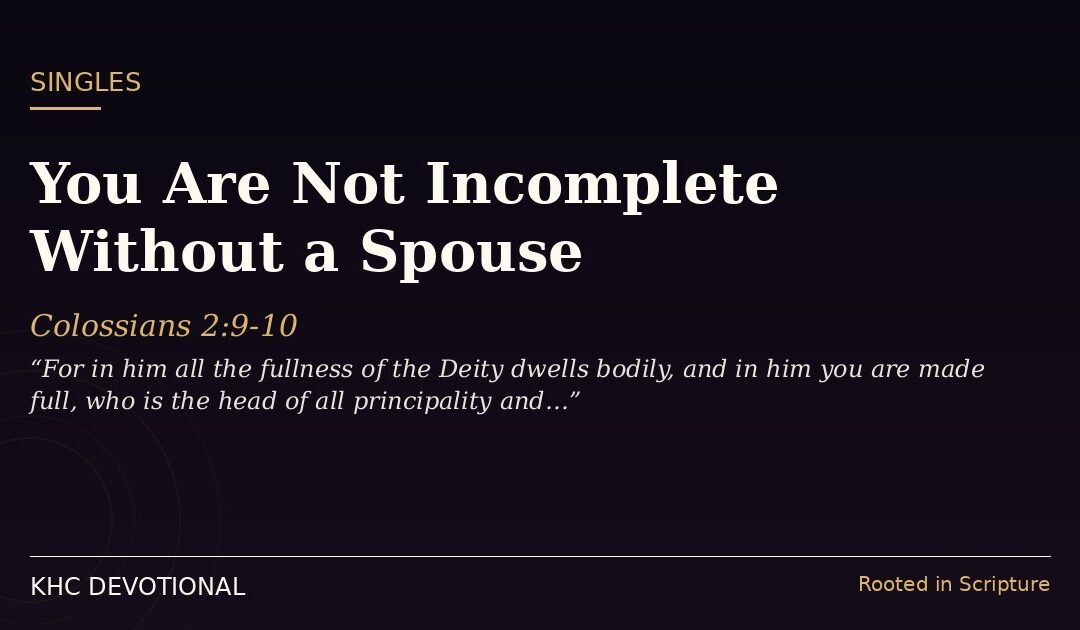
“For in him all the fullness of the Deity dwells bodily, and in him you are made full, who is the head of all principality and power.” (Colossians 2:9-10, WEB)
Christ himself, Paul says, holds all the fullness of the Deity, nothing lacking, nothing to add. This wasn’t an abstract theological point for the Colossian believers, many of whom were being told, in various forms, that their standing before God was still incomplete, still pending some further ritual or hidden knowledge. Paul’s letter systematically dismantles that anxiety, chapter by chapter, insisting that everything necessary for a right relationship with God was already accomplished in Christ, nothing deferred, nothing still owed. And because you are united to him, you are made full in him too. Not partially full, waiting on an additional ingredient. Full. Completeness, in Paul’s argument, isn’t something you build by adding the right components to your life. It’s something you already possess the moment you’re united to Christ, because he himself is not missing anything that needs supplementing.
When “Other Half” Becomes an Accidental Heresy
The sweetly-meant wedding toast, said enough times, over enough years, in enough movies and cards and conversations, quietly imports the very error Paul was correcting into how we think about marriage. If your spouse is your other half, the math implies you were only half a person before you found them, that something essential about your personhood was unfinished until a human relationship arrived to complete it. That is simply not what Scripture teaches, and it’s worth saying clearly: Jesus himself never married, and no one, not Paul, not any writer of Scripture, ever suggested his life was somehow incomplete as a result. If the pattern of Scripture were that marriage completes a person, the Gospels would be describing the least complete human being who ever lived, and that is obviously not the picture we’re given anywhere in the New Testament, where Jesus is instead portrayed as the fullest, most whole human life that has ever been lived.
What about Genesis 2:18, it is not good that the man should be alone? That verse is often used as a counterargument, but read in context, it describes Adam’s specific situation before the Fall, without another human being anywhere on earth, tasked with a vocational mandate, tending the garden, naming the animals, that genuinely required a partner. It was never intended as a universal statement that every unmarried person today is currently incomplete or defective. Paul, writing under inspiration in 1 Corinthians 7, explicitly commends singleness as good, not merely tolerable, precisely because it doesn’t diminish anyone’s completeness before God.
None of this makes marriage a lesser gift. Marriage adds real, good things: companionship, partnership, shared life, a covenant reflection of Christ and the church. But it adds those things to a person who was already, in Christ, missing nothing essential. Marriage is addition, not completion. The completion already happened, fully, at your union with Christ.
This distinction isn’t just theological hairsplitting. It changes what you actually expect a future spouse to do for you. If you enter dating or marriage believing you’re incomplete and looking for someone to finish you, you will eventually, and unfairly, ask another human being to carry weight only Christ was ever meant to carry, a level of validation, security, and identity no spouse can consistently supply. Couples who build a marriage on that expectation tend to find it buckles under the pressure. Believing you’re already full in Christ before marriage isn’t just good news for your singleness. It’s protection for whatever marriage may come.
Naming the Truth in the Ordinary Moment
This shows up in small, specific moments more than grand ones. A form that asks you to check a box, single, married, divorced, widowed, and something in you reads “single” like a verdict rather than a fact. A seating chart at a wedding that quietly clusters unmarried guests together, as though singleness were a category of guest rather than simply a season of life. A well-meaning sermon illustration that assumes every listener either has a spouse or is actively hunting for one. A relative’s question at a holiday table that lands with more weight than it should. A quiet, persistent internal narrative that treats your unmarried status as evidence that you’re not yet finished becoming who you’re supposed to be.
This week, when that word “single” comes up, on a form, in a conversation, in your own head, practice consciously pairing it with the truth Colossians 2:10 declares over you: single, and complete in Christ. Not single, waiting to become complete. Single, and already full, lacking nothing essential, because completeness was never something a spouse was ever meant to supply. You don’t need another half. You were never handed to the world as one.
The next wedding toast you hear will probably still use the same line, and that’s alright, it’s said with love, not theology. But you can let it wash past you differently now, knowing the fuller truth underneath the sentiment: that groom wasn’t half a person before he met his bride, and neither are you, sitting at whichever table you’re sitting at, already whole in the only way that was ever going to hold.
Reflect
- Where have you absorbed the message, from a toast, a movie, a well-meaning relative, that marriage is what makes a person whole?
- What would change about how you carry yourself if you actually believed Colossians 2:10 is true of you right now, unmarried?
- Is there a specific moment, a form, a question, a holiday, where the label "single" feels like a verdict of incompleteness, and what truth do you need to speak over that moment?
A Prayer for Today
Lord, thank you that my completeness was settled in Christ, not left unfinished until a wedding day. Forgive me for absorbing the idea, even quietly, that I'm only half a person until I'm married, that lie doesn't come from you, and I don't want to keep carrying it. Remind me, especially in the moments when my singleness feels most exposed, like a form to fill out or a question at a family gathering, that I am already full in Christ, lacking nothing essential to who I am. Let me hold the good desire for marriage without letting it define whether I believe I'm whole. In Jesus' name, amen.
Your Action Step
The next time you fill out a form or answer a question about your relationship status this week, silently name one specific way you are already whole in Christ right now.
MUSIC BY REV. DUNAMIS
Let the message become music
Keep your heart encouraged. Choose an album and enjoy all 10 songs right here.
Sounds of Mercy
Songs of mercy, faith and breakthrough.
Before You Say “I Do” — SINGLES
Wisdom for singles, dating couples and marriage preparation.
Ololufe Mi (My Beloved) — COUPLES
Celebrate love, friendship, prayer and partnership.
More songs for your journey with God.
Author
Want this in your inbox every week?
Get our best teachings on singleness, courtship, and marriage delivered free every Sunday morning.
Subscribe free →