
“I’m sorry” leaves his mouth almost before you finish your sentence, sorry for being late again, sorry for snapping, sorry for forgetting what you asked three times this month. It’s fast, it’s automatic, and lately it’s started to feel less like an apology and more like a period at the end of a sentence he wants to stop discussing. You believe he means it, in the moment. What you’ve stopped believing is that it changes anything. Next week, the same thing happens, followed by the same quick, practiced “sorry.” You’re starting to wonder if two words can actually mean anything if nothing ever moves after you hear them.
James, writing to scattered, struggling believers about prayer and healing, includes an instruction that speaks directly to this frustration, even though he wasn’t writing about marriage specifically.
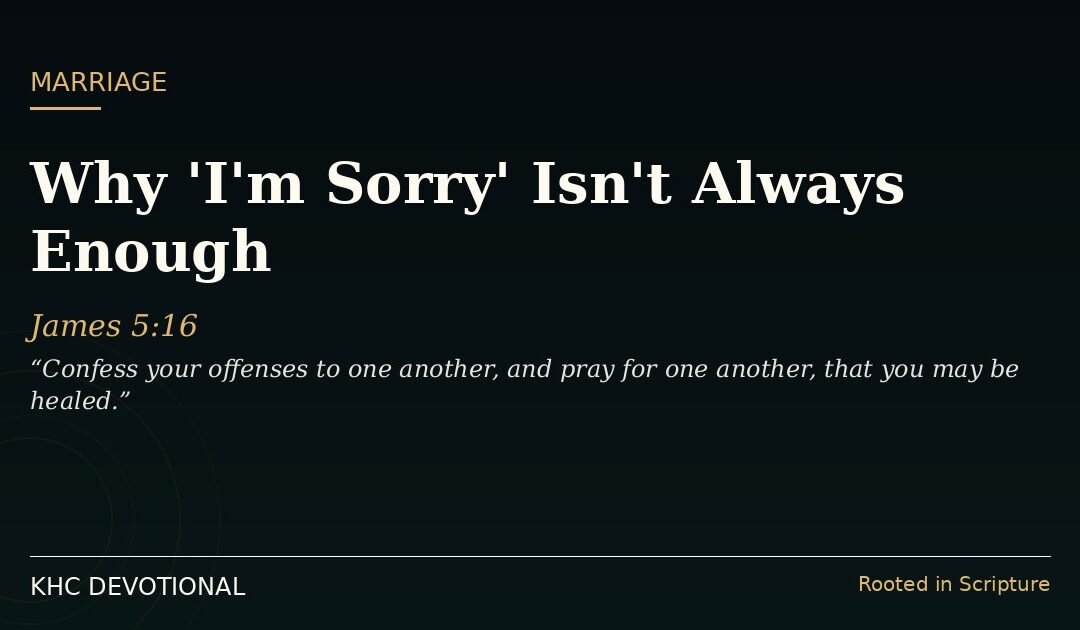
“Confess your offenses to one another, and pray for one another, that you may be healed.” (James 5:16, WEB)
James doesn’t say “apologize.” He says “confess,” a stronger, more specific word. Confession involves genuinely naming the offense, not glossing past it with a quick word designed to end the discomfort of the moment. “I’m sorry” can be said about anything or nothing in particular. Confession requires you to say what you actually did and why it was wrong: not “sorry you’re upset,” but “I dismissed what you were feeling, and that was wrong of me.” That specificity is exactly what’s often missing from the reflexive “sorry” that leaves a spouse feeling unheard rather than repaired.
There’s also real theological weight in James pairing confession with the phrase “that you may be healed.” Healing, in this passage, isn’t automatic just because words were exchanged. It’s connected to genuine confession, the kind that acknowledges real harm, paired with ongoing intercession for one another. A quick “sorry” followed by silence skips both halves of what James prescribes. It offers neither the specificity of real confession nor the follow-through of continued care.
It’s also worth noticing the second half of James’s instruction, which couples often skip entirely: pray for one another. Confession addresses the human side of repair, naming the wrong, owning the impact. Prayer addresses something confession alone can’t reach: the actual pattern in your heart that keeps producing the same offense. If forgetfulness, sharpness, or thoughtlessness keeps recurring despite genuine effort, that’s often a sign the issue isn’t just behavioral, it’s spiritual, tied to distraction, pride, or exhaustion that needs more than willpower to change. Praying for your spouse’s growth in this area, and inviting them to pray for yours, brings God into a repair process that human effort alone often can’t sustain.
This is the difference between an apology and repentance, and it’s a distinction worth naming plainly in a marriage. An apology can be a transaction: I say the magic words, the tension lifts, we move on. Repentance, biblically, involves a change of direction, not just acknowledging the wrong, but turning away from the pattern that produced it. Zacchaeus didn’t just apologize to the people he’d defrauded; he repaid them and changed his whole way of doing business. That’s the kind of “sorry” Scripture treats as credible, one backed by visible, costly change.
There’s freedom in this distinction too, for the spouse doing the apologizing. Real confession, paired with visible change over time, doesn’t require perfection on the first attempt. Repentance is rarely instant; it’s a direction, not a single event. A spouse who confesses specifically, prays honestly, and keeps trying, even imperfectly, is living out exactly what James describes, even if the old pattern occasionally resurfaces along the way. Grace covers the stumbling; it’s the ongoing direction that matters most.
This doesn’t mean every “I’m sorry” needs to come with an elaborate restitution plan. Most marital offenses are ordinary, forgetfulness, sharpness, distraction, thoughtlessness, not major betrayals requiring dramatic repair. But even ordinary offenses deserve the two things a reflexive “sorry” tends to skip: specific acknowledgment of what actually happened and its impact, and some visible effort toward change over time, not just in the next five minutes but across the following weeks.
If you’re the spouse whose “sorry” has started to feel hollow to your husband or wife, this week’s step is straightforward but not easy: the next time you need to apologize, slow down before you say it. Name specifically what you did, “I interrupted you and made you feel like your point didn’t matter,” rather than a general “sorry for that.” Then ask a real question: “What would help repair this, not just today, but going forward?” And follow through visibly on whatever pattern needs to change, so your spouse has evidence, not just words, that something actually shifted.
This same principle applies to the small, ordinary offenses that make up most of daily married life, not only the larger ruptures. Being late, forgetting a request, speaking sharply after a long day, none of these require a formal sit-down every time. But even the quickest exchanges benefit from a moment of real specificity instead of autopilot. “Sorry I’m late again, I should have texted you when I knew I’d be held up,” carries more weight and more change than “sorry” alone ever will, precisely because it names both the offense and the fix.
If you’re the spouse who’s grown weary of apologies that don’t change anything, it’s fair and healthy to say so directly, without accusing your spouse of insincerity: “I believe you mean it when you say sorry. What I need is for us to talk about what would actually help this stop happening.” That’s not holding a grudge. That’s asking for the confession James describes, the kind meant to lead somewhere, not just smooth over the moment.
Consider building this into your apology process directly: after naming the specific offense and asking what would help, close the conversation, even briefly, by praying together about it, out loud, however simply. “Lord, help me actually follow through this time, and give us both patience with each other while I’m working on it,” is a short, honest prayer that does something a private resolution to try harder can’t do on its own, it invites God into the pattern you’re both tired of.
Two words were never meant to carry the full weight of repair on their own. But confession paired with real change, offered and received with patience, is exactly the kind of ongoing care James says leads to healing, the ordinary, unglamorous kind that slowly makes a marriage more honest and more whole.
Reflect
- Does your typical apology to your spouse name the specific harm caused, or is it a general 'sorry' meant to end the discomfort quickly?
- Is there a pattern in your marriage where the same offense keeps recurring despite repeated apologies, and what would repentance actually require?
- When your spouse apologizes to you, do you look for evidence of change over time, or do you expect the words alone to fully resolve the hurt?
A Prayer for Today
Lord, I don't want my apologies to my spouse to be reflexive words that skip past real confession. Teach me to name specifically what I've done wrong instead of offering a quick 'sorry' just to end the discomfort. Give me the humility to ask what real repair would look like, and the follow-through to actually change the pattern, not just the moment. Where I've grown weary of apologies that haven't led to change, give me grace to ask directly for what I need instead of growing bitter in silence. Let confession between us lead to real healing, the way Your word promises it can. Amen.
Your Action Step
The next time you owe your spouse an apology, replace a general 'sorry' with a specific confession naming what you did and its impact, then ask them directly what would help going forward.
MUSIC BY REV. DUNAMIS
Let the message become music
Keep your heart encouraged. Choose an album and enjoy all 10 songs right here.
Sounds of Mercy
Songs of mercy, faith and breakthrough.
Before You Say “I Do” — SINGLES
Wisdom for singles, dating couples and marriage preparation.
Ololufe Mi (My Beloved) — COUPLES
Celebrate love, friendship, prayer and partnership.
More songs for your journey with God.
Author

Want this in your inbox every week?
Get our best teachings on singleness, courtship, and marriage delivered free every Sunday morning.
Subscribe free →