
You skip the dentist appointment for the second time this year because rescheduling felt like too much effort for something “only you” would benefit from. You eat cereal standing over the sink for the third night in a row because cooking a real meal for just yourself feels pointless. And somewhere between the missed appointment and the unfinished dinner, a quieter, harsher thought surfaces: you’re not really worth the effort anyway. You’d never say that sentence to a friend who was neglecting herself the same way. But somehow the rules are different when the person you’re being careless with is you.
A religious teacher asks Jesus which commandment matters most. Jesus answers with love for God first, and then, without being asked, adds a second commandment he considers inseparable from the first:
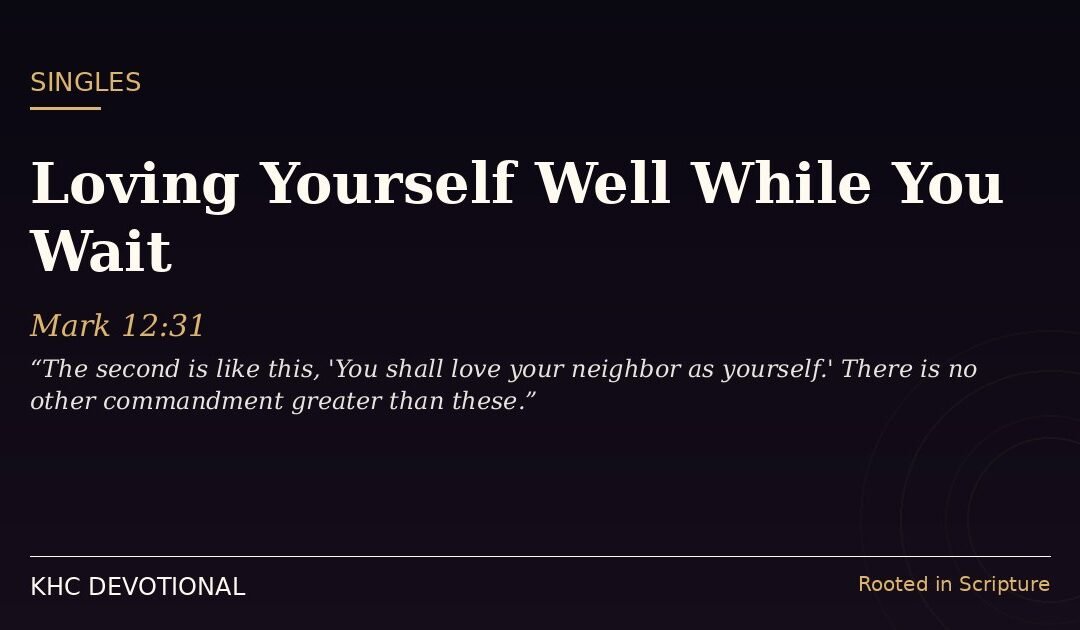
“The second is like this, ‘You shall love your neighbor as yourself.’ There is no other commandment greater than these.” (Mark 12:31, WEB)
Read the command carefully and you’ll notice something people often skip past: Jesus doesn’t say “love your neighbor instead of yourself,” and he doesn’t treat self-love as an optional afterthought. He uses it as the built-in measuring stick, love your neighbor as yourself, assuming a baseline of healthy self-regard already exists to measure by. That assumption matters enormously for anyone in a season of singleness who has quietly decided that being unmarried makes them a lesser priority, even to themselves. Jesus never commands self-hatred as a spiritual discipline. He assumes that a person made in God’s image, redeemed by Christ, is worth caring for, and he uses that as the template for how you’re meant to treat everyone else.
This is not the self-esteem culture’s version of self-love, which often just means indulging every impulse and calling it self-care. Biblical self-love is rooted in something outside of you, the fact that you were made in the image of God, and that Christ considered you worth dying for while you were still a sinner. That’s an entirely different foundation than “I deserve nice things” or “I’m enough because I say so.” It’s closer to this: God has already declared you worth loving, so loving yourself well is simply agreeing with his verdict rather than arguing against it every time the harsh inner voice speaks up.
For singles specifically, this command exposes a subtle trap. It’s easy to treat singleness as a season to survive rather than a life to steward, skipping the doctor’s appointment because “it’s just me,” letting the apartment go uncared for because “no one sees it anyway,” speaking to yourself in ways you’d correct instantly if a friend said them about herself. Each of those small neglects is a quiet violation of Mark 12:31, not because self-care is the point of the Christian life, but because refusing to love yourself as God’s image-bearer is its own kind of disobedience. You are not exempt from the second-greatest commandment just because there’s no spouse in the house to notice whether you kept it.
Loving yourself well while you wait also protects your capacity to love others well. A person who has learned to speak truth and kindness to themselves in hard moments brings that same steadiness into friendships, family, and eventually a marriage, if that’s the path ahead. A person who has practiced contempt for themselves in private tends to import that same harshness into their closest relationships later, whether they intend to or not.
There’s a reason Jesus phrases the second commandment as a comparison rather than two unrelated commands. He assumes the way you treat yourself will leak into the way you treat everyone around you, because it’s the pattern you rehearse most often and with the least resistance. If your internal voice defaults to contempt whenever you fall short, that same reflex will surface, in smaller or larger ways, the moment someone you love disappoints you. If your internal voice can offer yourself patience, honesty, and grace in a hard moment, you’ll have that same posture available for your future spouse, your friends, and your family, because you’ll have practiced it for years already, on the hardest audience of all: yourself. Loving yourself well isn’t a detour from loving others well. It’s the training ground for it.
What This Looks Like This Week
Think of Rachel, thirty-two, who realized during a counseling session that she talks to herself in a tone she’d never tolerate from anyone else, dismissive, impatient, quick to call herself pathetic for wanting a family she doesn’t have yet. Her counselor gives her a simple exercise: every time she catches a harsh inner comment this week, she has to say the sentence out loud, then ask, “Would I say this to my closest friend?” If the answer is no, she has to replace it with what she’d actually say to that friend instead. The first few times feel forced, almost silly, like she’s performing kindness rather than feeling it. By the end of the week, she notices the harsh comments arriving less often, simply because she’s stopped rehearsing them unchecked, and the replacement sentences are starting to feel less like a script and more like something she actually believes.
Try this yourself. For the next seven days, notice one recurring unkind thing you say to yourself, and practice replacing it, out loud, with what you would say to someone you love. Let Mark 12:31 set the standard, not your harshest private moment.
If the harsh inner voice feels too deeply rooted to interrupt on your own, consider naming it out loud to a counselor, pastor, or trusted friend rather than trying to white-knuckle your way through it in private. Loving yourself well sometimes means being humble enough to let someone else help you see yourself more truthfully than you can see yourself alone, especially when the voice you’ve been trusting has proven itself untrustworthy for years.
You are not excused from receiving love just because you’re single, including love from yourself. God has already settled your worth; loving yourself well is simply learning to agree with him, one honest sentence at a time.
Reflect
- What do you say to yourself in private moments that you would never say to a friend going through the exact same thing?
- In what practical ways have you neglected caring for yourself well because 'no one's watching' now that you're single?
- How might learning to love yourself well now shape the way you'll be able to love a spouse or friends later?
A Prayer for Today
Lord, you commanded me to love my neighbor as myself, which means you never intended for me to treat myself with contempt. Forgive me for the harsh, dismissive words I say to myself in private, words I'd never allow toward someone I love. Teach me to see myself the way you see me: made in your image, worth caring for, worth speaking kindly to, even in this single season. Help me steward my body, my time, and my heart well, not because I have someone to prove it to, but because you're already watching and you already call me valuable. Grow in me a self-love that reflects your love, not the world's vanity. In Jesus' name, amen.
Your Action Step
This week, notice one recurring unkind thing you say to yourself, and out loud, replace it with what you'd say to someone you love.
MUSIC BY REV. DUNAMIS
Let the message become music
Keep your heart encouraged. Choose an album and enjoy all 10 songs right here.
Sounds of Mercy
Songs of mercy, faith and breakthrough.
Before You Say “I Do” — SINGLES
Wisdom for singles, dating couples and marriage preparation.
Ololufe Mi (My Beloved) — COUPLES
Celebrate love, friendship, prayer and partnership.
More songs for your journey with God.
Author

Want this in your inbox every week?
Get our best teachings on singleness, courtship, and marriage delivered free every Sunday morning.
Subscribe free →