
The notification pops up while you’re brushing your teeth: a group chat exploding with heart-eye emojis because another friend just got engaged. You scroll the photos with your thumb before you’ve even rinsed, the ring, the tears, the “he asked and I SAID YES” caption, and you feel two things almost simultaneously: genuine happiness for her, and a private, uninvited math problem starting to run in the back of your mind. She’s younger than you. This is her second serious relationship since you’ve been single. You don’t want to be doing this math. You do it anyway.
What Paul Told a Comparison-Prone Church
Paul wrote to the churches of Galatia to correct a specific problem: believers measuring their spiritual standing against each other, competing over whose faith looked more impressive, whose credentials mattered more. In the middle of a passage about carrying each other’s burdens in community, Paul draws a careful, easily missed distinction.
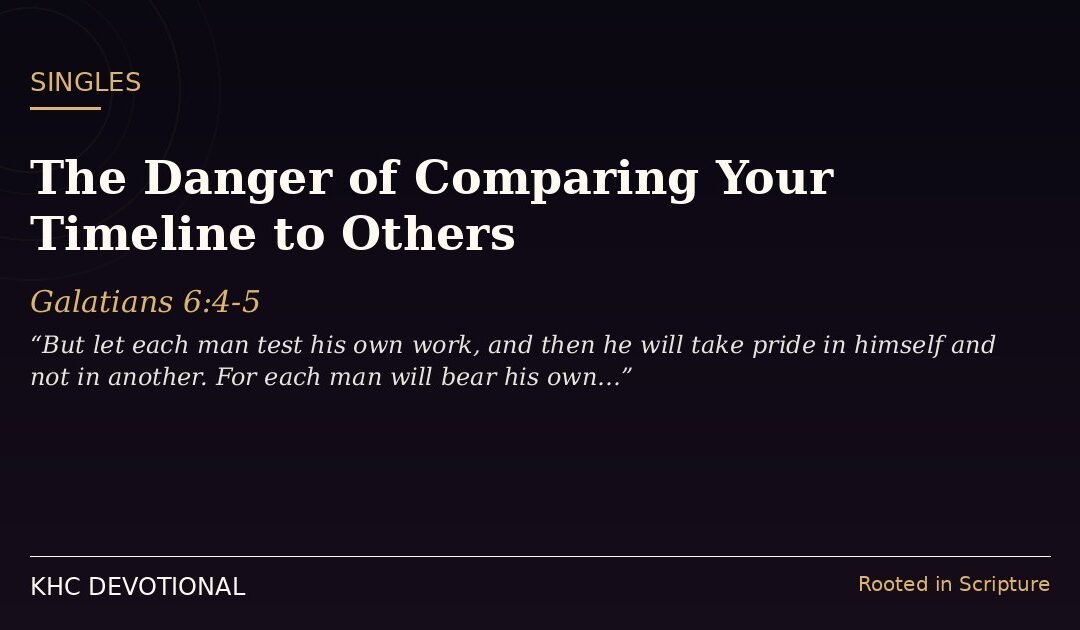
“But let each man test his own work, and then he will take pride in himself and not in another. For each man will bear his own burden.” (Galatians 6:4-5, WEB)
Just two verses earlier, Paul had said the opposite-sounding thing: bear one another’s burdens. That’s not a contradiction; the original language uses two different words. The burden in verse two pictures a crushing weight too heavy to carry alone, something the community shares. The burden in verse five pictures something closer to a soldier’s own pack, the personal load each person is responsible to carry themselves, that cannot be swapped or measured against someone else’s kit. Paul is saying: help carry what’s genuinely too heavy for one person, but also, don’t confuse your own individual assignment with anyone else’s.
Why Comparison Is a Rigged Scale
“Test his own work” is the operative phrase. You’re called to examine your own life against what God has actually assigned and given you, not against your friend’s relationship, her family history, her personality, her circumstances, or the particular providence that brought her and her fiance together on a timeline different from yours. Comparison takes two lives that were never given the same variables and tries to run them through the same scale, and the scale is rigged no matter which direction it tips. It’s also worth noting what “test his own work” does not mean. It isn’t a license for isolation, pretending your life has nothing to do with anyone else’s, or refusing to celebrate with people around you. Paul wrote this in a letter full of instructions about community, generosity, and carrying each other’s burdens. Testing your own work happens inside relationship, not apart from it. You’re still fully present at your friend’s engagement party. You’re just no longer silently auditing your own worth while you’re there. If you come out ahead, Paul says you’ll take pride in a false, unstable way, comparing up instead of measuring your own faithfulness. If you come out behind, which is the more common experience in singleness comparison, you walk away feeling like a failure at a game you were never actually competing in.
Scripture doesn’t give us a formula timeline for marriage, and that’s not an oversight. Isaac was well into adulthood before Abraham’s servant was sent to find Rebekah, and it happened through prayer and provision, not striving. Jacob’s path to marriage was a tangled, painful, fourteen-year detour full of deception he didn’t choose. Ruth was a widow with no prospects when she chose loyalty to Naomi, with no idea Boaz existed yet. None of these stories run on the same clock, and none of them would have been improved by the people in them anxiously measuring their progress against someone else’s story.
There’s a subtler cost to comparison that’s easy to miss: it doesn’t just distort how you see your own life, it distorts how you see the person you’re comparing yourself to. Reduced to a data point in your private timeline, your engaged friend stops being a full person with her own fears and history and instead becomes a symbol of what you don’t have yet. That’s not a small thing. It quietly damages real friendships, one silent comparison at a time, even when nothing is ever said out loud.
Your “own work,” the specific faithfulness, growth, and stewardship God is asking of you right now, cannot be evaluated by comparing it to your engaged friend’s Instagram feed. She has her own load to carry, her own work to test. You have yours. They were never meant to be weighed on the same scale, and trying to do it anyway will only ever produce false pride or false despair, never real peace.
Practicing a Different Response
Here’s what this can look like in practice: the next time an engagement announcement, a wedding invitation, or a pregnancy photo lands in your feed, pause before you respond. Before you type the congratulations, which should still be genuine, because her joy is not a threat to you, privately name one specific thing you’re grateful for in your own life right now that has nothing to do with a relationship. A friendship that’s deepened this year. A skill you’ve built. A prayer God has answered in a completely different area. This isn’t a trick to manufacture fake happiness. It’s a way of interrupting the automatic comparison reflex before it hijacks your genuine capacity to celebrate someone else.
Over time, this practice retrains what your mind reaches for first. Instead of an instinctive measuring, you build an instinctive gratitude, rooted not in denial of your own longing, but in the simple truth that your life was never supposed to be measured against hers in the first place. Test your own work. Bear your own load. Let her carry hers, and celebrate her for it, freely.
This is also worth praying through specifically, not just managing behaviorally. Ask God to show you where comparison has quietly become a habit of the heart rather than an occasional bad moment. Paul’s instruction isn’t a technique for feeling better about yourself; it’s a call to a different relationship with your own life altogether, one where your contentment is anchored to your own faithfulness before God rather than to how your story stacks up against everyone else’s.
Reflect
- Whose timeline do you catch yourself measuring your life against most often, and why that person specifically?
- What "burden" or assignment has God actually given you to steward right now, apart from anyone else's story?
- What would change if you evaluated your life only by faithfulness to what God has called you to, not by comparison to a friend's relationship status?
A Prayer for Today
Lord, forgive me for the private math I run every time someone else's relationship moves forward and mine doesn't, the comparisons, the quiet resentment, the way I let someone else's timeline define whether my life is going well. Help me test my own work, as your word says, instead of measuring myself against a friend's engagement or a stranger's wedding photos. Thank you for the specific life you've given me to steward, one that isn't a smaller version of anyone else's. Teach me to celebrate other people's joy without needing it to say something about my own worth. In Jesus' name, amen.
Your Action Step
The next engagement or wedding announcement that hits your feed this week, write down one specific thing you're grateful for in your own life before you respond.
MUSIC BY REV. DUNAMIS
Let the message become music
Keep your heart encouraged. Choose an album and enjoy all 10 songs right here.
Sounds of Mercy
Songs of mercy, faith and breakthrough.
Before You Say “I Do” — SINGLES
Wisdom for singles, dating couples and marriage preparation.
Ololufe Mi (My Beloved) — COUPLES
Celebrate love, friendship, prayer and partnership.
More songs for your journey with God.
Author

Want this in your inbox every week?
Get our best teachings on singleness, courtship, and marriage delivered free every Sunday morning.
Subscribe free →