
At her grandparents’ fiftieth anniversary party, Jenna watched her grandfather stand up, glass shaking slightly in his hand, and try three times to get through a toast to his wife without his voice breaking. He finally gave up on eloquence and just said, “There were years I didn’t know if we’d make it. I’m glad we did.” The room laughed, a little uncomfortable, a little moved. Jenna, six months into her own marriage and already wondering if the arguments over money were normal, found herself thinking: nobody tells you it’s supposed to be that hard sometimes. Nobody tells you “for better or worse” is a promise you’ll actually have to use.
Long before wedding vows included that phrase, a woman named Ruth spoke something like it to her mother-in-law, Naomi. Both women had lost their husbands. Naomi, bitter and broke, was heading back to Bethlehem and told her daughters-in-law to go home to their own families and remarry. Orpah went. Ruth didn’t.
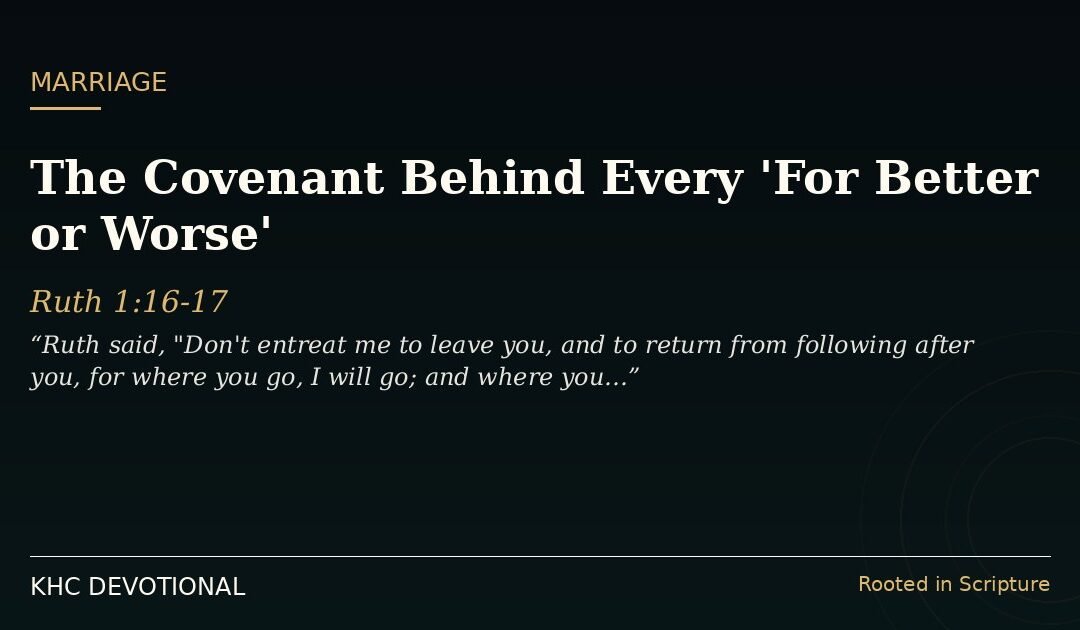
“Ruth said, ‘Don’t entreat me to leave you, and to return from following after you, for where you go, I will go; and where you lodge, I will lodge; your people shall be my people, and your God my God; where you die, I will die, and there I will be buried. May Yahweh do so to me, and more also, if anything but death parts you and me.'” (Ruth 1:16-17, WEB)
Ruth’s words weren’t spoken to a husband, but they are one of the clearest pictures in Scripture of what covenant loyalty actually sounds like, which is exactly why they’re read at weddings so often. Notice what Ruth commits to: not a feeling, but a series of actions and locations. Go where you go. Stay where you stay. Belong to your people. Worship your God. Be buried where you’re buried. She binds her future to another person’s, with no guarantee of what it will cost her. She had every reasonable excuse to leave. Naomi even told her to. Ruth chose the harder, less certain road because she had made herself Naomi’s family, and family doesn’t get renegotiated when it becomes inconvenient.
That’s covenant. A contract says, “I’ll do my part as long as you do yours.” A covenant says, “I am yours, regardless.” Marriage, biblically, was never meant to be a contract you exit when the terms stop working for you — it’s meant to be a covenant, sealed the way Ruth sealed hers: with a decision made before you know exactly what it will cost.
There’s another layer worth noting: Ruth wasn’t only pledging loyalty to Naomi, she was also stepping into a covenant community and its God, with no promise of reward. Later in the story, Boaz becomes what the law called a “kinsman-redeemer,” a relative with the right and responsibility to restore what was lost to a family that had fallen into hardship. Ruth’s loyalty positioned her, unknowingly, for redemption she could never have engineered on her own. That’s often how covenant loyalty works in marriage too. You don’t stay loyal because you can already see exactly how it will turn out well. You stay loyal because loyalty itself is the right response to the relationship you’ve entered, and you trust God with what you can’t yet see.
This matters for “for better or worse” because most couples say those words at twenty-five or thirty, with no real category yet for what “worse” might mean. Worse turns out to be specific: a diagnosis, a job loss, a miscarriage, a season of depression, simple years of monotony where the spark seems to have gone missing. The vow was written in advance precisely because none of us can know, on our wedding day, what the worse will actually look like. Ruth didn’t know what awaited her in Bethlehem either — poverty, gleaning in someone else’s field, an uncertain future. She committed to the relationship before she could see the outcome. That’s what makes it covenant loyalty and not just optimism.
Here’s the good news buried inside this hard truth: covenant loyalty is not the same as gritted-teeth endurance. Ruth’s story doesn’t end in grim survival — it ends in Boaz, in redemption, in a son named Obed who becomes the grandfather of King David and an ancestor of Jesus. Scripture doesn’t promise that staying loyal guarantees an easy road, but it consistently shows God working through covenant faithfulness to bring about more than either party could have arranged on their own.
Consider what this looks like practically for a couple like Jenna and her husband, six months in and already hitting real friction over money. Living out “for better or worse” this week doesn’t mean pretending the friction isn’t real or forcing a feeling of resolution. It means sitting down together, naming the actual disagreement instead of avoiding it, and saying out loud, “We’re going to figure this out together, because we belong to each other now.” It means choosing to interpret a hard season as something to work through rather than evidence the marriage was a mistake. It might mean asking an older couple, the kind sitting at that anniversary party, how they made it through their own hard years, and letting their honesty be instructive instead of intimidating.
Practically, this might mean actually doing what the anniversary toast implied but never spelled out: sitting across from each other this week, without distraction, and asking honestly, “What does staying loyal look like for us in this specific season, not just in theory?” It might mean revisiting the budget together instead of avoiding the conversation, or naming out loud that the money disagreements have made you privately wonder about compatibility, and choosing instead to treat them as a shared problem to solve rather than a referendum on the marriage itself.
Your “for better or worse” doesn’t have to look like Ruth’s famine and foreign land to be real covenant loyalty. It might look like staying present through a hard budget conversation, or choosing not to keep score during a rough month. Whatever your current “worse” looks like, the same loyalty Ruth offered Naomi is available to you and your spouse — and the same God who redeemed Ruth’s story is present in yours, working even the hard chapters toward something good.
Reflect
- What does 'for better or worse' actually mean to you right now, and has your current season stretched that promise in a way you haven't named?
- Like Ruth, are you committing to your marriage before you know how it turns out, or are you waiting to see how it goes before you commit fully?
- Who in your life has modeled long-term covenant loyalty the way Ruth modeled it to Naomi, and what could you learn from asking them directly about their hard years?
A Prayer for Today
Father, thank You for the picture of loyal love You gave us in Ruth, a love that chose commitment before it knew the cost. I confess there are days I want the benefits of covenant without the sacrifice it sometimes requires. Teach me to say, in both word and action, 'where you go, I will go' to my spouse, even in seasons that feel uncertain or hard. Root my commitment in something deeper than circumstance or feeling. Where our marriage is walking through a 'worse' season right now, remind me that You are present in it, working toward redemption the way You worked in Ruth's story. Make our covenant loyalty to each other a reflection of Your covenant loyalty to us. Amen.
Your Action Step
This week, ask an older married couple you respect to share one specific story of a hard season they stayed loyal through, and let their honesty shape how you think about your own 'for better or worse.'
MUSIC BY REV. DUNAMIS
Let the message become music
Keep your heart encouraged. Choose an album and enjoy all 10 songs right here.
Sounds of Mercy
Songs of mercy, faith and breakthrough.
Before You Say “I Do” — SINGLES
Wisdom for singles, dating couples and marriage preparation.
Ololufe Mi (My Beloved) — COUPLES
Celebrate love, friendship, prayer and partnership.
More songs for your journey with God.
Author

Want this in your inbox every week?
Get our best teachings on singleness, courtship, and marriage delivered free every Sunday morning.
Subscribe free →