
She found the folded paper tucked in a box of old anniversary cards while she was digging around for tape, her own handwriting from twelve years earlier staring back at her, the vows she’d written and read aloud with her hands visibly shaking that day. “For better or for worse, in sickness and in health.” She stood in the hallway reading it on an ordinary Tuesday afternoon, right in the middle of a season where worse had shown up far more than better lately, and felt something caught between conviction and grief. She hadn’t broken her vows. But she’d forgotten, somewhere in the daily grind, that she’d made them at all.
The Preacher who wrote Ecclesiastes, traditionally understood to be Solomon, spends much of the book wrestling honestly with the difficulty of life under the sun, including the weight of promises made to God. In chapter 5, in the middle of instructions about worship and reverence, he addresses vows directly, a topic that in ancient Israel referred specifically to promises made to God, but which carries clear application to any solemn promise made in his presence, including wedding vows spoken before witnesses and before God himself.
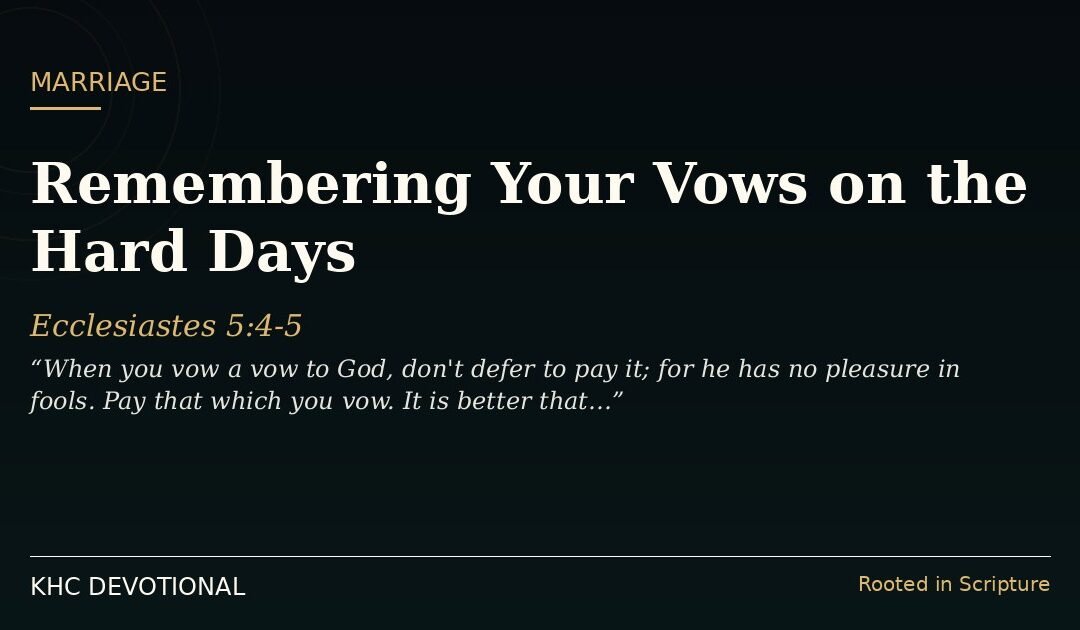
“When you vow a vow to God, don’t defer to pay it; for he has no pleasure in fools. Pay that which you vow. It is better that you should not vow, than that you should vow and not pay.” (Ecclesiastes 5:4-5, WEB)
The Preacher’s tone in these two verses is almost blunt, deliberately uncomfortable, offering none of the softer language we might expect. He isn’t gentle about broken promises. He says it would be better never to vow at all than to vow and then fail to follow through, because an unpaid vow treats God’s presence as witness lightly, as though the promise only mattered in the emotional moment it was spoken rather than in the years of ordinary life that follow. This principle applies with real weight to marriage, because wedding vows are, in the fullest biblical sense, vows made to God, not just to your spouse. You didn’t only promise your spouse faithfulness. You promised God, with your spouse and your community as witnesses, that you would keep faith regardless of circumstance.
What makes this hard is that vows are almost always spoken in a season of strong feeling, standing at an altar, surrounded by people who love you, emotion carrying the words easily off your tongue. But vows are tested in seasons that share none of those conditions, an argument that drags into its third day, a diagnosis neither of you expected, the quiet loneliness of a marriage that has grown distant without either person fully noticing. The Preacher’s warning isn’t really about the moment you make a vow, it’s about the years afterward when paying it requires effort the original moment didn’t demand. Fools, in the Preacher’s vocabulary throughout Ecclesiastes, aren’t unintelligent people, they’re people who fail to reckon honestly with reality, including the reality that a promise made to God carries ongoing weight long after the feeling that inspired it has faded.
This isn’t meant to induce guilt in marriages that are genuinely, painfully struggling right now. It’s meant instead as a reminder of what your vow actually was in the first place. You didn’t vow to feel loving every day. You vowed to act faithfully regardless of what you felt on any given day, which means the hard days aren’t evidence that your vow has failed, they’re the exact terrain your vow was written for. A vow that only needs keeping on easy days was never really a vow at all, just a preference.
It also matters that this promise was made publicly, before witnesses who heard it spoken. That community isn’t incidental to the vow, it’s part of its accountability structure. Friends and family who stood at your wedding didn’t just attend a party, they became, in a sense, secondary witnesses alongside God himself, people who can speak encouragement and truth into your marriage precisely because they heard the original promise. A couple struggling to pay what they vowed doesn’t have to do the paying in isolation. Bringing a trusted friend, a pastor, or a mentor couple into a hard season isn’t a failure to keep your vow privately, it’s making use of the very witnesses God placed there for exactly this purpose.
What This Looks Like This Week
Consider a couple in year fifteen of marriage, worn down by work stress, parenting teenagers, and a general sense of drifting that neither can quite name. Neither has been unfaithful in any dramatic sense, but both have quietly stopped investing the way they once did, coasting rather than actively paying what they vowed. One evening, instead of just waiting around for things to magically improve on their own, the wife digs through a closet until she finds the actual printed program from their wedding, vows and all, and lays it on the kitchen table between them. Reading their own promises out loud again, in their own kitchen, on an ordinary night, reorients something neither of them expected. It’s not a magic fix, but it’s a returning, a recommitment to pay what was promised rather than letting the vow quietly go unpaid through sheer neglect.
This week, find your own written wedding vows, printed program, handwritten copy, or an old email where you drafted them, and read them out loud together with your spouse. Talk honestly about which parts feel easiest to keep right now and which parts feel hardest, and pray together specifically about the hard part. If it would help, invite one trusted friend or mentor couple into that conversation too, someone who witnessed your vows and can now help hold you both accountable to them in this season.
Your vow was never meant to run on feeling alone. It was meant to be paid, deliberately, across every kind of day your marriage encounters, the ordinary Tuesdays as much as the anniversaries. God who witnessed your vow is faithful to help you keep it, even now, even on the hardest days, because he has never once failed to keep his own covenant with you.
Reflect
- When was the last time you actually read or reflected on the exact words of your wedding vows, rather than a vague memory of them?
- Which specific phrase of your vows, for worse, in sickness, for poorer, feels hardest to keep right now, and why?
- Have you been coasting in any part of your marriage, quietly letting a promise go unpaid rather than deliberately breaking it?
A Prayer for Today
Lord, you witnessed the vows I made to my spouse, and I don't want those words to have been spoken lightly. Forgive me for the ways I have let my promise go unpaid through neglect rather than deliberate betrayal. On the days when love feels like a decision more than a feeling, give me the strength to keep my word anyway. Remind me that you have never once let your covenant with me lapse, even when I have been unfaithful to mine. Help me pay what I vowed, faithfully, for the rest of our life together. Amen.
Your Action Step
This week, find your written or recorded wedding vows and read or watch them together with your spouse, then talk honestly about which part feels hardest to keep right now.
Author
Want this in your inbox every week?
Get our best teachings on singleness, courtship, and marriage delivered free every Sunday morning.
Subscribe free →