
“We don’t need it,” he said when the pastor first mentioned premarital counseling during their engagement meeting. “We already know each other really well. We’ve been together three years.” His fiancée nodded along beside him, half agreeing, half just not wanting to add one more item to an already overflowing wedding-planning calendar. The pastor didn’t push, but he did ask one question that stuck with both of them on the drive home: “If you already know everything you need to know, what are you afraid counseling might reveal?”
That question exposes something true about why so many engaged couples resist premarital counseling. It’s rarely because they think it’s genuinely pointless. It’s because some part of them suspects it might surface something uncomfortable, and it feels easier to skip the conversation than to have it. Proverbs, wisdom passed down through generations of Israelite instruction, repeatedly insists that wisdom is not something any one person possesses fully on their own, and that seeking outside counsel is a mark of strength, not weakness.
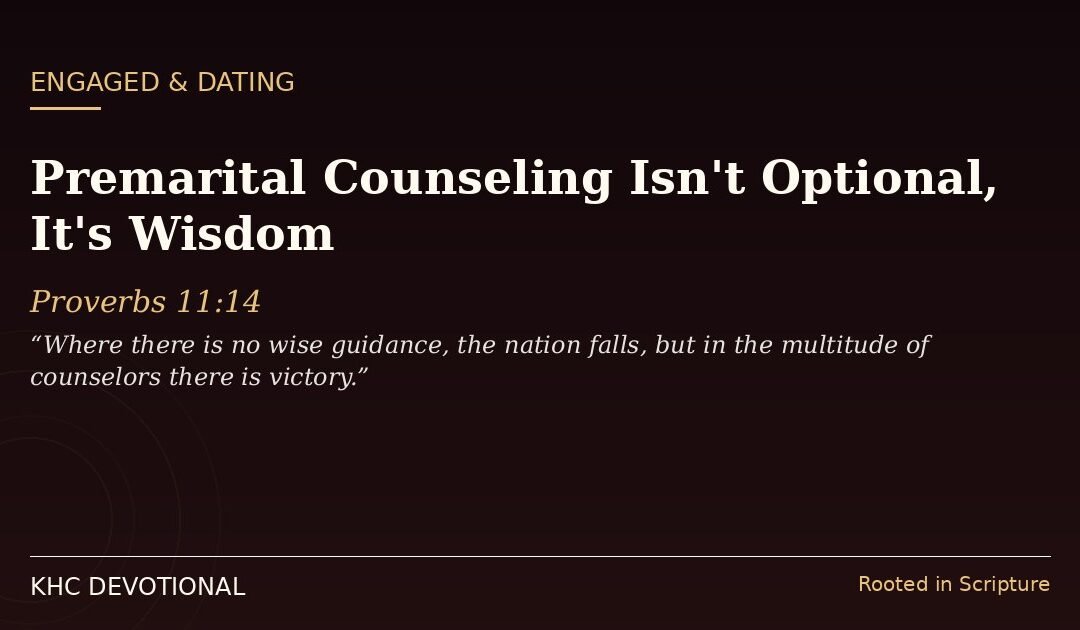
“Where there is no wise guidance, the nation falls, but in the multitude of counselors there is victory.” (Proverbs 11:14, WEB)
This proverb was originally written with something like national leadership in mind, but its underlying principle applies directly to any major, life-shaping decision made in isolation, marriage included. A leader who refuses input eventually leads a nation into collapse, not necessarily out of malice, but out of blind spots no single person can see in themselves. A couple heading into marriage carries the same risk. You cannot see your own patterns as clearly as an experienced counselor or pastor can, because you are standing inside the relationship rather than observing it from the outside. This isn’t a statement about how much you love each other or how well the two of you already communicate day to day. It’s simply an acknowledgment that every person carries blind spots, and love, however genuine, does not automatically dissolve them.
Premarital counseling isn’t primarily about crisis intervention, sitting on a couch only once there’s a problem serious enough to force the conversation. Its real value is preventative, surfacing questions about conflict style, family history, financial habits, expectations around intimacy, and spiritual practices before the wedding, while there’s still time to talk them through without the pressure of an actual crisis forcing the conversation. A good counselor or pastor has already walked dozens, sometimes hundreds, of couples through these exact same questions, and has seen firsthand which unaddressed patterns tend to resurface years later as real, costly strain. That kind of pattern recognition simply isn’t available to two people who, however much they love each other, have only ever seen their own relationship from the inside.
There’s also a specific kind of humility built into seeking outside counsel, one that Proverbs consistently praises throughout its pages as a mark of maturity rather than weakness. Skipping counseling because “we already know each other” often carries a quiet assumption that your relationship is the exception, that you’ve already figured out what other couples need help discovering. Scripture’s wisdom tradition pushes back hard against that instinct. The multitude of counselors isn’t a sign that the two of you have failed to communicate well on your own. It’s an acknowledgment that even strong, healthy relationships benefit from voices outside the relationship, the same way even excellent pilots run through a preflight checklist every single time, not because they’re incompetent, but because a second set of trained eyes catches what familiarity tends to miss.
It’s worth saying clearly that counsel can come from more than one source, and a couple doesn’t need to choose only one. A pastor can address the spiritual and covenantal dimensions of marriage, a licensed therapist can bring trained insight into communication and family-of-origin patterns, and a mentor couple who has weathered twenty or thirty years of marriage can offer the kind of lived wisdom no course can fully replicate. Many churches also offer structured premarital assessments, inventories that surface areas of strength and potential friction long before the wedding day. None of these replace the others. Together, they form exactly the kind of multitude of counselors Proverbs describes, each voice adding something the others cannot.
What This Looks Like This Week
Picture an engaged couple who finally agrees to eight sessions of premarital counseling with their pastor, somewhat reluctantly at first. In session three, a routine question about how each of their parents handled conflict opens up a conversation neither of them had ever had directly: he grew up in a home where disagreements were shouted and then never mentioned again, she grew up in a home where conflict was avoided entirely until it exploded rarely but severely. Neither pattern is inherently anyone’s fault, simply the residue of childhood homes neither chose, but neither pattern had ever actually been named or discussed openly before this session. That single conversation, guided by someone experienced enough to ask the right question, gives them language for a dynamic that would otherwise have quietly shaped their own marriage without either of them realizing where it actually came from, or how to interrupt it before it repeated itself in their own home.
This week, if you haven’t already, schedule your first premarital counseling session, whether with a pastor, a licensed counselor, or a trusted, seasoned couple willing to walk through real questions with you. If you’re already in counseling, commit to bringing one honest, unfiltered answer to your next session instead of the polished version you’d normally give. If cost or scheduling has been the obstacle, ask your church about resources, many congregations offer premarital counseling at little or no charge specifically because they consider it foundational, not optional, for couples preparing to marry.
Seeking counsel isn’t a sign that your relationship is fragile. It’s a sign that you’re wise enough to want victory more than you want comfort, and that kind of wisdom, applied now, will serve your marriage for decades to come, long after the wedding day itself has faded into a handful of photographs.
Reflect
- If you've resisted premarital counseling, what are you actually afraid it might reveal about your relationship?
- What conflict or communication pattern from your own family of origin have you never fully discussed with your partner?
- Who in your life has walked through enough marriages, as a counselor, pastor, or mentor, to offer you wisdom you can't see from inside your own relationship?
A Prayer for Today
Lord, thank you for the wisdom that says victory comes through many counselors, not through figuring everything out alone. Forgive me for the pride that has made me resist outside guidance, as if our relationship were the exception that needs no help. Give us the humility to seek wise counsel before the wedding, not just after a crisis forces us to. Help us bring honest, unfiltered answers to every conversation, even when they're uncomfortable. Use this season of preparation to build a foundation that will hold steady for the rest of our lives together. Amen.
Your Action Step
This week, schedule your first premarital counseling session with a pastor or licensed counselor, or if you're already meeting, commit to giving one fully honest answer instead of a polished one.
Author
Want this in your inbox every week?
Get our best teachings on singleness, courtship, and marriage delivered free every Sunday morning.
Subscribe free →