
It’s 11:40 p.m. and the wedding budget spreadsheet is still open on the laptop between you, the cursor blinking in a cell neither of you wants to fill in first. The venue costs more than either of you expected, which means something else has to shrink — the guest list, the honeymoon, the flowers nobody will remember in five years. You’ve moved numbers around for an hour, and every version feels like a trade-off between two things you both want. Somewhere in the frustration, your fiancée sets down her phone and asks a different question than the one you’ve been arguing about: “What are we actually building this budget — and this marriage — around?”
Jesus said this in the middle of the Sermon on the Mount, right after telling a crowd of ordinary, financially anxious people not to worry about food, clothing, or tomorrow — the exact kinds of pressures that show up in a dating or engaged relationship’s budget, calendar, and long-term plans. His solution to anxious striving wasn’t “try harder to balance everything.” It was to reorder what gets sought first.
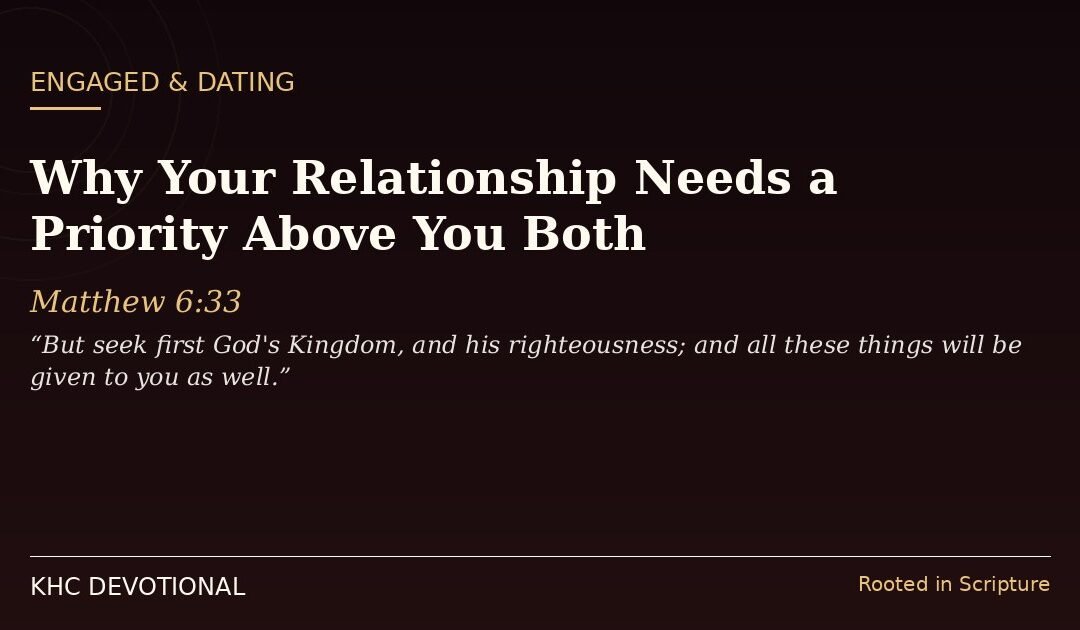
“But seek first God’s Kingdom, and his righteousness; and all these things will be given to you as well.” (Matthew 6:33)
“Seek first” doesn’t mean seek only, and it doesn’t mean exclude career, wedding planning, or family from your attention. It means sequence and priority. Everything else in this passage — what you’ll eat, what you’ll wear, what tomorrow holds — is real and matters, but it isn’t meant to be sought first. God’s kingdom, his rule and his righteousness, is meant to govern above your own comfort, ambition, and image.
Here’s why that matters so specifically for a couple who’s dating or engaged: it’s tempting, understandably, to treat the relationship itself as the highest good — the thing you organize your whole life around, the source of your security and identity. But when a relationship is asked to be the ultimate priority, it becomes fragile, because it’s being asked to bear a weight only God was ever meant to bear: your sense of worth, your security, your meaning. A relationship can’t hold that weight forever without cracking. But when God’s kingdom is legitimately first for both individuals — not just in theory, but in how you actually spend your time and money — the relationship becomes something you build together underneath a shared, greater priority, instead of two individuals locked in a quiet tug-of-war between competing “firsts”: career versus relationship versus family of origin versus personal ambition.
Notice, too, what Jesus promises: “these things will be given to you as well.” That’s not a prosperity guarantee that seeking God first means an easy budget or a stress-free wedding. It’s an assurance that when priorities are rightly ordered, the practical concerns — what to eat, what to wear, how to spend — find their proper, non-anxious place in your life, rather than driving every decision you make as a couple.
So ask honestly: does your calendar reflect that God’s kingdom is actually first, or has wedding planning quietly occupied the priority that worship, prayer, and service used to hold in your individual lives? Does your budget reflect stewardship and generosity, or has the wedding itself become something you’re both, without quite noticing, worshiping?
It’s worth being honest, too, about how subtly this shift usually happens. Almost no engaged couple sits down and decides on purpose to demote God’s kingdom. It happens by a thousand small substitutions — the small group you used to attend together quietly becomes something you’ll get back to after the wedding, the tithe check gets smaller because the deposit for the venue is due, the evening you used to spend serving at church gets absorbed by cake tastings and seating charts. None of those choices is sinful in isolation. The danger is cumulative: a season can slip by where the relationship, and the wedding that celebrates it, has quietly become the actual center of gravity, while God’s kingdom becomes something you’ll return to a state of things calm down eventually. Naming that pattern honestly, before the wedding rather than after, is itself an act of seeking him first.
Go back to that spreadsheet moment. Instead of the question “what can we afford,” the couple starts asking a different one together: “what does faithfulness look like with what we actually have?” That single shift changes the conversation. Maybe it means committing to tithe from wedding gifts instead of treating them as pure windfall. Maybe it means trimming the guest list, not because you have to, but because starting the marriage without debt matters more to both of you than an impressive event. Maybe it simply means pausing to pray over the spreadsheet together before either of you touches another number — not as a formality, but as an actual act of seeking God’s kingdom in a decision that, left alone, would just be two people negotiating for what they each want.
This principle extends well beyond the wedding budget, too. It applies to how you’ll decide where to live after marriage, how you’ll spend your Saturdays, whether one of you will pursue a demanding career track that leaves little room for church involvement or family. Every one of those decisions is, underneath the practical details, an answer to the question of what actually governs your life together. Couples who wait until after the wedding to ask that question usually find the patterns they built during engagement — treating the relationship itself, or comfort, or ambition as the unspoken priority — are far harder to unlearn once they’ve calcified into a marriage’s daily rhythm. Better to practice reordering your priorities now, while the stakes of any single decision are still relatively small, than to try to retrain years of habit once children, mortgages, and careers raise those stakes considerably.
A relationship anchored under God’s kingdom, rather than competing for the top spot in your life, will hold steady long after the wedding budget is forgotten and the flowers have wilted. Seek him first this week — in the small decisions, not just the big ones — and watch what settles into its rightful place underneath that.
Reflect
- If someone looked at your calendar and your spending this month, would they conclude that God's kingdom is actually first in your life, or that your relationship (or wedding) has quietly taken that place?
- What specific worry about money, timing, or having enough is currently driving your decisions instead of trust in God's provision?
- What would change about your wedding planning or dating life this week if you deliberately sought God's kingdom first in it, rather than fitting him in around it?
A Prayer for Today
Lord, I don't want our relationship to quietly become the thing I worship instead of you. Show me where anxiety about money, timing, or the future is driving our decisions instead of trust in your provision. Help us seek your kingdom first — not as a spiritual afterthought squeezed in around wedding planning, but as the actual priority that shapes our calendar, our budget, and our choices. Teach us that putting you first isn't a threat to our relationship but the very thing that will hold it steady. Give us the courage to reorder what needs reordering this week. In Jesus's name, amen.
Your Action Step
This week, before making your next wedding-planning or financial decision, pause together and pray specifically that God's kingdom, not comfort or image, would shape the choice.
Author
Want this in your inbox every week?
Get our best teachings on singleness, courtship, and marriage delivered free every Sunday morning.
Subscribe free →