
She closed her Bible app mid-read, somewhere around the verse about buying a field and planting a vineyard with her own earnings. She was twenty-six, renting a studio apartment, barely keeping a budget spreadsheet updated, and here was a woman who apparently ran a household staff, negotiated real estate, and stayed up sewing by candlelight. “I am never going to be marriage material,” she texted a friend, half-joking, mostly not.
That reaction is common, and understandable — and it usually comes from reading Proverbs 31 the wrong way: as a single day’s to-do list rather than what it actually is.
Scripture in Context
Proverbs 31 closes out the book with an acrostic poem — each line beginning with a successive letter of the Hebrew alphabet, a literary device signaling completeness, the full range A to Z of a life well-lived. Scholars generally agree it describes not one impossible morning but a composite portrait, likely a mother’s counsel to her son, King Lemuel, about the kind of character to look for and value in a wife, gathered across an entire lifetime of decisions.
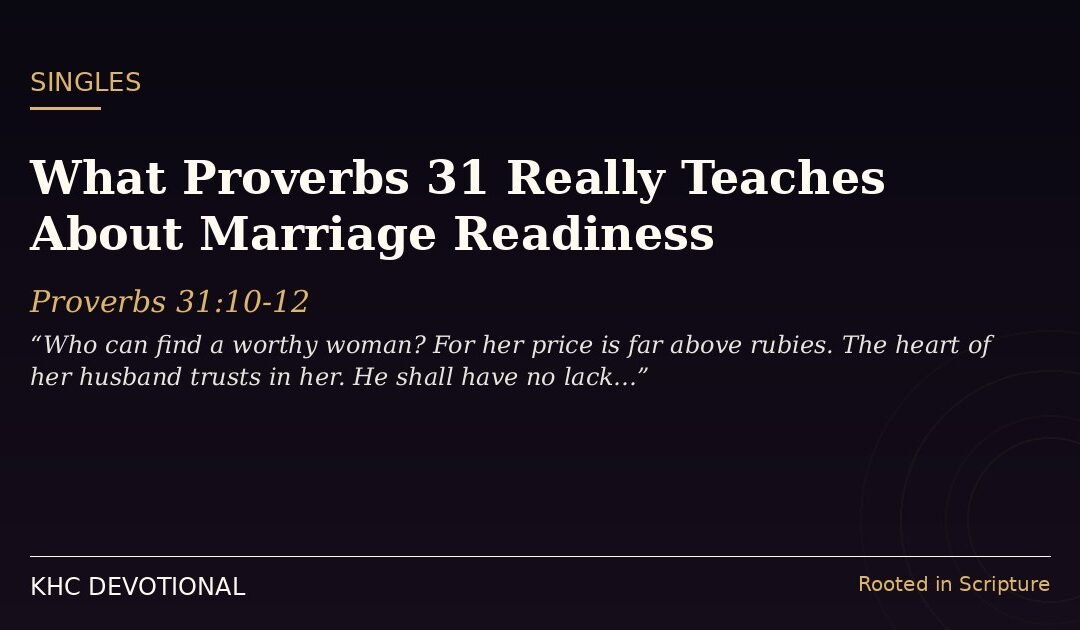
“Who can find a worthy woman? For her price is far above rubies. The heart of her husband trusts in her. He shall have no lack of gain. She does him good, and not harm, all the days of her life.” (Proverbs 31:10-12, WEB)
A Portrait, Not a Performance Review
Think of a family photo album spanning thirty years rather than a single snapshot. No page shows a person running a business, managing a household, extending charity, and speaking wisdom all in the same afternoon. The poem compresses an entire life of faithful, varied seasons into one flowing description. Read that way, Proverbs 31 stops being an impossible checklist and becomes something far more freeing: a portrait of character traits developed over years, not credentials required before the wedding.
Look at what the poem actually praises. It’s not primarily her productivity — though she is capable and industrious — it’s her trustworthiness (“the heart of her husband trusts in her”), her wisdom (“she opens her mouth with wisdom,” v. 26), her strength and dignity, and above all, her reverence for God. The poem’s own climax makes this explicit: charm is deceitful and beauty is vain, but a woman who fears the Lord will be praised (v. 30). Everything else in the passage — the business dealings, the sewing, the generosity to the poor — flows out of that root, not the other way around. She isn’t worthy of praise because she’s productive. She’s productive because of the kind of person, rooted in the fear of the Lord, that she has become.
This matters enormously for marriage readiness. If you read this poem as a resume of accomplishments, you’ll either burn yourself out chasing an unreachable standard or quietly despair that you’ll never measure up. But if you read it as a description of trustworthy, wise, God-fearing character developing over time, it becomes something you can actually pursue starting today, in whatever season you’re in — not by acquiring a household staff, but by becoming someone whose word can be trusted, who handles resources wisely, who speaks with kindness and wisdom, and whose life is oriented around God rather than appearances.
This applies just as much to men preparing for marriage, even though the poem’s language addresses a wife. The underlying values — trustworthiness, diligence, wisdom, generosity, the fear of the Lord over surface charm — are marriage-readiness qualities for anyone, not a gendered performance standard.
It’s also worth acknowledging honestly how this passage has sometimes been misused. In some circles, Proverbs 31 became less a portrait of character and more a checklist wielded to pressure women toward a narrow, culturally specific vision of domestic productivity — as if the poem’s ancient economic details (spinning wool, managing servants, trading in the marketplace) were themselves the point, rather than the faithfulness and wisdom those details illustrated in her particular time and place. Reading the poem that way turns Scripture into a cudgel it was never meant to be. The Proverbs 31 woman isn’t a fixed job description to replicate line by line; she’s an illustration, drawn from her own era, of what it looks like when trustworthy, God-fearing character gets lived out practically. Your version of that faithfulness might look like managing a career, a ministry, a household, or some combination none of those verses could have anticipated — and that’s entirely consistent with the poem’s actual point.
It’s also worth noticing who is actually speaking in this passage. These aren’t a young suitor’s romantic ideals about a wife he hopes to find. They’re a mother’s hard-won counsel to her son, King Lemuel, about the kind of character that actually sustains a household and a kingdom over decades (v. 1). That context matters. This is generational wisdom, not a courtship fantasy — the kind of thing you say to someone you love when you want them to build a life on something that will actually last, rather than something that merely looks impressive on a wedding day. Reading it that way turns Proverbs 31 from a source of anxiety into what it was always meant to be: a mother’s blessing, passed down, about the kind of person worth building a life with, and the kind of person worth becoming.
What This Looks Like This Week
Take that same twenty-six-year-old, still building her budgeting habits, still learning to manage a small apartment well. Instead of measuring herself against the vineyard-buying, staff-managing woman of verse 16, she could pick one trait from the poem’s actual core — trustworthiness, say — and ask where she can practice it this week. That might mean following through on a small commitment she’s been letting slide, or being honest with a friend about something she’d normally soften or hide. It’s not about becoming Proverbs 31 by Friday. It’s about letting one thread of that character take root now.
You are not being measured against a superhuman morning. You’re being invited into a lifetime of small, faithful choices that, strung together over years, become the kind of trustworthy, God-fearing character this poem was always describing. Start with today’s thread. The whole portrait comes later.
Reflect
- Which specific verse or line in Proverbs 31 makes you feel most inadequate, and what would it look like to read that line as a lifetime trait rather than a weekly task?
- Of the core traits the poem actually praises — trustworthiness, wisdom, diligence, generosity, the fear of the Lord — which one is currently the weakest thread in your character?
- Are you pursuing marriage readiness by trying to look impressive, or by quietly becoming trustworthy? How would someone close to you answer that question about you?
A Prayer for Today
Lord, thank you that Proverbs 31 was never meant to crush me with an impossible standard. Root my life in the fear of you above charm, beauty, or performance. Grow trustworthiness, wisdom, and generosity in me slowly, over years, not overnight. Where I've compared myself to an unreachable checklist and despaired, replace that despair with hope that you are patiently building character in me right now, in this ordinary season. Help me pursue becoming a person of substance, not a person of appearances. I want my life, over time, to reflect you. Amen.
Your Action Step
Choose one trait from Proverbs 31 — trustworthiness, wisdom, generosity — and practice it in one concrete way this week.
MUSIC BY REV. DUNAMIS
Let the message become music
Keep your heart encouraged. Choose an album and enjoy all 10 songs right here.
Sounds of Mercy
Songs of mercy, faith and breakthrough.
Before You Say “I Do” — SINGLES
Wisdom for singles, dating couples and marriage preparation.
Ololufe Mi (My Beloved) — COUPLES
Celebrate love, friendship, prayer and partnership.
More songs for your journey with God.
Author

Want this in your inbox every week?
Get our best teachings on singleness, courtship, and marriage delivered free every Sunday morning.
Subscribe free →