
She is thirty-two, has been walking with Christ for over a decade, and still catches herself resenting the word “purity” every time it comes up at church. It sounds, in her head, like a rule designed by someone who has never been lonely on a Friday night, never lain awake wanting to be touched, never had to explain to yet another well-meaning friend why she is still single and still, somehow, still trying to honor this particular boundary. She believes it is right. She is not sure anymore that she believes it is good, that it is actually for her, rather than just a hoop God is making her jump through before he decides she has earned something better.
Paul wrote to the church in Corinth, a city famous throughout the ancient world for its sexual permissiveness, where temple prostitution was woven into public religious life and casual sexual encounters were culturally unremarkable. Into a congregation still untangling itself from that world, Paul makes an argument that has nothing to do with shame and everything to do with identity:
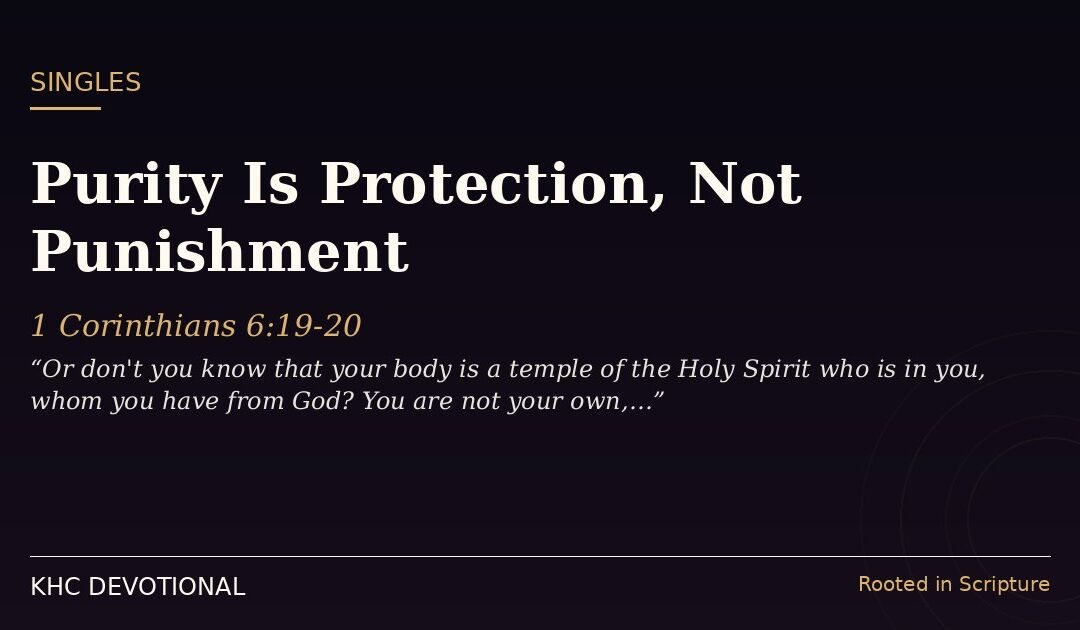
“Or don’t you know that your body is a temple of the Holy Spirit who is in you, whom you have from God? You are not your own, for you were bought with a price. Therefore glorify God in your body.” (1 Corinthians 6:19-20, WEB)
Just before this, Paul writes plainly, “Flee sexual immorality,” and explains that this particular sin is unlike others in how directly it involves the body itself. But notice the reasoning Paul reaches for. He does not say, “Don’t do this because it’s forbidden.” He says, essentially, “Don’t do this because of who you actually are.” Your body is not a neutral object to be used however desire or culture dictates. It is a temple, a place where God himself has chosen to dwell by his Spirit. And you are not your own, not because God is possessive in some controlling sense, but because he bought you at an immense cost, the life of his own Son, and that purchase changed your fundamental status from self-owned to God-owned, from autonomous to beloved.
This reframes purity entirely. A rule imposed from outside, with no explanation, is naturally experienced as restriction, an arbitrary line drawn by someone who does not have your good in mind. But Paul is not describing an arbitrary line. He is describing an architectural fact about your body: it houses the Spirit of the living God. Guarding what happens with a temple is not prudishness. It is basic reverence for what the temple actually is. Purity, in this light, is not God withholding pleasure from you out of suspicion of your desires. It is God protecting something sacred, namely you, from being treated as disposable, from being used and discarded in ways that leave deep, often invisible wounds behind.
Consider what casual sexual activity outside of covenant so often produces in real human experience, regardless of what a culture tells you it should feel like: comparison that follows you into future relationships, attachment to someone who has made no lasting commitment to you, shame that resists easy explanation, and a gradual erosion of the connection between physical intimacy and genuine, safe, permanent love. None of that is God being petty. That is what happens when something designed for the safety of covenant gets detached from it. God’s command to flee is not punitive; it is the same kind of warning a parent gives a child near a busy street, not because the parent is opposed to the child’s freedom, but because the parent can see danger the child cannot yet fully weigh.
There is also something significant in Paul telling the Corinthians they are “bought with a price” in a city where human bodies, particularly women’s and slaves’, were routinely bought, sold, and used without consent. Paul is not diminishing the value of the body; he is elevating it. To be bought by God is to be rescued from being anyone else’s to use, whether a partner’s, a culture’s, or your own impulsive desire’s in a given moment. That price, the life of Jesus, sets a floor under your worth that nothing about your sexual history, your loneliness, or your past choices can lower. Purity flows out of that settled worth; it does not have to be achieved in order to earn it.
Purity, then, is less a wall keeping you from something good and more a wall keeping something destructive from getting to you. It protects your future ability to trust and be trusted, your capacity for undivided intimacy within marriage, and your own sense of being valued for who you are rather than what you can be used for. That protection is not punishment. It is love with foresight.
What This Looks Like This Week
Think of Danielle, twenty-nine, dating someone seriously for the first time in years and feeling the familiar pressure, both from him and from her own loneliness, to let physical intimacy move faster than her convictions. This week, instead of treating purity as a test she is failing at, she reframes the conversation with him directly: “I’m not holding this boundary because I think God is trying to keep something good from me. I’m holding it because I believe he’s protecting something in both of us that we’ll need later, whether that’s with each other or with someone else.” It is an honest, vulnerable conversation, not a lecture, and it changes the tone of their relationship, from negotiation to shared conviction.
You can have a similar conversation this week, whether with a partner, a mentor, or simply with yourself in prayer. Name specifically what purity is protecting in your life right now, not just what it is restricting, and let that truth strengthen your resolve rather than your resentment.
You are not being punished by the standard God has set for your body. You are being protected, as something he considers valuable enough to have purchased and precious enough to indwell. Let that truth change how purity feels the next time it costs you something.
Reflect
- Where have you unconsciously believed purity is God withholding something good from you, rather than protecting something valuable in you?
- What specific pain, in yourself or someone you know, have you seen come from treating sexual intimacy as disconnected from covenant commitment?
- How would viewing your body as a temple of the Holy Spirit change a specific decision you are currently facing?
A Prayer for Today
God, I confess that purity has often felt like punishment to me, like a rule keeping me from something I'm owed. Help me see what Paul saw, that my body is a temple where your Spirit dwells, and that you are protecting something precious, not withholding something good. Thank you that you bought me at a cost I cannot fully comprehend. Give me the strength to flee what would harm me, not out of fear, but out of genuine understanding of what you are guarding. Heal the resentment I carry toward this boundary, and replace it with gratitude for a God who sees dangers I cannot yet see. In Jesus' name, amen.
Your Action Step
This week, write down one specific way purity is protecting your future, not just restricting your present, and share it honestly with a trusted friend, mentor, or the person you are dating.
MUSIC BY REV. DUNAMIS
Let the message become music
Keep your heart encouraged. Choose an album and enjoy all 10 songs right here.
Sounds of Mercy
Songs of mercy, faith and breakthrough.
Before You Say “I Do” — SINGLES
Wisdom for singles, dating couples and marriage preparation.
Ololufe Mi (My Beloved) — COUPLES
Celebrate love, friendship, prayer and partnership.
More songs for your journey with God.
Author

Want this in your inbox every week?
Get our best teachings on singleness, courtship, and marriage delivered free every Sunday morning.
Subscribe free →