
Six weeks in, and they were already looking at rings online. Everything about the relationship moved at the speed of a wildfire: constant texting from the first date, “I love you” by week three, a shared calendar by week five, and a running joke about honeymoon destinations before either of them had met the other’s parents in person. Friends who tried to gently ask questions got waved off with the same line: “When you know, you know.” Six months later, the relationship ended in a single devastating conversation, and she sat in her apartment wondering how something that had felt so certain could have been built on so little actual information.
Solomon, writing wisdom literature meant to train discernment in everyday decisions, addresses this exact pattern directly, though he is not talking specifically about dating. He is talking about a mindset that ruins good decisions of every kind:
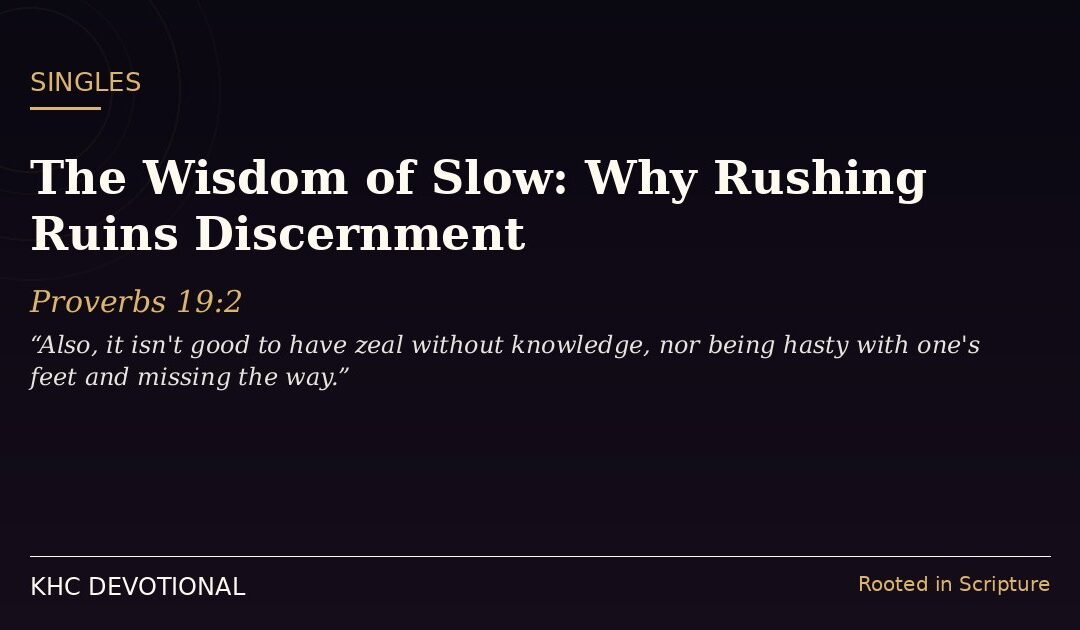
“Also, it isn’t good to have zeal without knowledge, nor being hasty with one’s feet and missing the way.” (Proverbs 19:2, WEB)
Zeal is not the problem Solomon names. Enthusiasm, passion, excitement about a new relationship, none of that is inherently wrong; Scripture is full of wholehearted devotion offered as a virtue. The problem is zeal without knowledge, enthusiasm that has outrun the actual information available to support it. Solomon pairs this with an image of hasty feet missing the way, someone moving so fast toward a destination that they run straight past the road that would have actually gotten them there. Speed feels like progress. It is not the same thing as direction.
Apply this to dating and the picture becomes uncomfortably familiar. Zeal without knowledge looks like being swept up in how someone makes you feel before you have any real evidence of who they actually are under pressure, in conflict, over time, in ordinary unglamorous moments. It looks like mistaking intensity for depth, assuming that because a relationship feels enormous, it must therefore be right. Knowledge, in the biblical sense, is not just information; it is understanding gained through time, testing, and honest observation, exactly the things a whirlwind romance skips past in its hurry to arrive at certainty.
There is a reason rushed relationships so often unravel, and it is not bad luck. When two people accelerate past the normal pace of getting to know each other, they are not actually getting to know each other faster; they are substituting emotional intensity for real information. Big declarations, constant contact, and rapid escalation feel like closeness, but they can just as easily be adrenaline mistaken for intimacy. Real character, real compatibility, and real red flags reveal themselves over repeated seasons and ordinary days, not over a few weeks of infatuation. A person’s patience under stress, honesty when it costs them something, and consistency between their words and actions cannot be verified on an accelerated timeline, no matter how strongly you feel.
This is not an argument for coldness or for treating every new relationship with suspicion. Solomon is not condemning enthusiasm; he is condemning the specific combination of enthusiasm and ignorance, moving with your whole heart before your mind has had time to actually learn anything true. The wisdom of slow is not about dragging things out needlessly or refusing to ever feel deeply. It is about letting knowledge catch up to zeal before you build major decisions on top of feelings alone. A relationship that is actually strong will not be weakened by time; it will be revealed and strengthened by it. Only a relationship built on too little information is threatened by the passage of time, because time is precisely what would expose the gaps.
Consider also what Solomon means by “missing the way.” A traveler in a hurry does not merely arrive late; he can run straight past the correct road entirely, ending up somewhere he never intended to go, sometimes without even realizing the wrong turn happened until much further down the path. That is the real danger of rushed relationships. It is not simply that they might end sooner than a slower one would have. It is that hurried couples often miss information along the way that would have clearly told them this was not the right road at all, information that a slower pace would have surfaced in time to change course. Speed does not just risk heartbreak later; it actively obscures the very discernment that could have prevented it.
What This Looks Like This Week
Consider Tyrell, twenty-eight, four weeks into a relationship that already feels like the most intense connection he has ever had. His friends have started gently pointing out that he has canceled plans with them three times this month to see her, and that he still knows almost nothing about how she handles conflict, what her friendships look like, or what her last relationship taught her about herself. This week, instead of adding another grand gesture to a relationship still built mostly on feeling, he decides to intentionally slow the pace: one dinner with mutual friends present, one honest conversation about how each of them handles disagreement, and one weekend apart, on purpose, just to notice whether the relationship can hold steady without constant contact fueling it. The zeal is still there. He simply refuses to let it run ahead of the knowledge it needs to actually be trustworthy.
You can practice the same discipline this week. If you are in the early, intense stage of a new relationship, deliberately introduce one slower element: a shared meal with people who know you both, a conversation about a real disagreement rather than only easy topics, or simply more time between dates than your excitement wants to allow. Let time do the work only time can do.
God is not asking you to feel less. He is asking you to let knowledge grow alongside your zeal, so that what you are building rests on something sturdier than how fast it happened. Slow is not the opposite of love; often, it is love’s most patient form.
Reflect
- Where in your current or past relationships has intensity been mistaken for depth, and what did the relationship look like once the intensity settled?
- What specific piece of real information about this person's character are you still missing because the relationship has moved faster than the getting-to-know-you process?
- Who in your life has tried to gently slow you down in a relationship, and how did you respond to them?
A Prayer for Today
Lord, I confess how easily I mistake intensity for certainty, how quickly a feeling can convince me I already know everything I need to know. Teach me the difference between zeal and knowledge that Proverbs 19:2 describes. Slow my hasty feet before they miss the way. Give me the patience to let real understanding grow alongside my excitement, and the humility to listen when people who love me suggest I might be moving too fast. I don't want to build something important on adrenaline alone. Help me trust that love which is real can withstand time, and help me have the courage to give it that time. In Jesus' name, amen.
Your Action Step
This week, introduce one deliberate slow-down into your current relationship, a shared meal with people who know you both, a real conversation about conflict, or a weekend with less contact than usual, and notice what it reveals.
MUSIC BY REV. DUNAMIS
Let the message become music
Keep your heart encouraged. Choose an album and enjoy all 10 songs right here.
Sounds of Mercy
Songs of mercy, faith and breakthrough.
Before You Say “I Do” — SINGLES
Wisdom for singles, dating couples and marriage preparation.
Ololufe Mi (My Beloved) — COUPLES
Celebrate love, friendship, prayer and partnership.
More songs for your journey with God.
Author

Want this in your inbox every week?
Get our best teachings on singleness, courtship, and marriage delivered free every Sunday morning.
Subscribe free →