by Rev Dunamis Okunowo | Aug 26, 2026 | Singles
Reading Time: 5 minutesShe watched the wedding pictures scroll by on her phone — two people who’d seemed impossibly solid three years ago, now filing paperwork to end it. Nothing dramatic had happened, from what she’d heard. No affair, no single explosive event. Just years of two people quietly drifting, handling every hard season privately instead of together, never really building anything underneath the beautiful ceremony everyone remembered. She closed the app and found herself asking a question she hadn’t expected to ask at twenty-nine, still single: what actually makes a marriage able to survive?
Jesus answers that question directly, though he’s not talking about weddings at all. He’s closing out his most famous sermon with a parable about two builders and one unavoidable storm.
Scripture in Context
Matthew 7 ends the Sermon on the Mount, Jesus’s extended teaching on kingdom life — prayer, generosity, judgment, and true righteousness. He closes not with a summary but with a warning wrapped in a story: hearing his words is not the same as building on them.
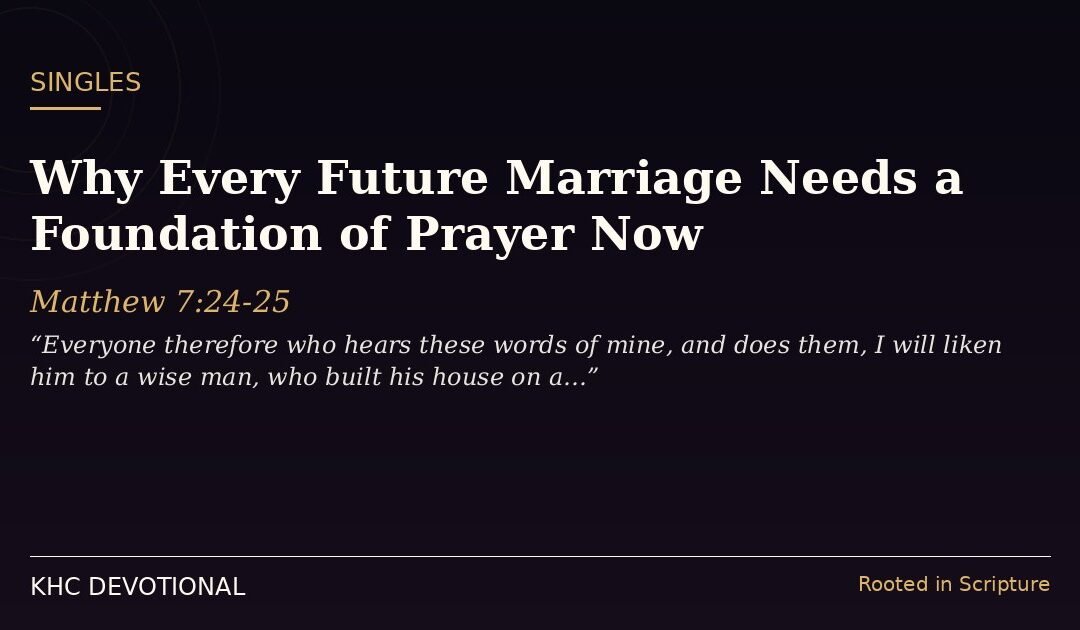
“Everyone therefore who hears these words of mine, and does them, I will liken him to a wise man, who built his house on a rock. The rain came down, the floods came, and the winds blew, and beat on that house; and it didn’t fall, for it was founded on the rock.” (Matthew 7:24-25, WEB)
What’s Actually Holding Up a Marriage
Consider two trees standing side by side in a field, identical in height, identical in the fullness of their branches. From the outside, in calm weather, there’s no way to tell them apart. But one has spent years sending roots deep into the soil, unseen, unphotographed, unremarkable to anyone walking by. The other has stayed shallow, growing quickly but never digging down. The difference is invisible until the storm comes. Then only one is still standing.
Jesus’s parable makes the same point about two houses that likely looked identical when they were first built — same walls, same roof, same impressive facade. The difference wasn’t in what people could see on the day of construction. It was in the foundation, laid before the first wall ever went up, tested only later when rain, flood, and wind arrived — as they always eventually do.
Applied to marriage, this parable directly challenges the idea that a strong marriage is mostly about compatibility, chemistry, or a well-executed wedding day. Those are the visible walls. What Jesus says actually determines whether the house stands is what was built before the storm, unseen — specifically, “hearing these words of mine and doing them.” For a couple, and for each individual preparing for marriage, that means a life already shaped by obedience to Christ, already practiced in prayer, already rooted in Scripture — not a discipline you’ll pick up once the marriage needs rescuing.
This is why prayer specifically matters as marriage preparation, not just marriage maintenance. Prayer is one of the primary ways a foundation gets built before it’s tested — it’s how a person practices dependence on God rather than self-sufficiency, honesty rather than performance, humility rather than control, long before a spouse ever requires any of those things from them. A couple who begins praying together during dating or engagement isn’t just adding a nice ritual. They’re laying rock underneath a house that hasn’t been built yet, so that when the inevitable storm arrives — and it always does, for every marriage — there’s already something solid underneath it.
Waiting until a marriage is in crisis to start praying together is like trying to pour a foundation during the flood. It can be done, by God’s grace, but it’s infinitely harder than laying it in the calm, unhurried years beforehand.
It’s worth naming why prayer specifically, rather than just general spiritual interest, functions as this kind of foundation. Prayer is where a person practices honesty they can’t fake anywhere else — admitting weakness, confessing failure, asking for help they can’t manufacture on their own. A couple who prays together is, whether they realize it or not, practicing vulnerability with each other in the presence of God, which is a very different skill than simply getting along well or sharing common interests. It’s also where a couple practices remembering that their marriage ultimately isn’t sustained by their own effort, chemistry, or compatibility, but by a God who is bigger than both of them and their circumstances. That posture of dependence is precisely what Jesus’s parable is describing — hearing his words and doing them, not managing life by sheer competence.
This doesn’t require eloquence. Some of the most foundational prayers a couple ever prays are short, halting, even a little awkward — a whispered thank you before a meal, a request for patience before a hard conversation, a simple “help us” in a season of stress. The habit matters more than the polish.
It’s also worth saying that not every prayer laid in this season will feel powerful in the moment. Some of it will feel repetitive, some of it awkward, some of it like talking into silence. That’s normal, and it doesn’t mean the foundation isn’t being laid. Roots grow underground, unseen, long before there’s any visible fruit above the surface. The value of prayer as a foundation isn’t measured by how dramatic it feels on a given evening — it’s measured, years later, by whether it was there at all when the storm finally came.
What This Looks Like This Week
Take a couple, dating seriously but not yet engaged, who have never actually prayed out loud together — it’s felt too vulnerable, too soon. This week, foundation-laying might be as simple as one of them suggesting they pray together before parting ways after a date, even briefly and awkwardly at first. For someone still single with no relationship in view, it might mean establishing a personal, unhurried prayer rhythm now — not as a project to complete before a wedding, but as the rock-laying work of an entire life, married or not.
You cannot control the storms a future marriage will face. But you can, starting today, lay rock instead of sand, through a life and a relationship already practiced in prayer. When the wind comes, and it will, that unseen foundation will be exactly what holds.
Reflect
- Do you currently have a personal prayer rhythm that exists independent of a relationship, or has prayer mostly been something you imagine doing 'once you're married'?
- If you're dating or engaged, have you and your partner prayed out loud together yet? What's kept you from starting, or what has it looked like so far?
- What 'storm' have you already watched hit someone else's marriage, and what does it reveal about what you want to build underneath your own relationship now?
A Prayer for Today
Lord, I don't want to wait until a crisis forces me to start praying seriously about my relationships. Teach me to build a foundation of prayer now, in the calm, ordinary days, before any storm arrives. Whether I'm single or in a relationship, help me hear your words and actually do them, not just admire them from a distance. If I'm dating or engaged, give us the courage to pray together even when it feels awkward at first. Root my future marriage, and my life right now, on rock instead of sand. I want to still be standing when the winds come. Amen.
Your Action Step
This week, either start a personal daily prayer habit or, if you're in a relationship, initiate praying out loud together for the first time.
by Rev Dunamis Okunowo | Aug 25, 2026 | Singles
Reading Time: 5 minutesShe was still irritated with her roommate three weeks after the actual incident — a canceled plan, a passive-aggressive comment about dishes — long after her roommate had clearly moved on and forgotten. It wasn’t a big deal. That was the strange part. She kept turning it over anyway, rehearsing what she should have said, holding onto it the way you hold onto a splinter you can’t quite dig out. If a canceled coffee date could occupy that much space in her mind for weeks, she found herself wondering, what happens when the stakes are actually high — when it’s a husband, not a roommate, and the hurt is real?
That question is worth sitting with before marriage, not during a crisis inside it. Paul’s instruction to the Ephesian church gives both the command and the reason forgiveness is possible at all.
Scripture in Context
Paul wrote to the church in Ephesus to describe what a life transformed by the gospel actually looks like in community — how people who were once “dead in trespasses” now relate to one another as members of one body. Chapter 4 moves from theology into ethics, specifically addressing how believers handle anger, speech, and offense with each other.
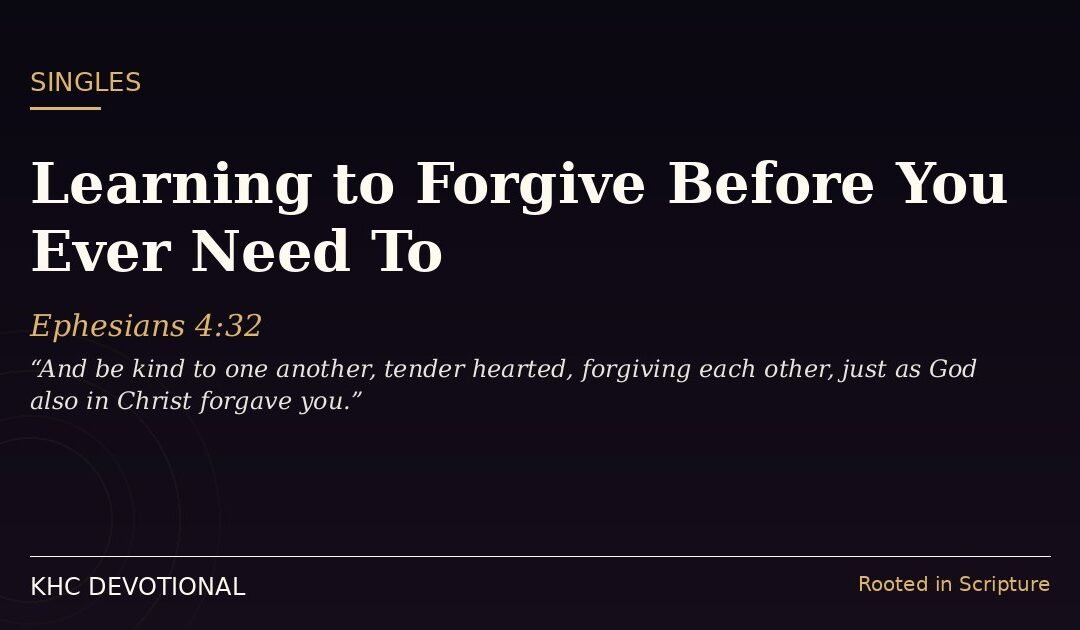
“And be kind to one another, tender hearted, forgiving each other, just as God also in Christ forgave you.” (Ephesians 4:32, WEB)
Forgiveness Is a Skill Before It’s a Crisis Response
No concert pianist walks onto a stage and plays a difficult piece for the first time in front of an audience. Long before that night, there were years of scales, practiced slowly and imperfectly in an empty room where no one was watching or applauding. The skill required for the big performance was built entirely in a thousand small, unglamorous repetitions beforehand. Forgiveness works the same way. Nobody forgives a serious betrayal well on the first attempt if they’ve never practiced releasing anything smaller first.
Paul’s command here is aimed at ordinary community life — the small frictions of people doing life together — not primarily catastrophic betrayal. “Be kind to one another, tender hearted, forgiving each other” describes an everyday posture, not a once-in-a-lifetime crisis response. That’s significant, because it means forgiveness is meant to be practiced in exactly the low-stakes moments singles often dismiss as too small to matter: the friend who forgot to text back, the roommate’s passive-aggressive comment, the sibling who took credit for your idea. Every one of those is a scale, played quietly, building the capacity for the concerto later.
Notice, too, the reason Paul gives: “just as God also in Christ forgave you.” This is not forgiveness as a personality trait some people happen to have and others don’t. It’s forgiveness as an act of imitation, grounded in a forgiveness you’ve already received, that was infinitely costlier than whatever you’re currently holding onto. If you struggle to release a canceled coffee date, that’s not a character flaw to be ashamed of — it’s information. It tells you where your forgiveness muscle is currently weak, and it gives you time, now, before marriage, to strengthen it in low-stakes settings before your future spouse’s very real, very human failures ask more of you than a roommate’s dish comment ever will.
This is also protective for your future marriage. Every marriage, even a healthy one, will include real hurt — thoughtless words, broken promises, seasons of selfishness on both sides. A person who has never practiced forgiving anything small will not suddenly develop the capacity to forgive something large the week it’s required. But a person who has spent years training that skill on the ordinary offenses of singleness enters marriage with it already partially built.
It’s worth distinguishing forgiveness from a few things it isn’t, because confusion here causes real damage. Forgiveness isn’t the same as pretending you weren’t hurt, and it isn’t the same as automatically restoring trust or access to someone who is still actively harmful. Paul’s command to forgive as Christ forgave doesn’t erase the reality of genuine wrongdoing or require you to stay in unsafe situations. What it does require is releasing your own claim to bitterness and revenge — choosing not to keep a private ledger of offenses that you replay and add to over time. That release can happen even when reconciliation takes longer, or in some cases never fully happens on the other side.
This distinction matters for singles because it means practicing forgiveness now doesn’t require you to have zero boundaries or endless patience for people who consistently mistreat you. It means, in the ordinary friction of daily relationships, training yourself to let go quickly of what doesn’t need to be carried, so that when marriage eventually asks something harder of you, you’re not starting the skill from zero.
Consider, too, how differently a small offense feels once you’ve decided in advance that forgiveness is simply how you operate, rather than something you have to negotiate case by case. A person who has practiced this for years develops a kind of reflexive grace — not because the hurt doesn’t register, but because releasing it has become the well-worn path rather than the difficult exception. That reflexive grace is exactly what sustains a marriage through the ordinary, repeated friction of two imperfect people sharing a life for decades. It isn’t glamorous. It’s also one of the most durable gifts you can bring into a future marriage.
What This Looks Like This Week
Take the woman still irritated with her roommate. This week, forgiveness practice doesn’t require a dramatic reconciliation scene. It might mean privately choosing, in prayer, to release the specific offense — naming it honestly to God rather than pretending it doesn’t bother her, and asking him to help her let go of the rehearsed resentment. It might mean one small, ordinary gesture of kindness toward her roommate this week, not because the issue is fully resolved emotionally, but as an act of obedience that trains the skill regardless of how she currently feels.
Every small forgiveness you practice now — with roommates, friends, family, coworkers — is quietly preparing you for the marriage you’re hoping to build. You’re not wasting these ordinary moments. You’re rehearsing, in private, for a love that will need this skill for the rest of your life.
Reflect
- What's the smallest, most recent offense you've held onto longer than it deserved — and what does that reveal about your current capacity to forgive?
- Is there someone in your life right now you're withholding forgiveness from while telling yourself it's 'not that serious' to address?
- How does remembering how much you've been forgiven by God change how you feel about the small offense you're currently nursing?
A Prayer for Today
God, thank you for forgiving me completely through Christ, at a cost I could never repay. I confess the small grudges I've been quietly holding onto, the ones I've told myself don't really matter. Teach me to forgive quickly, in the small everyday moments, so that forgiveness becomes a practiced habit and not a crisis skill I'm forced to learn under pressure. Soften my heart toward the people who've mildly frustrated me this week. Prepare me now, in these ordinary offenses, for the deeper forgiveness marriage will one day require of me. Amen.
Your Action Step
Identify one small grudge you're currently holding and take a concrete step to release it this week — in prayer and in action.
by Rev Dunamis Okunowo | Aug 24, 2026 | Singles
Reading Time: 4 minutesThey’d been engaged for two months when they finally sat down with both bank statements open on the kitchen table. She saw the number on his credit card balance and went quiet. He saw her student loan total and did the same. Neither had lied, exactly — they just hadn’t asked, and hadn’t offered. Now, eight weeks from a wedding they’d already started paying for, they were having the money conversation they probably should have had eight months earlier.
Scenes like that play out in countless engagements every year, not usually because anyone was hiding something maliciously, but because talking about money still feels more vulnerable than talking about almost anything else. Proverbs has clear, practical wisdom for exactly this kind of moment — wisdom that has nothing to do with how much you make and everything to do with how you plan.
Scripture in Context
The book of Proverbs is a collection of wisdom sayings, largely attributed to Solomon, written to train young people — often addressed as “my son” — in practical righteousness for everyday life: work, speech, relationships, and money. Proverbs 21 sits within a section contrasting the wise and the foolish, the diligent and the hasty, showing that character shows up in ordinary decisions long before it shows up in a crisis.
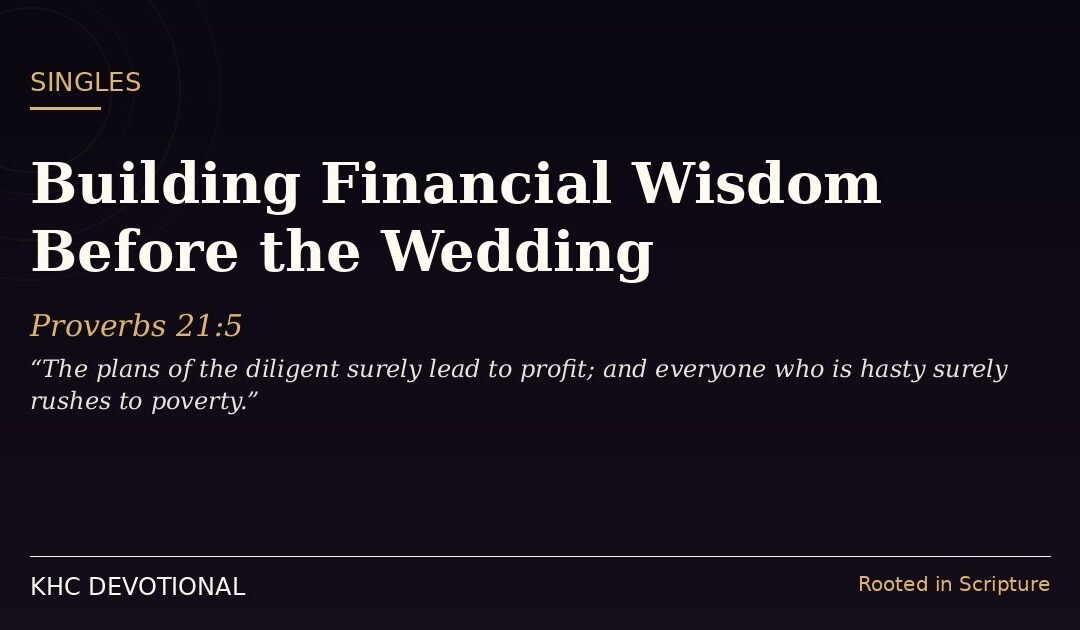
“The plans of the diligent surely lead to profit; and everyone who is hasty surely rushes to poverty.” (Proverbs 21:5, WEB)
Diligence Is a Discipline, Not a Personality Trait
Think about how a runner prepares for a marathon. No one crosses twenty-six miles on willpower alone, discovered the morning of the race. They build a training plan months in advance, log slow, unglamorous miles on ordinary Tuesday evenings, and adjust the plan as they learn their body’s limits. The runners who show up undertrained, hoping adrenaline will carry them, usually don’t finish well. Proverbs 21:5 describes the financial equivalent of that training plan versus that under-prepared sprint.
“The plans of the diligent” isn’t primarily about being naturally gifted with money. It’s about the deliberate, unglamorous work of planning — budgeting, tracking spending, having the hard conversation before it’s urgent. “Hasty,” by contrast, describes decisions made under pressure, without foresight, chasing whatever feels most pressing in the moment. Solomon isn’t condemning people who struggle financially through no fault of their own; Scripture is full of compassion for the poor and the unjustly burdened. He’s contrasting two postures toward money: one that plans ahead with patience, and one that reacts without it.
For an engaged couple, this proverb lands squarely on premarital finances. Diligence looks like disclosing debt honestly before the wedding rather than discovering it afterward. It looks like building a shared budget together while you’re still two separate bank accounts, so you’re practicing the skill before it’s urgent. It looks like agreeing, in advance, how you’ll handle windfalls, emergencies, and disagreements about spending — because those conversations are far easier to have calmly in engagement than in the middle of a real financial crisis three years into marriage.
The “haste” this proverb warns against often shows up in wedding planning itself — overspending on a single day because of social pressure or comparison, without a plan for how that spending fits into a shared financial future. A wedding is one day. A marriage’s financial habits are decades. Proverbs 21:5 is quietly asking every engaged couple which one they’re actually planning for.
Diligence also means having specific conversations before the wedding, not vague good intentions. Couples who do this well tend to actually sit down and talk through questions like:
- Will we combine our finances fully, partially, or keep them separate, and why?
- What does each of us currently owe, and what’s our realistic plan to pay it down together?
- Who will handle the day-to-day budgeting, and how will we make larger financial decisions jointly?
- What did money look like growing up in each of our families, and how has that shaped our instincts around spending and saving?
- What’s our plan for giving, saving, and emergencies, before either of them becomes urgent?
None of these questions are romantic. All of them are acts of diligence Solomon would recognize — the unglamorous planning that quietly protects a marriage from decades of avoidable conflict. Couples who skip this work aren’t usually reckless; they’re simply following the cultural script that says finances can be figured out later, once the wedding itself is handled. Proverbs 21:5 suggests the opposite order is wiser: plan first, celebrate second.
It’s worth adding that diligence doesn’t mean anxiety. Some couples avoid financial planning because money conversations have historically triggered fear or shame in one or both of them — maybe from a childhood marked by scarcity, or a previous relationship where finances became a weapon. Proverbs 21:5 isn’t calling anyone to obsess over every dollar out of fear. It’s calling couples toward calm, steady, unhurried planning, the kind that actually reduces anxiety over time because nothing important is being left to chance or discovered too late. Diligence, done well, is one of the most peace-producing, anxiety-reducing habits any engaged couple can build together, long before the wedding day ever arrives.
What This Looks Like This Week
Take that couple from the kitchen table. Diligence, this week, doesn’t mean solving every financial issue in one conversation. It means scheduling a second conversation, calmer than the first, where they each bring their full financial picture — debts, savings, spending habits, financial fears inherited from their families — and start building a shared plan rather than reacting to what they discovered. It might mean meeting with a financial advisor or pastor experienced in premarital counseling to build a realistic post-wedding budget together, before the wedding, not after.
Money conversations before the wedding can feel like they threaten the romance of engagement, but they’re actually one of the most loving things you can do for your future marriage. Diligence now, however unglamorous, is how you build a financial foundation strong enough to hold whatever the next fifty years bring.
Reflect
- Have you fully disclosed your financial picture — debt, spending habits, saving patterns — to your partner or fiancé, or is there something you've been avoiding bringing up?
- Where in your financial life right now are you being 'hasty' rather than diligent — reacting instead of planning?
- What financial habit did you inherit from your family, good or bad, that you and your future spouse need to name and talk through before the wedding?
A Prayer for Today
Lord, give me diligence instead of haste with money, and courage to be fully honest about my finances with the person I plan to marry. Forgive me for the times I've avoided hard financial conversations because they felt too vulnerable. Help us build a plan together rooted in wisdom, not pressure or comparison to others. Guard us from letting money become a source of shame or secrecy between us. Teach us to steward what you've given us faithfully, as a team, starting now, so our marriage is built on something sturdier than a single beautiful wedding day. Amen.
Your Action Step
Schedule one dedicated conversation this week to fully disclose your debts, savings, and spending habits to your partner.
by Rev Dunamis Okunowo | Aug 23, 2026 | Singles
Reading Time: 5 minutesShe closed her Bible app mid-read, somewhere around the verse about buying a field and planting a vineyard with her own earnings. She was twenty-six, renting a studio apartment, barely keeping a budget spreadsheet updated, and here was a woman who apparently ran a household staff, negotiated real estate, and stayed up sewing by candlelight. “I am never going to be marriage material,” she texted a friend, half-joking, mostly not.
That reaction is common, and understandable — and it usually comes from reading Proverbs 31 the wrong way: as a single day’s to-do list rather than what it actually is.
Scripture in Context
Proverbs 31 closes out the book with an acrostic poem — each line beginning with a successive letter of the Hebrew alphabet, a literary device signaling completeness, the full range A to Z of a life well-lived. Scholars generally agree it describes not one impossible morning but a composite portrait, likely a mother’s counsel to her son, King Lemuel, about the kind of character to look for and value in a wife, gathered across an entire lifetime of decisions.
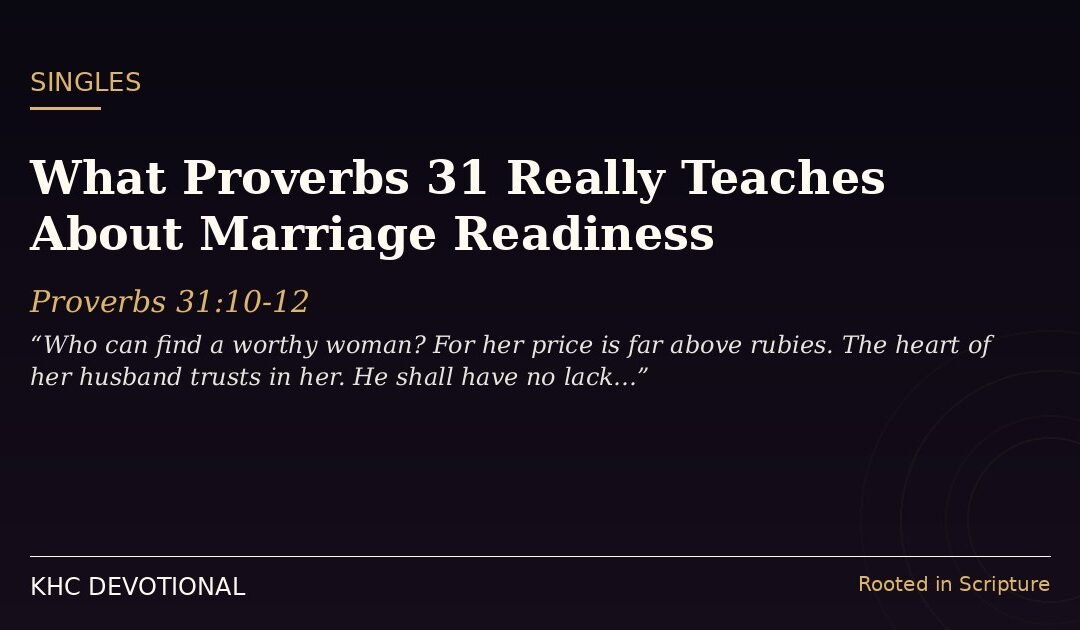
“Who can find a worthy woman? For her price is far above rubies. The heart of her husband trusts in her. He shall have no lack of gain. She does him good, and not harm, all the days of her life.” (Proverbs 31:10-12, WEB)
A Portrait, Not a Performance Review
Think of a family photo album spanning thirty years rather than a single snapshot. No page shows a person running a business, managing a household, extending charity, and speaking wisdom all in the same afternoon. The poem compresses an entire life of faithful, varied seasons into one flowing description. Read that way, Proverbs 31 stops being an impossible checklist and becomes something far more freeing: a portrait of character traits developed over years, not credentials required before the wedding.
Look at what the poem actually praises. It’s not primarily her productivity — though she is capable and industrious — it’s her trustworthiness (“the heart of her husband trusts in her”), her wisdom (“she opens her mouth with wisdom,” v. 26), her strength and dignity, and above all, her reverence for God. The poem’s own climax makes this explicit: charm is deceitful and beauty is vain, but a woman who fears the Lord will be praised (v. 30). Everything else in the passage — the business dealings, the sewing, the generosity to the poor — flows out of that root, not the other way around. She isn’t worthy of praise because she’s productive. She’s productive because of the kind of person, rooted in the fear of the Lord, that she has become.
This matters enormously for marriage readiness. If you read this poem as a resume of accomplishments, you’ll either burn yourself out chasing an unreachable standard or quietly despair that you’ll never measure up. But if you read it as a description of trustworthy, wise, God-fearing character developing over time, it becomes something you can actually pursue starting today, in whatever season you’re in — not by acquiring a household staff, but by becoming someone whose word can be trusted, who handles resources wisely, who speaks with kindness and wisdom, and whose life is oriented around God rather than appearances.
This applies just as much to men preparing for marriage, even though the poem’s language addresses a wife. The underlying values — trustworthiness, diligence, wisdom, generosity, the fear of the Lord over surface charm — are marriage-readiness qualities for anyone, not a gendered performance standard.
It’s also worth acknowledging honestly how this passage has sometimes been misused. In some circles, Proverbs 31 became less a portrait of character and more a checklist wielded to pressure women toward a narrow, culturally specific vision of domestic productivity — as if the poem’s ancient economic details (spinning wool, managing servants, trading in the marketplace) were themselves the point, rather than the faithfulness and wisdom those details illustrated in her particular time and place. Reading the poem that way turns Scripture into a cudgel it was never meant to be. The Proverbs 31 woman isn’t a fixed job description to replicate line by line; she’s an illustration, drawn from her own era, of what it looks like when trustworthy, God-fearing character gets lived out practically. Your version of that faithfulness might look like managing a career, a ministry, a household, or some combination none of those verses could have anticipated — and that’s entirely consistent with the poem’s actual point.
It’s also worth noticing who is actually speaking in this passage. These aren’t a young suitor’s romantic ideals about a wife he hopes to find. They’re a mother’s hard-won counsel to her son, King Lemuel, about the kind of character that actually sustains a household and a kingdom over decades (v. 1). That context matters. This is generational wisdom, not a courtship fantasy — the kind of thing you say to someone you love when you want them to build a life on something that will actually last, rather than something that merely looks impressive on a wedding day. Reading it that way turns Proverbs 31 from a source of anxiety into what it was always meant to be: a mother’s blessing, passed down, about the kind of person worth building a life with, and the kind of person worth becoming.
What This Looks Like This Week
Take that same twenty-six-year-old, still building her budgeting habits, still learning to manage a small apartment well. Instead of measuring herself against the vineyard-buying, staff-managing woman of verse 16, she could pick one trait from the poem’s actual core — trustworthiness, say — and ask where she can practice it this week. That might mean following through on a small commitment she’s been letting slide, or being honest with a friend about something she’d normally soften or hide. It’s not about becoming Proverbs 31 by Friday. It’s about letting one thread of that character take root now.
You are not being measured against a superhuman morning. You’re being invited into a lifetime of small, faithful choices that, strung together over years, become the kind of trustworthy, God-fearing character this poem was always describing. Start with today’s thread. The whole portrait comes later.
Reflect
- Which specific verse or line in Proverbs 31 makes you feel most inadequate, and what would it look like to read that line as a lifetime trait rather than a weekly task?
- Of the core traits the poem actually praises — trustworthiness, wisdom, diligence, generosity, the fear of the Lord — which one is currently the weakest thread in your character?
- Are you pursuing marriage readiness by trying to look impressive, or by quietly becoming trustworthy? How would someone close to you answer that question about you?
A Prayer for Today
Lord, thank you that Proverbs 31 was never meant to crush me with an impossible standard. Root my life in the fear of you above charm, beauty, or performance. Grow trustworthiness, wisdom, and generosity in me slowly, over years, not overnight. Where I've compared myself to an unreachable checklist and despaired, replace that despair with hope that you are patiently building character in me right now, in this ordinary season. Help me pursue becoming a person of substance, not a person of appearances. I want my life, over time, to reflect you. Amen.
Your Action Step
Choose one trait from Proverbs 31 — trustworthiness, wisdom, generosity — and practice it in one concrete way this week.
by Rev Dunamis Okunowo | Aug 22, 2026 | Singles
Reading Time: 5 minutesHe was only twenty minutes late replying to a text. She knew that, logically. But by the time he called, she’d already spiraled through anger, then tears, then a wall of silence he couldn’t figure out how to get past. It wasn’t really about the twenty minutes. It was about a father who used to disappear for days without a word, and a nervous system that had learned, long before this relationship began, that silence meant abandonment. They were engaged, six months from the wedding, and she was starting to realize she couldn’t out-love a wound she’d never actually let anyone treat.
Almost everyone carries something like this into engagement — an old ache that current love keeps accidentally brushing up against. The psalmist speaks directly to people in exactly that condition, offering not a technique but a description of who God actually is toward the brokenhearted.
Scripture in Context
Psalm 147 is a communal hymn of praise, likely written after Israel’s return from exile, celebrating God as the one who rebuilds what was scattered — both the city of Jerusalem and the hearts of its people. The psalmist moves seamlessly from God’s power over the stars to God’s tenderness toward the wounded, refusing to separate his cosmic strength from his personal compassion.
“He heals the broken in heart, and binds up their wounds.” (Psalm 147:3, WEB)
Why This Matters Before the Wedding, Not After
Notice the imagery: binding up wounds. In the ancient world, this was the work of a physician, cleaning and dressing an injury so it could actually close rather than fester under a surface that looked fine. That’s an important picture for anyone preparing for marriage, because so many of us are tempted to treat old wounds the way you’d treat a cut you’re embarrassed about — cover it, don’t mention it, hope no one notices it’s still there.
The trouble is, marriage doesn’t let wounds stay hidden. It’s the most intimate, sustained, daily relationship most people will ever have, which means it will eventually press on every unhealed place you carry — old family dysfunction, a previous relationship’s betrayal, a season of rejection that taught you love isn’t safe. Your future spouse isn’t the source of that wound, but they will, without meaning to, become the person standing closest to it. If it’s never been tended, they’ll get blamed for pain that started years before they arrived.
This is where the psalm becomes genuinely good news rather than one more task on the wedding checklist. Healing isn’t something you’re required to manufacture on your own before you’re allowed to marry. The psalmist doesn’t say “heal yourself, then come to God.” He says God is the one who heals — the binding up of the wound is his work, not a self-improvement project you complete solo. That takes the pressure off pretending you’re fully whole before the wedding and puts the responsibility where it belongs: bringing the wound to the God who specializes in exactly this kind of repair, often through prayer, through godly counsel, and yes, often through the patient, professional help of a good Christian counselor.
It also reframes what engagement season is for. It’s not only cake tastings and guest lists. It’s one of the last unhurried windows either of you will have to do this work before daily married life adds its own pressures on top of whatever you haven’t yet addressed.
It’s worth being specific about how these wounds actually surface, because they rarely announce themselves clearly. They show up as disproportionate reactions to small things — an unanswered text that triggers panic, a raised voice that triggers total shutdown, a moment of criticism that triggers days of self-loathing. They show up as patterns you keep repeating without meaning to: always needing to win an argument, always assuming the worst about your partner’s intentions, always pulling away right when things get serious. None of these reactions are moral failures to be white-knuckled through. They’re signals, usually pointing back toward something that happened long before this relationship began, asking to finally be acknowledged rather than managed.
This is also where community matters. Healing rarely happens in isolation, and it rarely happens quickly. A good premarital counselor, a wise pastor, or a mature mentor who has walked this road themselves can help you see patterns you’re too close to notice on your own, and can offer tools — not just prayer, though prayer matters enormously, but practical frameworks for communication and self-awareness — that make the healing tangible rather than abstract.
There’s a common fear underneath all of this that deserves to be named directly: the worry that acknowledging a wound means something is fundamentally wrong with you, or with the relationship. It doesn’t. Every person carries some history that shapes how they love and how they fear being loved. The couples who struggle most in marriage aren’t usually the ones who came in with wounds — nearly everyone does — but the ones who never learned to name them, so the wounds kept quietly running the relationship from the background instead of being brought into the light where God’s healing could actually reach them.
What This Looks Like This Week
Consider a couple, engaged, where one partner recognizes a pattern: every time there’s conflict, he shuts down completely for days, a habit traced back to a household where arguments meant someone would eventually leave. This week, healing before “I do” might look like naming that pattern out loud to his fiancée — not as an excuse, but as information — and scheduling one session with a premarital counselor specifically to talk through it, rather than hoping it quietly resolves itself once the rings are on. It might mean journaling honestly about where the pattern started, and bringing that history to God in prayer rather than only managing its symptoms in the relationship.
You don’t have to walk down the aisle already fully healed — no one does. But you can walk toward the wedding actively bringing your wounds to the God who binds them up, instead of hiding them in the closet of your new life together. He’s not in a hurry, and he’s not surprised by what you’re still carrying. He’s already reaching for it.
Reflect
- What's a recent overreaction in your relationship that, looking back, was really about an old wound rather than what actually happened in the moment?
- Have you ever hidden or minimized part of your story from your partner or fiancé out of fear it would change how they see you? What kept you from bringing it into the light?
- What would it look like, practically, to bring one specific wound to a counselor, mentor, or pastor before your wedding rather than hoping marriage will quietly heal it?
A Prayer for Today
Father, you are the God who heals the brokenhearted and binds up wounds — I bring mine to you now instead of hiding them. Thank you that I don't have to be fully whole before I'm allowed to love or be loved. Show me the old pain I've been carrying into my relationship without realizing it, and give me the courage to name it honestly, to my partner and to the people you've placed around me for support. Do the deep, patient work of healing in me before the wedding day, not just after it. I trust you with what I haven't been able to fix myself. Amen.
Your Action Step
Name one specific old wound out loud to your fiancé or a trusted counselor this week, rather than managing it silently.
